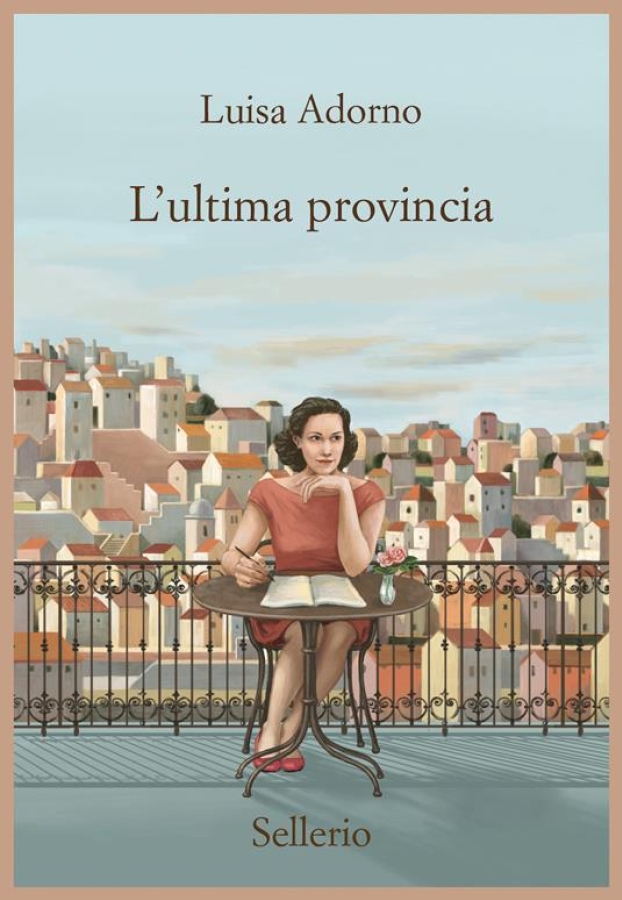
The Last Province
Luisa narrates in the first person her entry into her husband's family. Cosimo is the son of a Sicilian prefect who travels across Italy guided by two tenacious principles: nostalgia for Sicily, > when we were at Bosco Canniti...(...) a small piece of black earth, fine as sand, rugged with lava boulders, with ledges, knolls, sudden precipices: (...) a latifundium in its tenderness ; having a post where there is no "noxious weed," that is, where "poverty and a right-wing majority imprinted a slow breath." When Cosimo declared that he would spend the summer at the prefecture in his father's new post, "at that moment my human interest in him was born," along with a curious and affectionate willingness to let herself be drawn into a provincial family, so distant from her own culture and social background. And herein lies the essence of this novella. Luisa, an urbanite, left-wing and independent, does not adopt an attitude of superiority toward her husband’s family; rather, she describes with gentle irony the traits of a small social unit (the Prefect, the Prefettessa, the maid Concetta, and the dog), stubbornly Sicilian throughout, despite their numerous relocations across Italy. They form a series of portraits marking a sort of *Bildung* for the young woman, initially bewildered and amused, and later permeated by the subdued sweetness of provincial life. A few examples: The Prefettessa is ill, and amidst her feverish delirium fears that the faithful maid will abandon her: «Is it true that you are leaving with the *mondine*?, she asked breathlessly.» «Cu cui? [With whom?],» the other retorted, «and from that moment on it became a habitual curse:» «Cu' sti mondini». And the discovery of pyjamas at the dinner table? «In pyjamas, alongside care for one's clothing, one drowns self-control, and the restraint of one's speech. Mostly they stay silent, content, with the murky air of someone who has just got out of bed. If they speak, it is only in dialect. If they shout, it is 'cacchio'. Cacchio of a woman, of light, of a fly, depending on whatever jolt stirs them > . Official ceremonies are duties that the Prefect carries out with pained yet meticulous solicitude. He had put on a pair of comfortable shoes. (...) It was the feast of Saint Joseph (...) a procession with ranks of boarding-school boys, of little orphans.... grey rows of yoked young girls. (...) In April he had followed the Good Friday procession, in May that of the patron saint.... > . Having become a mother, with her baby in swaddling clothes, holidays at Borgo Canniti are an astonishing discovery for Luisa. Right from the ferry across the strait, soaring and solitary on a flat horizon Mount Etna had appeared, (...) A fine plume, ave!« exclaimed the Prefect. On the small farm »the heat was shelterless. (...) Indifferent to the dazzling reality, the Prefect was content with a straw hat, pyjamas, and a walking stick, to pace the grounds several times each day > . (...) When the sun disappeared behind the mountain and the small houses rose like a curtain to let in the evening air, the voices and noises seemed to die down. (...) From the bricks rose to our legs, enveloping them, an animal warmth that the fresh breath of the sea gradually cooled: the scent of jasmine was so sharp and precise that one could almost hear it To the child > Ce lo date 'u succu d'uva? the Prefettessa's sister asked in the meantime. (...) Within a few hours, before the gathered family, Concetta was slipping the first spoonful of juice into the child's mouth . The novella is slender, devoid of a true plot, vague and light like a sketched painting. Sustaining it is a refined, evocative, and pleasing style of writing, in which the recourse to dialect enriches the narrative, offering moments of fantastic suspension. It is as if an ancestral world, magical and intimate, peeked through an educated and thus distant stylistic approach: dialect breathes life into the characters and the descriptions of the settings. Too much is left unsaid for one to offer a wholly positive assessment. Why read it? Pleasant
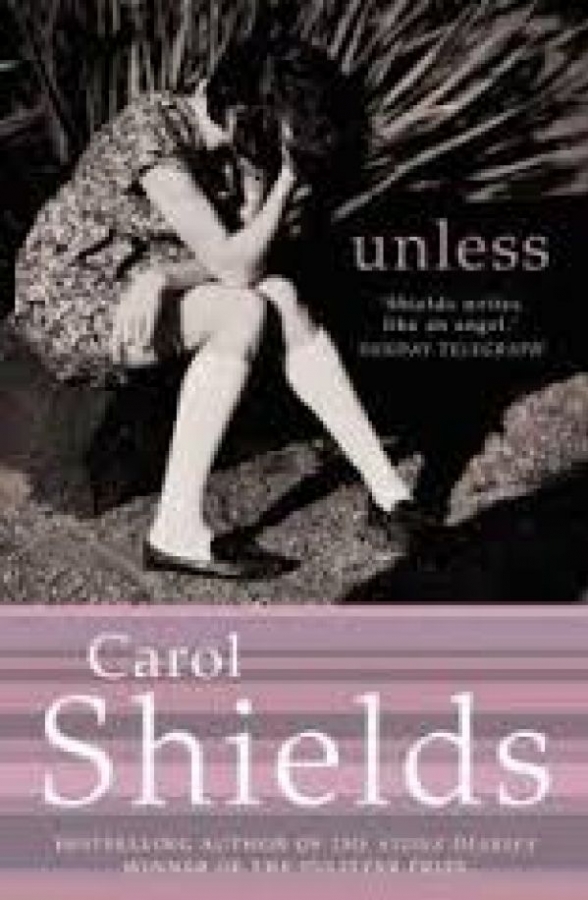
Unless (unless)
Reta, a doctor’s wife and mother of three, is with her friend Danielle, for whom she translates from French into English. > It would be better (...) to use the word mind instead of heart; (...) referring to the heart as the seat of feelings is no longer in fashion, condemned by critics as evanescent. (...) Danielle pondered for a moment, then smiled at me affectionately yet mordantly, and placed her hand on her breast: but this is where I feel grief, she said, and tenderness . Is it possible to confront rationally a daughter’s abandonment, the profound grief that turns the small habits of life into “costume jewelry”?. > In our big, old house (...) we lived the life we chose long ago: abundant, intense, yet with interludes of peace, surrounded by furniture, books, soft cushions to lie upon, food in the fridge, even more in the freezer . Suddenly Norah, the eldest daughter, drops out of university, takes to the street to beg with a sign bearing the word “Goodness”. How to react? The malaise is so profound, invading every moment of life and engulfing the whole family, driving each of them to withdraw into themselves, desperately trying to make sense of it, to offer help, to endure the sorrow while continuing the routine of daily life. Yet it is not possible; the suffering is too immense. Reta finds herself in the restroom of a restaurant and on impulse writes on the wall: > my heart is broken, which I would later recognize as an act dramatic, childish, indulgent, grandiose, and full of strength. (...) Immediately I felt relief between my ribs. (...) Something akin to joy swept over me, if only for a moment (...) as if under an enchantment. I had allowed myself to be receiver and transmitter at once, not a dead thing but a living link to all that would become unbearable suffering. In that moment I trusted my instinct, I set down words that revealed the truth, bearing witness to the most private and alarming of visions, rather than the self-pitying and melodramatic graffiti it actually was. Reta reacts by dedicating herself to writing a novel, a work of fiction she wants to be light, superficial, and blessed with a happy ending. Two fiances are meant to marry, but she is not convinced about marriage; she is not truly in love. How much of Reta’s suffering finds its way into the novel? And how much does it reflect her own marriage? Reta is at a crossroads: to give the story a dramatic twist, as her editor would like in order to turn it into a work of substance, or to stick to the original idea, namely a "romance > , aimed at the general reading public rather than the critics. Reta remains anchored to her project because she clings to hope, to the longing to find her daughter again. The protagonist does not marry; she chooses her own happiness; just as the writing of the novel concludes, Norah’s ordeal also comes to an end. Through a sequence of fortunate circumstances, the daughter, gravely ill, is rescued in extremis and treated; she returns to her family. In the hospital, the doctors notice that Norah has numerous burns; she had in fact been caught in a fire, when a young woman committed suicide by setting herself ablaze. In that moment Norah realized that the world is not good—that, on the contrary, injustice and existential suffering prevail outside the walls of home and university. God is dead! Like Simone Weil, who saw in her own physical wasting the only way to resurrect God, so Norah pursues her own self-destruction to cry out her longing for God, to bear witness to the desire for Goodness. And thus Norah’s behavior also has its logical explanation, an understandable motive: it is the mind, and not the heart, that is the source of Norah’s act. It is a complex and difficult book. The writing is elegant and masterly, the reading flows smoothly, enthralled by the beauty of the language. Too many themes are addressed, from philosophical questions to the female condition, down to the cathartic function of narrative imagination; missing, however, is psychological depth, which would better illuminate the motives behind Norah’s behavior and the reactions of Reta, her husband, and their other daughters. It is as though the author fled from the human condition to retreat into a metaphysical, political, and sociological dimension: an approach that dissipates the universality of a story told with such skill and preciousness. On the other hand, the use of unless” (in Italian “a meno che non”) presupposes the third conditional form, already indicative in itself of a deliberately sophisticated approach to narrative: perhaps greater simplicity would have lent more vigor to the story. Why not read it? It is difficult to grasp, at times prolix and tedious.