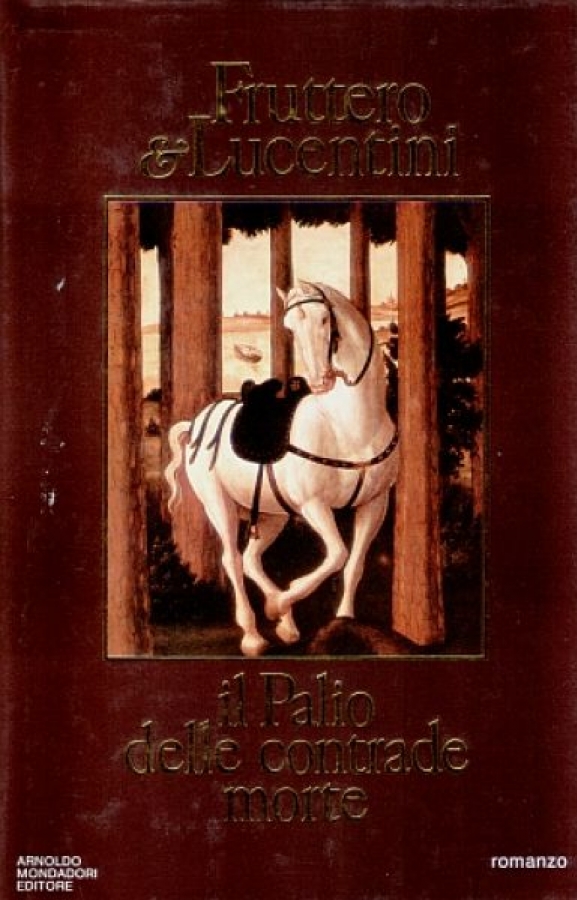
The Palio of the Dead Contrade
It is likely not one of the two authors’ best books. Beyond its brisk and lively style, the plot is utterly inconclusive: a husband and wife, their marriage frayed and dull, find themselves by chance in a patrician residence near Siena, where they witness a crime (the murder of a well-known Palio jockey), embark on affairs with the master of the house and his daughter, respectively, and take part in the Palio, in which the *contrade morte* (those excluded from the race) take revenge for their non-participation through the “ghost” of the slain jockey. A detective novel, a work of the fantastic, a reflection on the desolation of human relationships, or simply the pursuit of a paradoxical story: it is impossible to tell, and one is left, in truth, disappointed.
The past is a foreign country
Perhaps it is not the author’s best book. A brilliant young student is dragged by a friend into a descent into hell: first gambling, then drugs, until he even risks becoming implicated in a rape. Faced with extreme violence, he reacts by saving the girl, and in some measure saves himself as well. The narrative premise could well be interesting, but it drags sluggishly along, offering neither plot twists nor any psychological probing of the motives behind behavior so vastly divergent from his past life. It almost seems as though the character were weak, someone who had always passively endured what was expected of him, only for his true personality to surface under his friend’s pressure. The style wavers between that typical of atmospheric crime fiction and that used in introspective narratives: the synthesis is sheer tedium in the reading.
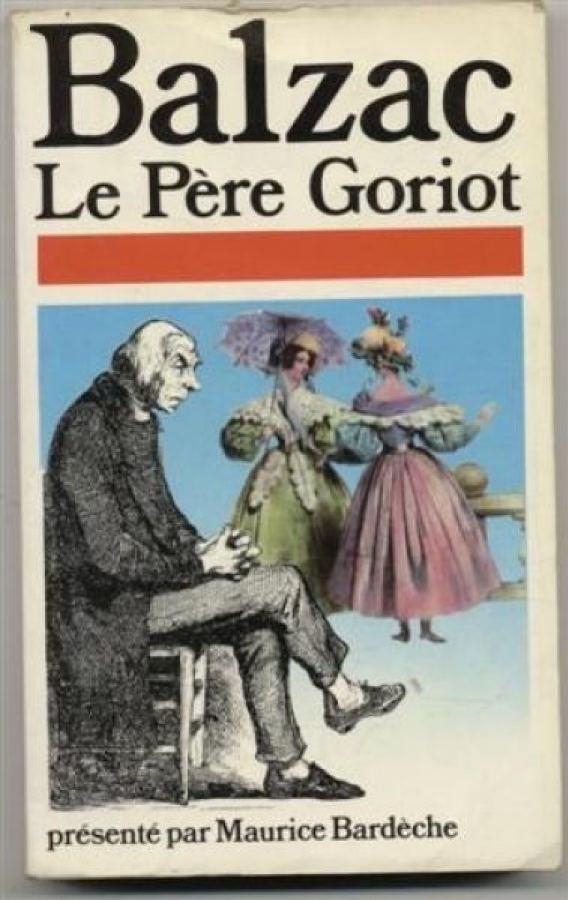
Father Goriot
Balzac lived in the first half of the nineteenth century and thus depicts the society of Louis-Philippe. The novel recounts the story of a man who, out of love for his daughters, leads a wretched and despised life. His paternal devotion stands in stark contrast to a society dominated by money, appearances, and climbing the social ladder at all costs. The approach is moralistic, the style tedious and ponderous, the French difficult: in short, a "bad" novel, which I could not bring myself to finish. When one compares Balzac (at least the Balzac of this book) with Stendhal, the disparity in quality is striking: where Stendhal is nimble yet profound in his characterizations (figures rich in contradictions), Balzac appears rigid, didactic, and predictable. In Stendhal there are "heroes"; in Balzac, opaque figures already condemned to an existence trapped within the constraints of money and social ambition. Perhaps Balzac’s society is truer to life, but it is undeniably duller. To say nothing of the French. In Stendhal it flows, and it is the very structure and rhythm of the sentence that endow the narrative with meaning (with no need for an excess of adjectives); in Balzac, an elaborate vocabulary is required merely to give expression to the tale.
The Electric Fish
The book recounts the journey of three journalists to Turkey to meet a friend of theirs, imprisoned in an asylum by the authorities for being a friend of the Kurds, who is about to be released. It is unclear whether it is an introspective tale (a search for oneself), a portrait of Turkey, or a detective story. In truth, it is a dull book, poor in its descriptions and mediocre in its dialogue. I was unable to finish it.
The Pianist
The book belongs to a period prior to the "detective-style" novels and deals with the years immediately following Franco’s death, marked by the initial disillusionment with the democratic system and the left’s inability to bring about genuine change. It is a tedious novel in both content and style, far removed from the detective fiction of the subsequent period, even in its setting and depiction of life in Barcelona. Dialogue predominates, often repetitive and sluggish, in which the protagonists seem to fulfill preordained roles as bearers of broad thematic meanings (by now bound to distant debates and events) rather than expressing personal stories.
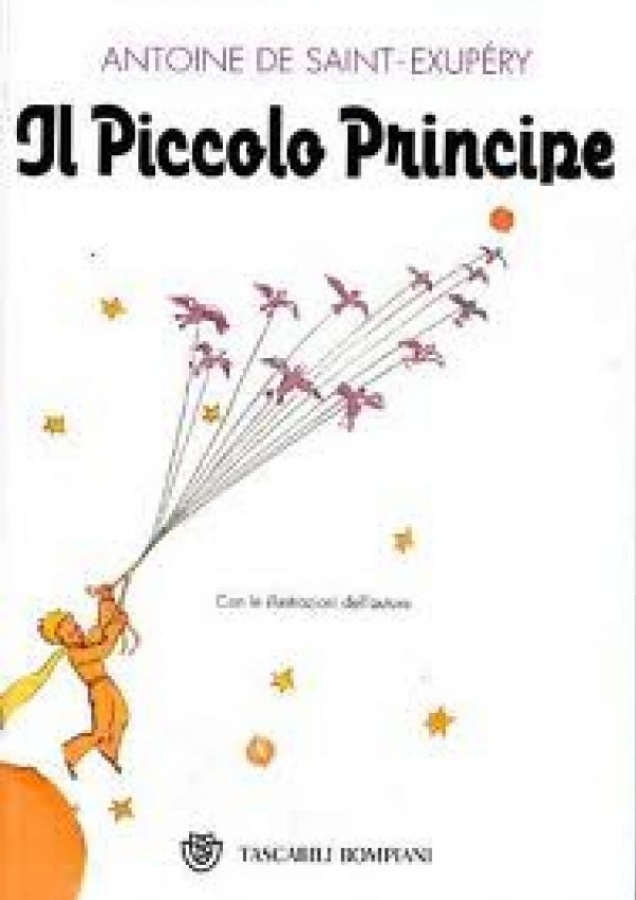
The Little Prince
*The Little Prince* is, perhaps, one of the most famous and widely read books in the world. The narrative opens with an episode from the narrator’s childhood, an aviator like Saint-Exupéry himself. At the age of six, he had drawn a "boa constrictor digesting an elephant," which to those who lack imagination—such as grown-ups—merely looked like a hat. Indeed, they > advised me to lay aside my drawings of boa constrictors, whether from the inside or the outside, and devote myself instead to geography, history, arithmetic, and grammar . From then on, the narrator spent "his life alone, with no one to truly talk to," until, having crashed with his plane in the desert (an actual event in Saint-Exupéry’s life), he encounters a "little fellow" (*the little prince*), who has arrived from outer space. The little prince lived on a minuscule world, so tiny that > you only had to move your chair a few steps to watch the twilight whenever you wished On this planet, the little prince tended to a flower, the only one in his world, "but he was too young to know how to love her." And, as so often happens to those who take no joy in what is close at hand, he sets off on a journey in search of something else. In his wanderings, he encounters six tiny worlds, each inhabited by a solitary soul: a king who "demanded from each what each could give"; a conceited man, who wished to be admired as the handsomest man on the planet, even though he was its sole inhabitant; a drunkard, who drank to forget that he was ashamed of drinking; a businessman, who endlessly counted; a fellow who constantly lit and extinguished a street lamp, because his planet spun so fast that day turned into night in an instant; and finally a geographer who had never explored the rivers, mountains, and seas he recorded on his map. Eventually, he lands on Earth, where the little prince makes several interesting discoveries, such as a fox who reminds him that "what is essential is invisible to the eye," and therefore his flower is unique not because other flowers do not exist (indeed, the little prince had already come across a field of roses), but because he had cared for that specific flower: > men have forgotten this truth. You become responsible, forever, for what you have tamed —that is to say, that to which you have bound yourself through an act of care. > Whether it be a house, the stars, or the desert, what makes them beautiful is invisible and it lies in loyalty to something, to an idea, to someone. And indeed, the little prince leaves Earth because he must return to tend to his little flower. Once he has departed, the narrator (Saint-Exupéry) realizes he forgot to add the leather strap to the muzzle drawn for the little prince's sheep. Will the sheep now eat the flower as well?! > Look up at the sky. Ask yourselves: has the sheep eaten the flower or not? And you will see how everything changes... One must ask oneself unpredictable, irrational questions aimed at probing the mysteries of the universe and the human soul: only the pursuit of the impossible can prevent life from lapsing into the prosaic nature of mere existence. The tale is autobiographical, recounting an exceptional and misunderstood life. The device of the fable allows the author, unburdened by the constraints of verisimilitude, to assert the necessity of holding onto a dream—which, in Saint-Exupéry's case, means flight, exploration, and adventure. Beneath the gentleness of the prose and the delicate lightness with which various existential themes are addressed (the allure of nature and mystery, friendship and loyalty, human flaws and the grandeur of the universe, imagination versus economic rationality), an enormous conceit actually emerges: the notion of being unique in the universe, the belief that the pursuit of one's dreams must know no bounds, and that when one realizes they are no longer attainable, death is preferable. The parade of little worlds serves as a vehicle to mock figures loathed by the author, yet it also mirrors an individualistic worldview, positing that only in isolation can our personality be fully realized. In the same vein, the desert setting encapsulates a longing for solitude, a state in which the author appears to indulge himself: it is far easier to converse with a child (the "little fellow") than with adults who fail to understand us. *The Little Prince*, despite all its sweetness and delicacy, stands as an allegory for a delusion of omnipotence—that of a man, and of a humanity, unwilling to accept limits: the swan song of the twentieth-century cultural superhero. Why not read it? It can certainly be read, as it is very brief, albeit pointless. A word of caution, however: do not give it to children to read, for it lacks any pedagogical value.
The Pirates of the Mountains
According to Daniel Pennac, the reader's second right is the right not to finish a book. “Does the book drop from your hands? Let it fall.” And he goes on to say that there are thousands of reasons to abandon a book, the principal one being: we never have time, and it is better to spend what little time we have reading what we like. In the past, I used to try to finish a novel or an essay even when I was not enjoying it. What torture! The eldest of my sons persists in this error; for example, he stubbornly insists on finishing *All the Pretty Horses*, despite finding it ponderous and tedious (see the review of Cormac McCarthy's novel on this site). A few years ago, I decided that I would let a book drop “from my hands” after eighty pages if I found its story uninteresting, its characters poorly drawn, and its prose unappealing, or simply if I preferred to read another book. I applied these superficial rules in this instance. We find ourselves in the midst of the Resistance. Among unidentified hills, but likely along the north-eastern border of Italy, a small contingent of partisans fights against the Nazi-Fascists: they are of various nationalities, united by the shared necessity of survival rather than by hatred toward the Germans and Fascists. There is also a nine-year-old boy: Giorgio, nicknamed the Cabin Boy because the partisans imagine themselves to be the fabled pirates of Tortuga and their band akin to Buccaneers sailing the Caribbean seas. A truly bizarre metaphor, given that they are in the mountains! Why not a group of mountaineers striving to conquer a peak, or the *Alpini* in the First World War? It is not clear why Giorgio left his home and parents; as we read, we learn that > it had begun, for him, with collaborationist fascists chasing after him. (...) With him running like a hare along the path that, past Capodistrada, climbs for another eight hundred paces—nine hundred if you are tired—before slipping through the brush and into the tangle of brambles, to emerge, already on all fours, at the barn and thus reach that hiding place. Here the boy was adopted by a group of men and women, already accustomed to war and death: loyal, brave, profoundly honest, and protective of Giorgio, as though they were the Tigers of Mompracem. Giorgio learns to live like a partisan, learning step by step to endure cold and hunger, to hide, to remain on alert for a sudden German attack, to forget his family, and finally to fight. > Giorgio, known as the Cabin Boy, narrowed his eyes and, trying to recover that sensation of invisibility, rolled himself up in the rough woolen blanket, waiting for the dawn when > the contours of things are more under the mind's control and those very things loom less large. The novel's opening pages promised an interesting story: an adolescent coming of age by confronting a harsh life and fighting for freedom. Unfortunately, the narrative quickly succumbed to the three golden rules. First of all, the storytelling is dull, devoid of plot twists or moments of tension—a predictable and repetitive succession of wartime events and partisan life. Secondly, the characters lack depth, especially Giorgio, whose personality accepts these new, dramatic experiences far too easily. Lastly, the writing is cluttered with pointless, banal dialogue at the expense of setting descriptions and the creation of an atmosphere that aspires to the imaginative, yet remains flatly prosaic. Consequently, I decided to let the book drop; I had another to read, and time is so scarce! Why not read it? It is boring.
Pleading Guilty
The book’s plot is typical of Scott Turow: set in a law firm, the protagonist, a former police officer, is tasked with tracking down an attorney from the firm who has vanished, leaving behind a substantial shortfall in a major client's funds. The narrative is characterized by frequent incursions into the protagonist's life, resulting in a tedious read. Furthermore, the style is exceedingly dense and convoluted, devoid of fluid, engaging English. I abandoned the book at page 161 out of 464.

I have probably lost my way
The protagonist is a young woman: she lives in Tehran with a young child, is separated, is seeing a therapist, and has a friend: Gandom. The story unfolds over the span of a few hours. Waking up disoriented to the ringing of her ex-husband's call, she finds herself covered in bruises, with a black eye (was she beaten?); she barely remembers sending her child to kindergarten by taxi; immediately, she begins an imaginary dialogue with Gandom. > Why didn't I ever tell her that sometimes dreams accompanied by fears, anxieties, and worries are more beautiful than reality, and sometimes even more real than reality... They were childhood friends; they grew up in the same provincial town and left it together to study in Tehran; they fell in love with the same man, but then the protagonist married the one chosen by her family. She leaves the house; the traffic is heavy and noisy; the radio invades the car's interior with commercials, news items steeped in political propaganda, religious appeals: > Cick, Cick, Cick... the chocolate for young and old, (...) Economic troubles are a plot by the enemy, (...) Women and men are essentially different. If a woman strays from the path of purity, she brings dishonour upon her husband, but if a man..., (...) When a child is to be born, an angel comes from God (...). The angel ushers it into this world and watches over it for life... She keeps talking to Gandom, and so we learn that her father and brothers have died, and that she grew up in a family ruined by debt, with a cold, severe mother. > Since when, since when have I covered myself with this heavy, black chador? (...) Perhaps I left something behind somewhere, in the past. (...) Ah, if only it were possible, with a single deep breath, to swallow the past and gulp it down forever.... Gandom is altogether different: full of life, joyful, confident, with an affectionate father, a kind grandmother, and plenty of money to spend on shopping. They are inseparable, with the friend ever ready to assert her superiority, knowing her better than she knows herself. > Gandom always had to humiliate me, both when she threw my fears in my face and when she didn't. My entire life went to shit with this person, a person who seemed to know everything about me, as if she knew my hidden corners, as if she were closer to me than I was to myself... my entire life... it makes me laugh... . She hasn't seen her in many years; she must find her because she cannot live without her; she seeks her out through the man they both loved. > I am thirty-five years old. Tomorrow I will take Samiar to kindergarten, and when I walk out the front door, I will see a thirty-five-year-old woman standing there, watching me with a smile. This time, after all these years, I recognize her, with those bright black eyes, with that smooth, amber skin, with all that hair escaping here and there from her headscarf and framing her face... with that smile that brings two dimples to her cheeks... I go toward her and grasp her hands tightly in mine. She says: how warm they are. I would like to tell her that it is not my hands that are warm... I say nothing... I just hold them tight in mine and smile... after all these years, I know that when I smile, dimples appear on my face too . It is the story of a split personality. Oppressed by the nightmares of the past, from which she tried in vain to escape by moving to the big city—only to find herself even more isolated and desperate—the protagonist has slipped into schizophrenia. > I placed my hand on hers. Her perpetual presence was better than her absence. Her presence, with all the suffering it caused me, and perhaps with all the suffering I caused myself... (...) It is as if I had lost myself years ago, lost under that star-filled sky of Zahedan . To find herself again, she would have to return to childhood, deep into the past, and that is impossible. Will maternal love save her? > I weep... I weep out loud, (...) Samiar strokes my hair and I sink into his embrace... . The narrative is constructed on several levels: the real, insignificant plot; the rapid-fire dialogues with Gandom, which are obviously soliloquies; the visits to the therapist, brief and useless for understanding the protagonist; and contemporary Iran, caught between modernity and traditionalist Islam. What emerges is a fragmented, disjointed narrative, further marred by an exasperating overuse of ellipses—intended to convey a stream of consciousness, but in truth merely a trite literary device to avoid delving into the protagonist's existential drama. One is left perplexed and unsatisfied, with the impression of a superficial, contrived, overly intellectualized story, lacking the weight of genuine lived experience. Why skip it? Inconsequential and pointless.

Proletkult
In 1906, Aleksandr Bogdanov, the pseudonym of Bolshevik revolutionary Aleksandr Malinovsky, wrote *Red Star*, a science-fiction novel in which real socialism had been fully realized on the planet Mars. With exceptional prophetic insight, he imagines that the new society modeled on Marxist utopia had not proved immune to imperialism, seeking to colonize Earth after exterminating its population. Leonid, the protagonist of *Red Star*, opposes the project and is banished to Earth as punishment, ending up in an asylum. The Wu Ming collective envisions a possible sequel. Denni, Leonid’s frail daughter, descends to Earth to search for her father and goes straight to Bogdanov, who, besides being a writer, is a philosopher and a scientist. The man finds himself facing a > strange girl who looks like a boy. Impeccably white, perfect teeth. Very small, well-shaped ears. Pale, perhaps overly so. The year is 1927, and Bogdanov has shut himself away in his clinic, wanting no further involvement in perilous affairs amid the first Stalinist purges. He takes refuge behind fiction: drawing on the hallucinations of poor Leonid, he invented a science-fiction story, setting it on Mars because it is the Red Planet. From here, the novel could take any number of directions: a nostalgically ideological work about an utopia—the communist one—that can only be built on another planet; Denni's search for her father across an Earth ravaged by wars, repression, and famine; Bogdanov's realization that Leonid was not mad and that his book mirrored an actual society. This last path would have been the most compelling, leading toward the unsettling visions of Philip K. Dick. Instead, Wu Ming wander between historical digressions and a tenuous plot, unsupported by narrative twists or vivid depictions of settings and characters. It is regrettable that in 2018 these talented writers remain entangled in the disappointments of an unrealized world revolution, spellbound by figures that have vanished after a century of history. The Wu Ming collective consists of five writers: often they succeed in blending their voices, producing a narrative that is cohesive from both a historical and literary standpoint (see the review of *L'Armata dei Sonnambuli* on this site). Here, the operation falls flat, perhaps because the events and characters are emotionally and politically too close to us compared to those depicted in *L'Armata dei Sonnambuli*, a tale set during the French Revolution. The novel's sole virtue is that it prompts us to read *Red Star*. Why not read it? Boring.
The Betrothed
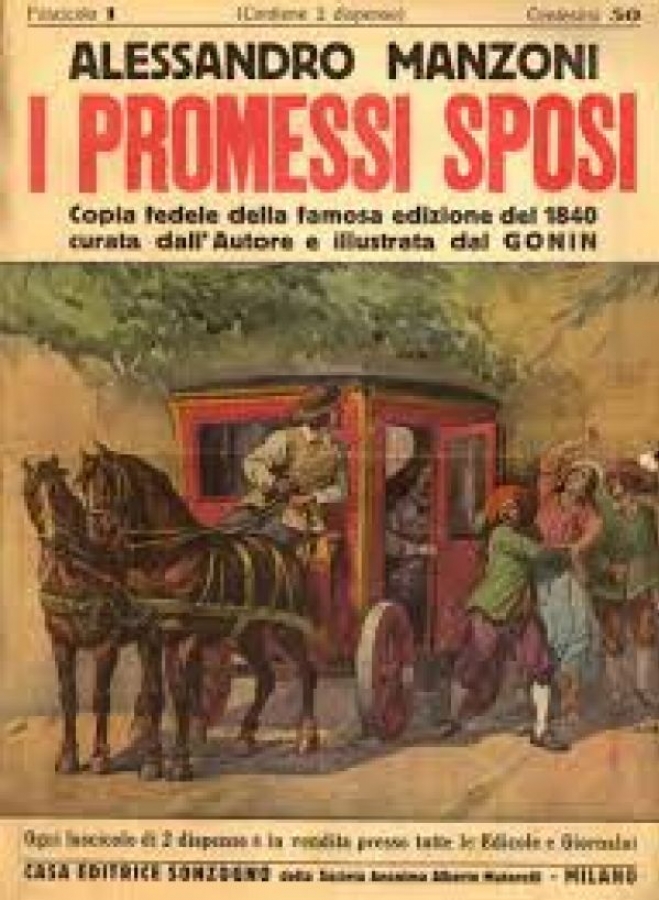
*I Promessi Sposi* is set in the seventeenth century, in the Duchy of Milan, then a Spanish possession; it is not a historical novel, even if many events actually took place; rather, it speaks to the present, bearing a distinctly conservative message: we must entrust ourselves to Divine Providence, for we are part of a grand design, incomprehensible to us. Thus Cardinal Federigo Borromeo explains to Lucia, having just been freed by the Unnamed: > Poor young woman, God has allowed you to be put to a great trial; but He has also shown you that He had not taken His eyes off you, that He had not forgotten you. He has restored you to safety; and He has used you for a great work, to show great mercy to one man, and to comfort many at the same time . The plot, the characters, the prose possess no autonomy of their own; they are subservient to a “morality,” to a vision of society that demands the common people remain quiet, awaiting the salvific intervention of God and His Church. To each section of the book corresponds a slogan. The first block of chapters, from I to VIII, is set in a small village near Lecco, recounting the lives of the humble, unwittingly overwhelmed by misfortunes through no fault of their own. We meet the two protagonists, Renzo and Lucia: the young man a blend of peasant cunning and plebeian impetuousness; the girl a combination of superstitious devotion and apparent docility. Then there are the other characters: Agnese, Lucia’s mother, who embodies peasant common sense; Don Abbondio, the village curate, representative of the moral and character flaws of the lower clergy; Fra Cristoforo, a Capuchin friar with a troubled past, who in turn personifies the torment of a faith hard-won between the urge to rebel and obedience to the Lord; and finally the villain, Don Rodrigo, the symbol of abuse and caprice, of power wielded without justice. The story is the age-old tale, in the Italian countryside as in so many other lands. Lucia is the object of Don Rodrigo’s desire, and neither Agnese’s cunning nor Fra Cristoforo’s stratagems are of any avail: Renzo and Lucia must part ways and flee their native village. Just as the novel opens with the famous description of the mountains around Lecco, wild and pleasant at once, the opening chapters draw to a close with one of the most poignant passages in the entire book. > Farewell, mountains rising from the waters and elevated to the sky, familiar to whoever grew up among you, and impressed upon their mind no less than the features of their closest kin; (...) How sorrowful is the step of one who, raised among you, departs! (...) One who, torn simultaneously from their fondest habits and thwarted in their dearest hopes, leaves those mountains behind to set out in search of strangers whom they never wished to know, unable even in imagination to fix upon a time appointed for return! Were we to possess even a fraction of this affectionate compassion, perhaps we could face immigration with humanity, rather than letting ourselves be overcome by fear and hatred! The two subsequent chapters, IX and X, recount the story of the Nun of Monza: a young woman forced into a cloistered convent who refuses to accept her fate. Manzoni speaks to us of the Christian virtue of resignation: failing to entrust herself to faith—and therefore to God’s will—leads the wretched woman to impiety, to the point of betraying Lucia, who had been entrusted to her care, and handing her over to the Unnamed’s bravi. At times it seems Manzoni is on the verge of plumbing the undeniably conflicted feelings of this wretched woman; then, the writer retreats to a dry biography of the nun and vague psychological sketches, refusing to linger because it serves no purpose for his ends; real life does not interest him; what matters to him is delivering a universal moral lesson. In chapters XI to XVIII, the narrative turns to the great bread riot that convulsed Milan in 1628, and Renzo's role in it as he naively turns into a popular ringleader. It is a lengthy digression whose purpose is this: rebellion is futile and harmful, it achieves nothing, and above all, the common people, in their gullibility and fickleness, allow themselves to be duped and are effectively manipulated. As Renzo will say, > to conduct myself better in the future. I have learned not to get involved in riots: I have learned not to preach in the public square, I have learned to watch whom I speak to... We have arrived at what ought to be the novel’s centerpiece: the conversion of the Unnamed, a man so wicked and powerful that people dared not even utter his name, > it signified something irresistible, strange, fabulous... his life was the subject of popular tales . The chapters concerning him run from XIX to XXVII; the plot would have them be the turning point, the struggle between good and evil, with good triumphant: none of the sort. Federigo Borromeo’s dialogue with the Unnamed is nothing more than a long, cloying sermon by the former, with the latter listening, already defeated before even stepping into the room. Moreover, the crisis of the Unnamed is not ethical in origin (the consciousness of the evil he has wrought), nor does it stem from an act of love (toward wretched Lucia); at its foundation lie the terror of God and the dread of death. > To grow old! to die, and then? (...) now there rekindled from time to time in his soul the vague yet terrible idea of an individual judgment, of a reason independent of example, (...) the sense of a dreadful solitude. (...) That God of whom he had heard, but whom for a long time he had cared neither to deny nor acknowledge, (...) he seemed to hear Him shouting within him: I am, nonetheless . And this is the meaning of the lengthy chapters recounting the conversion of the Unnamed: to affirm that God exists. Mind you! Not Christ, who suffered upon the Cross, but the God of the Old Testament, implacable and elusive, before whom one can only bow. The abstract moralism underpinning the encounter between Federigo and the Unnamed becomes glaringly apparent when one contrasts this exchange with the drama and depth of the chapter "The Grand Inquisitor" in *The Brothers Karamazov*; there, faith is a torment poised between freedom of conscience and Church-enforced tutelage. Like the Grand Inquisitor, Manzoni believes that > it is not free decision (...) that matters, nor even love, but mystery, to which [men] must blindly bow, even against their conscience . Let us return to *I Promessi Sposi*. > Finally, new events, more sweeping, more potent, more extreme, reached even them, even the lowest among them according to the world’s scale: like a vast, driving, wandering whirlwind, tearing down and uprooting trees, stripping roofs... (...) searches out in the corners the withered, light leaves that a lesser wind had confined there, and carries them off whirled into its plunder . It is the plague (chapters XXVIII through XXXV). The pivotal chapter is the Thirty-Fourth, which deserves to be read and reread for its evocative power and raw realism. Manzoni prefaces it with an interesting historical digression, explaining the causes of the epidemic (famine, war, the indifference and incompetence of the authorities, superstition) and delving into the political, cultural, and individual mechanisms that overwhelmed a seemingly well-ordered society. They are > a confused hum of suppliant voices, (...) a vast, bewildered mass of public folly , in which only the Church is capable of ministering to the derelict, the sick, and the dying. And we arrive, finally, at the masterpiece: Renzo enters Milan in search of Lucia, whom he will find unharmed in the lazaretto; the description of his wandering through the Lombard city offers the occasion for a moving fresco of the plague and its victims. > Descending from the threshold of one of those doorways (...) was a woman whose appearance bespoke an advanced, though not bygone, youth, (...) Her gait was weary, yet not faltering; her eyes shed no tears, but bore the mark of having wept many; there was in that grief a certain quiet and profound quality that attested to a soul fully conscious and present in feeling it. (...) She carried in her arms a little girl of perhaps nine years, dead, yet neatly arranged, her hair parted on her forehead, in a dress of purest white, as though those hands had adorned her for a feast promised long ago and granted as a reward. (...) A foul monatto went to take the child from her arms, (...) "No," she said, "do not touch her for now; I must lay her upon the cart myself" . This passage, along with many others, bears witness to an empathy so profound as to shatter the frigid moralism; it leads us, without ideological filters, to the suffering of so many peoples, past and present: in Syria, in refugee camps scattered everywhere, to the millions fleeing cruelty and violence. Here, Manzoni truly rises to the universal, transcending time and space like a Platonic ideal that encapsulates the sorrow of all the wretched of the earth. After the plague, the subsequent chapters (the final ones, from XXXVI to XXXVIII) amount to very little indeed. Like a neat fairy tale, everything ends for the best: Renzo and Lucia marry and will live happily ever after. Troubles befall us, but > trust in God softens them and turns them to account for a better life . Is that truly so? Like many, I read *I Promessi Sposi* in school and did not like it. I blamed the obligation and the oral exams. Re-reading it many years later, I found my initial judgment confirmed: it is a truly dreadful novel. Its suffocating moralism saps the narrative pace, rendering it tedious and prolix; it fails to breathe life into the characters, who remain stereotypes and often lapse into caricature (such as Don Abbondio); and ultimately, it withers the prose. Manzoni’s celebrated Italian, held up as a benchmark by grammars, is an artificial tongue. I am referring not so much to the fact that peasants like Lucia and Renzo speak flawless Italian (fleeing dialect is, regrettably, a constant in our literature), but rather to the extreme use of punctuation, which chops up sentences, weighs down the syntax, and prevents the creation of atmosphere: the prose reduces discourse to mere reportage, accentuates haughtiness, and fails to evoke anything. To say nothing of the moralizing judgments with which the novel is saturated: let us be frank, Manzoni could have spared us them, for they are truly irritating. If it is such a dreadful novel, why did it become a pillar of literature? Why not place Fogazzaro, Ippolito Nievo, Federico Tozzi, Collodi, Matilde Serao, and the great Deledda at the center? It would be interesting to see critics answer these questions. I venture an explanation: *I Promessi Sposi* mirrors the worldview of the post-unification ruling class, a narrow elite that desired an absent and supine populace. Manzoni’s novel helped cement this vision, turning it into an undercurrent in our culture from which we have never managed to break free. Why not read it? Boring, dry, insufferable.