
Olives Included
We are in 1930s Italy, at the height of the Fascist era. In a small village on Lake Como, four good-for-nothings spend their time lingering in taverns and playing pranks. One day, as a favor to the village prostitute, they poison the pigeons that typically congregate in the squares and streets. One of these pigeons is given to an elderly woman, who dies from the poison. From this incident unfolds a whole sequence of events centered on the village *maresciallo*. He is the classic figure of the *carabiniere*: dutiful, stern yet pragmatic and sensible, attempting to resolve the locals' troubles by acting as a «benevolent paterfamilias». The narrative moves swiftly, buoyed by a lively, stripped-down style, weaving through somewhat absurd situations—such as a brother fretting that his skinny, pious sister might marry a friend endowed with exceptionally exaggerated sexual attributes—and singular characters, like the wife of the *podestà*, who believes herself to be three people in one and is constantly shifting personalities. The atmosphere evoked by the author is the familiar one handed down to us regarding Fascist Italy: an absurd regime, unloved yet endured, while at the same time paternalistic and condescending. The book’s greatest virtue is that it is a very smooth read, yet both characters and settings remain superficial and distant. The former verge on mere caricatures; the latter (Lake Como and village life) ultimately prove irrelevant. The deft narrative pacing fails to compensate for the vacuity of its content. Why not read it? Because it only makes sense to read it on a train, when one is thoroughly exhausted.
Oliver Twist
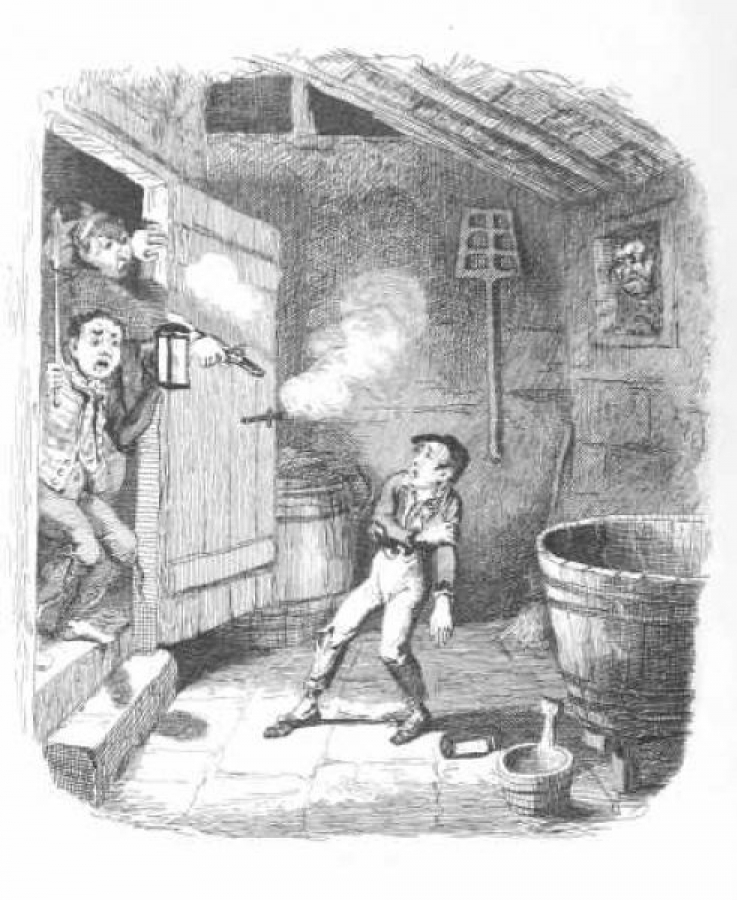
The setting is the England of the second half of the nineteenth century, marked by widespread poverty, rising criminality, and a bigoted bourgeoisie that was often hostile toward the poor. Oliver is a foundling who is first raised in a workhouse, only to be apprenticed (or handed over) to a family to learn a trade. There he suffers relentless abuse and consequently decides to flee, only to fall into the hands of a gang of criminals led by an avaricious and cruel Jew (Fagin), and by another character who is violent and paranoid. Oliver is forced to learn how to steal; during a burglary, however, he is wounded and taken in by a family who nurses him back to health, thereby introducing him to the kindness and generosity of the respectable middle class. There follows a series of adventures and an entanglement of characters, through which it is ultimately revealed that Oliver is the heir to a vast fortune and had been abducted by the Jew on behalf of his half-brother, who sought to prevent Oliver from claiming his lawful birthright. All ends well: the villains are punished, and Oliver can live happily with his new family. At a certain point in the novel, Dickens recalls how > it is the custom on the stage in all murderous melodramas to present comic scenes and dramatic scenes in regular alternation. Such changes appear absurd: but they are not so unusual as they seem at first sight. The transition in real life from a well-spread board to the deathbed, and from mourning weeds to holiday garments is no less incredible: only, there, we are actors rather than passive spectators, and that makes a vast difference . Life is thus an endless surprise, and the story of *Oliver Twist* seeks to portray the nineteenth-century journey of a hero in the era of massive urbanization. Yet there is nothing fantastical or truly adventurous in Dickens’s tale, save for a sequence of frequently maudlin episodes steeped in a facile moralism that sharply demarcates good from evil. In the first part of the novel, recounting the trials of young Oliver, the author still displays a subtle irony toward the English society of his day and a critique of the hypocritical approach to poverty that conceals contempt and cruelty beneath a veneer of charity and benevolence. Particularly effective in this regard is the scene where young Oliver, timid and awkward, appears before the workhouse board to be evaluated regarding his future placement. Dickens describes the various board members masterfully, revealing a lucid portrait of a bourgeoisie that views poverty as an innate predisposition toward wickedness and misfortune. Similarly, the author advances a social critique against the exploitation of child labor and the utter disregard for children's physical and intellectual needs. In the novel’s second half, the narrative lapses into melodrama, drawing a stark divide between the “world of good” (the middle-class gentry fueled by wholesome sentiments) and the “world of evil,” embodied by society’s underworld: the grasping Jew, the young prostitute who ultimately redeems herself, the brute, and the wicked half-brother. Oliver himself fades from view, while Fagin emerges as the pivotal figure, incessantly scheming in his pursuit of wealth and possession. The finest scenes are precisely those depicting the gang of criminals and their movements through the streets of London: a dark, filthy, decaying city where people dwell in windowless, dilapidated, foul-smelling tenements. In its richness and expressive power, the depiction of London recalls D’Annunzio’s poetry on the monstrous cities. Urbanization is viewed by Dickens as the community’s descent into an inhuman world, in contrast to the countryside, where one can live happily and serenely. It is hardly coincidental that Oliver and his companions ultimately abandon London to return to the small villages of rural England. The plot is predictable, an overbearing moralistic approach predominates, and the style is not always fluid—the sentence structure being frequently convoluted and redundant: all elements that render the novel scarcely enjoyable.
Beyond the River
Gee’s Bend is an arm of land, bordered on three sides by the Alabama River, where the water forms a sort of vast, arcing hairpin bend. To reach the nearest town, the "Benders" must undertake an hour-and-a-half drive or a fifteen-minute ferry ride—had the ferry not been abolished in the 1960s by the county sheriff with the following unassailable reasoning: > we didn’t close the ferry because they were black, (...) we closed it because they forgot they were black . Gee’s Bend is a unique enclave: all its residents are descendants of the sixteen slaves who settled this strip of land in 1816; geographical isolation and the land's meager appeal allowed the small community to remain untainted by the momentous social and political upheavals that marked American history: the Civil War, racial segregation, the Great Depression, Martin Luther King’s freedom movement. Even when the latter drew them in, holding them up as a paradigm of the exploitation of the African American people, the "Benders" went "over the river," as the great Black leader urged them, fought for him, and grieved his death, but then returned to their land, because > for a woman of color, descended from slaves, (...) the river begs to be crossed, and at the same time bars the way . Yet today this small community, now dwindled to a few hundred survivors, risks vanishing. The project of a new ferry will shatter its isolation once and for all. Moehringer deftly captures this moment, narrating it through the eyes and mind of a small woman of Gee’s Bend. > Mary is made entirely of circles. Her body is round, her face is round, her river is round. In Mary Lee’s world everything is round, because only at the end of something, of a century, of a story, of a sentence, does one truly understand its beginning. (...) She has spent her entire life in this timeless place. How did age manage to track her down? Through Mary Lee, Moehringer retraces the history of Gee’s Bend, interweaving social events with episodes from the woman’s life. It is a gentle, melancholic narrative: there are moments of revolt, there is immense endurance, yet the whole is steeped in resigned benevolence; and this not merely because Mary Lee > is a kind person (... if I can’t laugh and joke with you, if I can’t be nice and friendly, we might as well leave it alone) , but because > a lifetime ago Mary Lee counted on the river to protect her from those who were anything but friendly. (...) Her river is a strong brown God, (...) Eternal, Silent, Gives life, and takes it without hesitation. It is the force that shaped Mary Lee’s world. (...) There are people who spend their lives fighting against what limits them. Mary Lee was baptized in the water that limits her. To her it is a gift, and for what she has been given she gives thanks. This long story brings to mind a great Italian novel: *The Mill on the Po*. As in Riccardo Bacchelli’s book, here too the subject is the humble, the victims, and it is approached just as the conservative Catholic Bacchelli approached it: with nostalgia, as if to say life was better then, when one was isolated, schooling was out of reach, poverty reigned, and one suffered the abuses of white people, but at least one lived sheltered by the great river (here the Alabama, there the Po), in a tranquil, timeless existence. But history marches on, my dear Moehringer, and the exploitation of Black people, of peasants, of the "wretched of the earth" cannot simply be a trite occasion for folklore, for winning an undeserved Pulitzer Prize with a Hollywood-style tale. Why not read it? Trite; better *The Mill on the Po*.
Oracle Night
The protagonist is a writer slowly emerging from a serious illness. On his daily walks, he enters a stationery shop, run by a Chinese man, and buys a notebook. He begins writing once more, but above all, a sequence of events is set in motion—some actually lived, others imagined and the product of illusions. Is the notebook magical? Does it possess the power to reveal what the writer had not previously realized? For example, the protagonist's wife is expecting a child, yet she does not seem happy: but is the child truly his own, or the result of an affair between his wife and an old family friend? The conclusion is not unequivocal, because reality is entirely an illusion, and it is always difficult, if not impossible, to know the truth. Like other novels by this author, the reading moves swiftly, aided on the one hand by a linear, elegant style, and on the other by a spare language that leaves no room for the use of difficult words. Yet a certain intellectualism always prevails, which in the long run makes the book heavy going.