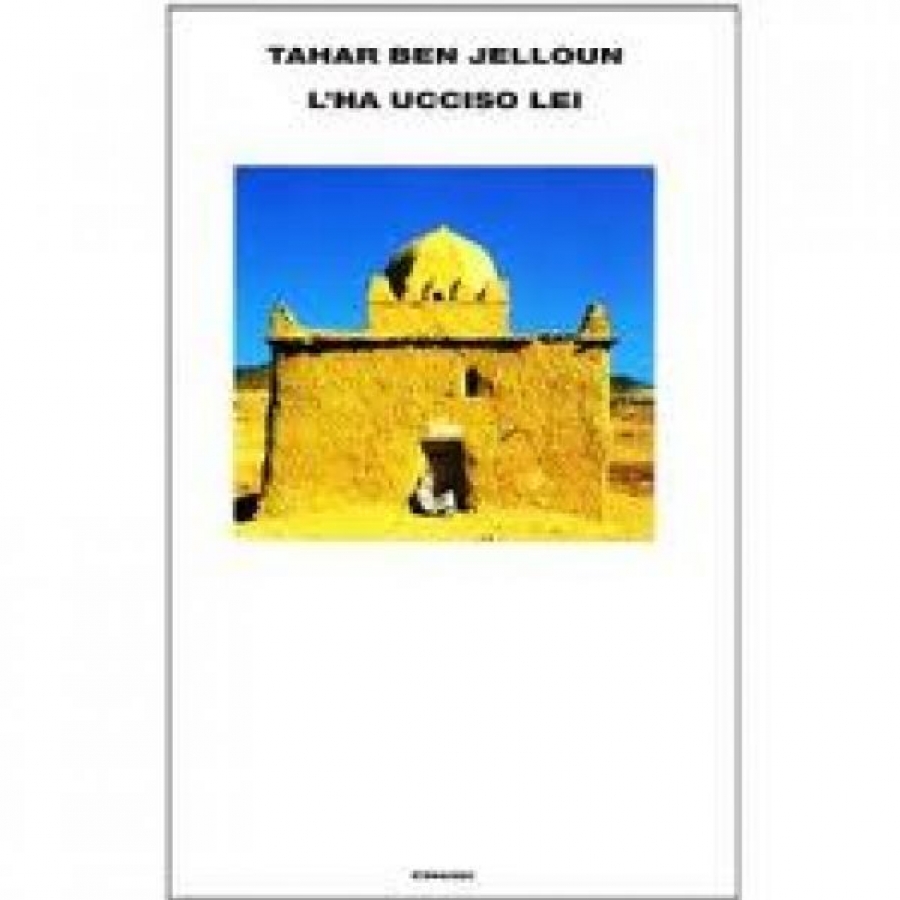
She killed him
Mohamed emigrated from Morocco to France to work in a factory, a harsh life that enabled him to raise five children. They are now estranged from him because they are integrated into French society, whereas he has remained tied to his traditions, feeling Moroccan rather than French. The daily grind of an intense working life allowed him to conceal, first and foremost from his own conscience, the discomfort with a culture he does not share and his refusal to integrate, to resign himself to Western ways. Retirement age arrives, however, and he can no longer escape a sense of unease he has always harbored: that of being “someone who never found his place.” Most of the short novel is the narrative of an inner journey. Mohamed tries by every means to give meaning to life as a French pensioner, but he would have to spend his days at the café, > drink beer? Out of the question. Watch TV, follow the race results, fantasize about those half-naked girls who populate American TV shows? Or take the advice of a fellow countryman: move back to his home village and take a pretty girl as a second wife. Neither solution is possible. The bond with his own tradition, religion, land, and the customs of his Morocco is too strong within him. His rectitude and sense of family duty do not allow him, either, to offend his wife or set himself at odds with his children. > Mohamed set off, his fists clenched in his pockets. He thought of his children and had the feeling of having lost them. He felt himself plummeting into the void, hurled into nothingness like a sack of rubble. A sack full of things that are no longer of any use. In this sack lay a rat, long dead. And from it emanated an unbearable stench. He told himself: I am the sack and the rat, I am the stones and the rusted iron, I am the creature that nobody loves... Mohamed no longer exists. No one thinks of him anymore, no one calls for his presence. It is over, he has reached the end of the long road . And so Mohamed reacts to this anguish in the only way imaginable for him, an emigrant and a stranger to his new homeland: returning to his country, building a large house capable of accommodating his whole family. Yet, as a shadow that appeared before him told him, this building will be > a place of penance for lost souls like you, strangers who no longer know who they are or where they come from . The final part of the novel is, precisely, the account of this journey, which cannot but end in a solitary death, seated in an armchair that > sank deeper every day... only the head stuck out (until) on the fortieth day the earth swallowed the head.. (and) in a few days the grave was covered with lush green grass . It is as if Morocco were taking him back after a lifetime of exile: a dark yet beautiful image. The novel addresses some traditional themes of the immigrant condition, balanced between the land of origin and the host country. Retirement is the catalyst for men who found in work a way to hide from themselves that deep existential unease, which derives from a condition increasingly isolated from, if not in conflict with, the new generations. It is very interesting that the entire narrative revolves around the intergenerational relationship, rather than tackling predictable cultural and sociological issues. The distinctive element of the novel is the figure of Mohamed. He seeks no loopholes or half-measures, but stubbornly and wretchedly confronts his estrangement from French society and the dream of returning to his own culture. But to whom, then, does the author refer with that *Lei* of the title: to the nostalgia for his homeland that killed him, or rather to Mohamed's own rectitude, which forbids him from accepting compromises? Very well written, it is nevertheless a pity that an intellectualized imprint can be felt, which deprives the narrative of sincerity. The leap between the bulk of the book, made of psychological introspections, and the oneiric, surreal final section is too stark. Why read it? It is very well written; yet the author loses himself in the psychological mechanisms of the protagonist.
Harry Potter & the Philosopher's Stone
Harry Potter lives with his aunt and uncle, a prosaic bourgeois family who hate, above all, that > anyone speak of anything that shouldn't be, no matter if it is in a dream or even a cartoon, (...) it might be a dangerous idea . As in the fairy tale of Cinderella, Harry is treated dreadfully by his aunt and uncle, the butt of his cousin's stupid and brutal pranks; in short, he is a victim, orphaned by parents considered eccentric and better left unmentioned. Strange letters begin to arrive: they invite Harry to a boarding school for witches and wizards. His uncle destroys the mail, but it keeps on coming; he then flees with the family to unreachable places; all in vain, as mysteriously the mail arrives everywhere. He must accept that his nephew has been admitted to a school where they teach "what shouldn't be"; he must even accompany him to platform "nine and three-quarters," the track that isn't there. The first part of the book is built entirely on paradox, between what is real and what could be, what we often wish were so and experience through fantasy. It is the best part of the novel. From that point on, we follow Harry to his peculiar school, where the magical arts and the secrets of witches are taught, but where the mechanisms of any boarding school are at work: rivalries, friendships, discipline and how to break it, strict teachers, indulgent ones, the likable and the unlikable. The boarding school, a dark castle, conceals a mystery: a three-headed dog guards a Philosopher's Stone, the possession of which grants immortality and bestows powers capable of conquering the world. Harry suspects that a teacher wants to seize it to hand it over to Voldemort, the Lord of Evil, whose name no one dares utter, so great is the fear. Adventures, perils, and acts of courage test Harry and his circle of friends; in the end, there is a twist, with a direct confrontation between Harry and Voldemort. How did the boy manage to resist the force of evil? > If there is one thing Voldemort cannot understand, it is love. He did not understand that love as powerful as your mother's for you would leave its own mark , giving Harry protection forever. And again, > only one who wanted to find the Stone, find it, but not use it, would be able to get it . The author skillfully blends magical and adventurous elements with an environment familiar to adolescents, namely school. The narrative pace is not as intense and surprising as one would expect, not least because one remains aware that the danger is merely apparent and will always resolve for the best. The salvific role of the super-wizard Dumbledore flattens Harry's autonomy, excessively aided by forces and figures far above him. The book fails to fully become a *Bildungsroman*, in that the young protagonist never fully matures into adulthood. If one compares *Harry Potter* with *Treasure Island*, the difference between Jim and Harry is striking: the setting is always exceptional, but the former emerges a man, while the latter remains an adolescent, subordinate to the adults. Is this perhaps why youngsters read *Harry Potter* and not Stevenson's great book? Because they can cling to the illusion that someone or something will always help them in life? The chief virtue of Rowling's novel is the writing: elegant, clear, effective, grammatically flawless. The book could easily be used to teach the most demanding forms of the English language. Why read it? Beautiful English
How to Get Filthy Rich in Rising Asia
The novel presents itself in the form of a manual. The author envisions teaching how to become rich in Asia, a continent in profound transformation. > Why persist in reading the much-lauded, yet so tedious, foreign novels... if not out of a desire to understand those distant countries that, because of globalization, increasingly affect your life? What is this desire of yours, in its essence, if not a quest for self-learning? . The chapter titles and their sequence mirror the crucial stages of an ascent up the social ladder. For each of which the author offers the proper instructions: leave the countryside and move to the city, get an education even at the expense of family members, avoid falling in love and pursuing ideals, learn the ropes of business from a master and then discard him without scruple, be prepared for violence, make deals with criminality, bribe bureaucrats and the military, resort to debt without fear. > Going into debt is a way for the small to become big, for the big to become enormous, a glorious abstraction, the promise of tomorrow today, yes, a liberation from time..... going into debt is to be immortal . A splendid definition of rampant capitalism! In short, it takes a great deal of work, but one must also be ruthless, open to fraud. It is equally true that at each of these stages there are alternatives. Life is a constant fork in the road between what one has become and what one might have been. For instance, one could have helped one’s parents and siblings more by giving up an education; one could have followed the girl one went on to love, vainly, for an entire lifetime; or one could have stayed closer to one’s wife and son so as not to lose them, not to let them become strangers. A gently ironic and seemingly light style guides the reader along the protagonist’s peregrinations as he marches toward wealth with resolve yet with an inward sorrow, as if compelled by destiny, by an irresistible force. This is Asia—tumultuous, violent, and ripe with opportunity: either play the game, or succumb. > Through the windows of your office you see your city altering around you, any urban zoning and planning constraints slipping away, deep foundations and skeletons of buildings occupying the land that just a few years ago an aerial photograph would have shown frothing with opulent baroque villas . As often happens, success is followed by a fall from grace—in this case, illness and bankruptcy. The advice is to “focus on the fundamentals”: cut expenses, keep as low a profile as possible, accept defeat. And so our protagonist does, and we expect a decline unto death, in utter solitude. This does not happen, however, because our author provides an exit strategy—unhoped-for, if implausible. Our protagonist meets the girl he loved in his youth, who in turn has attained success only to find herself sorrowfully alone. The long-yearned-for love becomes reality in old age, and both realize that true happiness lies in giving oneself to the other, in wishing for the other “not to be alone.” Is the whole thing then reduced to a fairy tale? On the other hand, > all of us are in flight from our childhoods. And so we turn, among other things, to stories. To write a story, to read a story, is to escape from our status as fugitives... there was a time when everything was possible. And there will be a time when nothing is possible. But in between, we can create . The novel is a fresco of one of many possible lives. We could conceive of others, and thus it is fitting that the author offers us a happy and tender ending. Why should it not be possible to imagine one? Reading the book in English brings to light the distinctiveness of the writing—rich in uncommon vocabulary, though free of neologisms, and characterized by a complex syntactic structure, at times difficult to follow. Mohsin is undoubtedly a refined writer, possessing a stylistic imprint all his own. He ought, however, to return it to greater sobriety. He, too, stands before a fork in the road. Why read it? It is deeply enjoyable.