Finished reading on: March 12, 2014
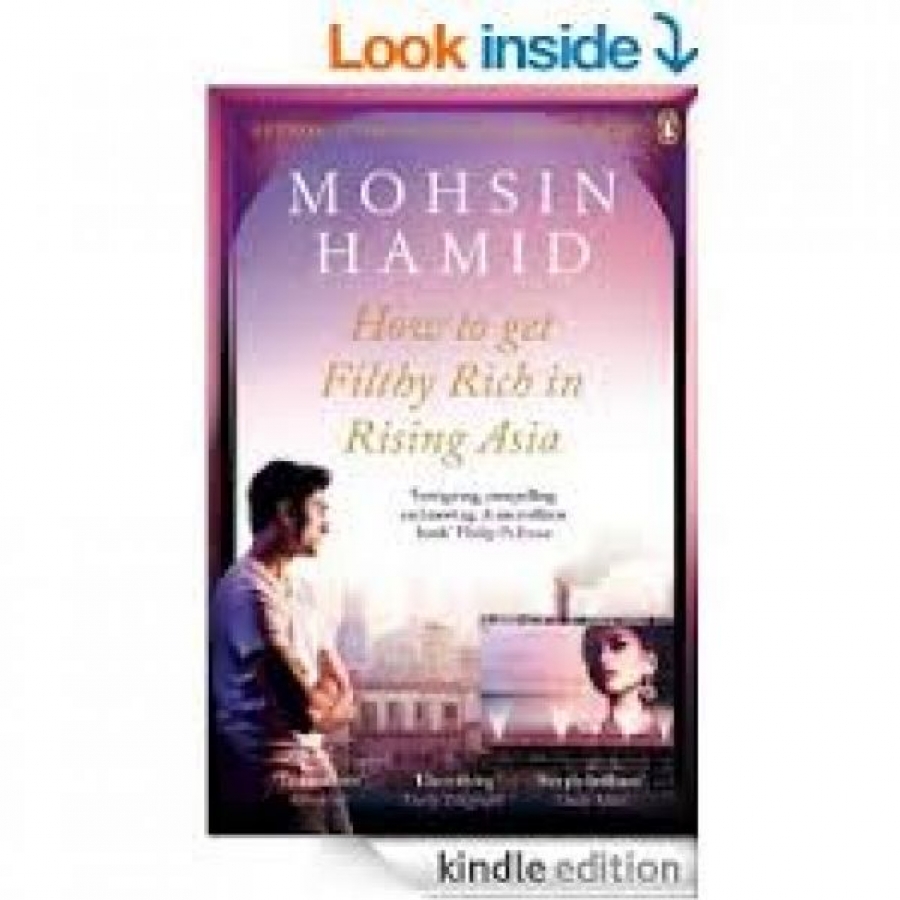
How to Get Filthy Rich in Rising Asia
AI Translation Notice: This review was translated from the original Italian using artificial intelligence. Book quotes and excerpts are translated interpretations and will not match the author's original English phrasing or official published translations.
The novel presents itself in the form of a manual.
The author envisions teaching how to become rich in Asia, a continent in profound transformation.
Why persist in reading the much-lauded, yet so tedious, foreign novels...
if not out of a desire to understand those distant countries that, because of globalization, increasingly affect your life? What is this desire of yours, in its essence, if not a quest for self-learning?
.
The chapter titles and their sequence mirror the crucial stages of an ascent up the social ladder.
For each of which the author offers the proper instructions: leave the countryside and move to the city, get an education even at the expense of family members, avoid falling in love and pursuing ideals, learn the ropes of business from a master and then discard him without scruple, be prepared for violence, make deals with criminality, bribe bureaucrats and the military, resort to debt without fear.
Going into debt is a way for the small to become big, for the big to become enormous, a glorious abstraction, the promise of tomorrow today, yes, a liberation from time.....
going into debt is to be immortal
.
A splendid definition of rampant capitalism! In short, it takes a great deal of work, but one must also be ruthless, open to fraud.
It is equally true that at each of these stages there are alternatives.
Life is a constant fork in the road between what one has become and what one might have been.
For instance, one could have helped one’s parents and siblings more by giving up an education; one could have followed the girl one went on to love, vainly, for an entire lifetime; or one could have stayed closer to one’s wife and son so as not to lose them, not to let them become strangers.
A gently ironic and seemingly light style guides the reader along the protagonist’s peregrinations as he marches toward wealth with resolve yet with an inward sorrow, as if compelled by destiny, by an irresistible force.
This is Asia—tumultuous, violent, and ripe with opportunity: either play the game, or succumb.
Through the windows of your office you see your city altering around you, any urban zoning and planning constraints slipping away, deep foundations and skeletons of buildings occupying the land that just a few years ago an aerial photograph would have shown frothing with opulent baroque villas
.
As often happens, success is followed by a fall from grace—in this case, illness and bankruptcy.
The advice is to “focus on the fundamentals”: cut expenses, keep as low a profile as possible, accept defeat.
And so our protagonist does, and we expect a decline unto death, in utter solitude.
This does not happen, however, because our author provides an exit strategy—unhoped-for, if implausible.
Our protagonist meets the girl he loved in his youth, who in turn has attained success only to find herself sorrowfully alone.
The long-yearned-for love becomes reality in old age, and both realize that true happiness lies in giving oneself to the other, in wishing for the other “not to be alone.”
Is the whole thing then reduced to a fairy tale? On the other hand,
all of us are in flight from our childhoods.
And so we turn, among other things, to stories.
To write a story, to read a story, is to escape from our status as fugitives... there was a time when everything was possible.
And there will be a time when nothing is possible.
But in between, we can create
.
The novel is a fresco of one of many possible lives.
We could conceive of others, and thus it is fitting that the author offers us a happy and tender ending.
Why should it not be possible to imagine one?
Reading the book in English brings to light the distinctiveness of the writing—rich in uncommon vocabulary, though free of neologisms, and characterized by a complex syntactic structure, at times difficult to follow.
Mohsin is undoubtedly a refined writer, possessing a stylistic imprint all his own.
He ought, however, to return it to greater sobriety.
He, too, stands before a fork in the road.
Why read it? It is deeply enjoyable.