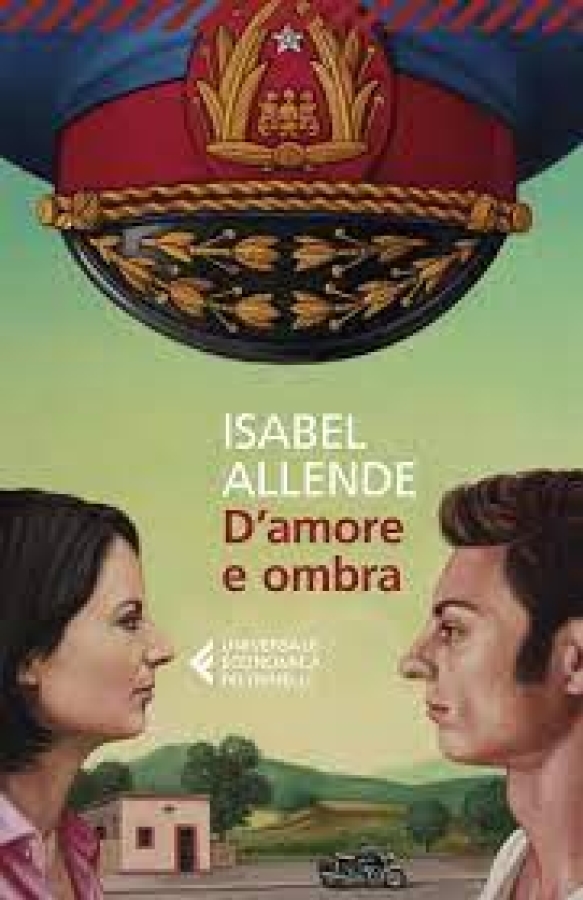
Of Love and Shadows
The novel is set in Chile, ten years after the coup d'état that brought Pinochet and the military junta to power, establishing a brutal dictatorship: Chile, > a spot on the map, immersed in a vast and prodigious continent where progress arrives centuries late, (...) a territory in whose eternal humus mythological animals drag themselves along and human beings live unchanged since the dawn of the world , where a gilded, powerful elite coexists with a marginalized, silent mass. Francisco belongs to a family that fled Spain following the rise of Francoism; he works as a photographer, commits himself to social causes, and covertly assists the flight into exile of the many persecuted by the military regime. And it is precisely while looking for work that he meets Irene: > with her strange mane of hair tousled over her shoulders, (...) she wore an overly long skirt of homespun fabric, an unbleached blouse, (...) with rings on every finger and a rattle of bronze and silver bracelets on her wrist, (...) with a coquettish smile, the final touch needed to conclude that this young woman could steal every thought of his, for he had seen her just as she was in his childhood readings and adolescent dreams. The young woman, however, belongs to that elite living sheltered behind "doors guarded until the curfew signal." Francisco senses that many things separate them, from social standing to family ties and culture; unwilling to jeopardize their friendship by confessing his feelings, he prefers that love "fill her gently, just as it had happened to him." An extraordinary event brings about a radical shift in their lives, especially Irene's. Word spreads that a girl possesses miraculous powers while in a trance, and crowds flock to seek miracles and help from her; the throng and curiosity provoke the military to intervene, but the young woman, endowed with prodigious strength in her state of ecstasy, hurls the officer—the arrogant and criminal Ramirez—into a pigsty, where he sinks into the filth before the stunned eyes of his soldiers, the onlookers, and a pig. It is an affront that cannot go unavenged; a few days later, the girl is taken away and vanishes into thin air. Irene refuses to accept the official accounts; she begins to investigate, thereby awakening to the reality in which she lives, and, at the same time, to her love for Francisco. Confronted with the bloated, unrecognizable corpses, in the horrifying discovery of a mine where the butchered bodies of the victims of military violence lie hidden, Irene does not resign herself; slowly yet inexorably, she reveals a character resolved to uncover and denounce the unspeakable horror of violence. Irene is no longer the eccentric, colorful scion of the haute bourgeoisie; the chrysalis has transformed into a pained, conscious fighter. The main narrative thread, the story of love and shadows between Francisco and Irene, is embedded within the choral tale of a people, an intricate weave of events, characters, situations, and contexts told in a fantastical, almost surreal atmosphere—both when capturing microcosms and when delving into violence, without coyness or subterfuge, but with stark clarity, compelling the reader to blanch just as Irene did. A muted sense of resignation pervades the work, as if Latin America could never be liberated from abuse and violence, leaving no alternative but flight, or losing oneself in the splendid landscapes, among the great peaks of the cordillera, or more simply in the explosion of clamor and color of the markets: > piles of seasonal fruit, peaches, melons, watermelons, (...) stalls of spurs, stirrups, saddles, and straw hats, rows of red and black crockery, cages of chickens and rabbits, amidst a hullabaloo of shouts and haggling . The prose flows smoothly, with that narrative rhythm rich in asides and digressions so characteristic of South American literature; at times one loses one's way, and it perhaps becomes somewhat trite in the second half, lingering too long, yet it remains consistently engaging and evocative. Why read it? It confronts violence through the lens of love.
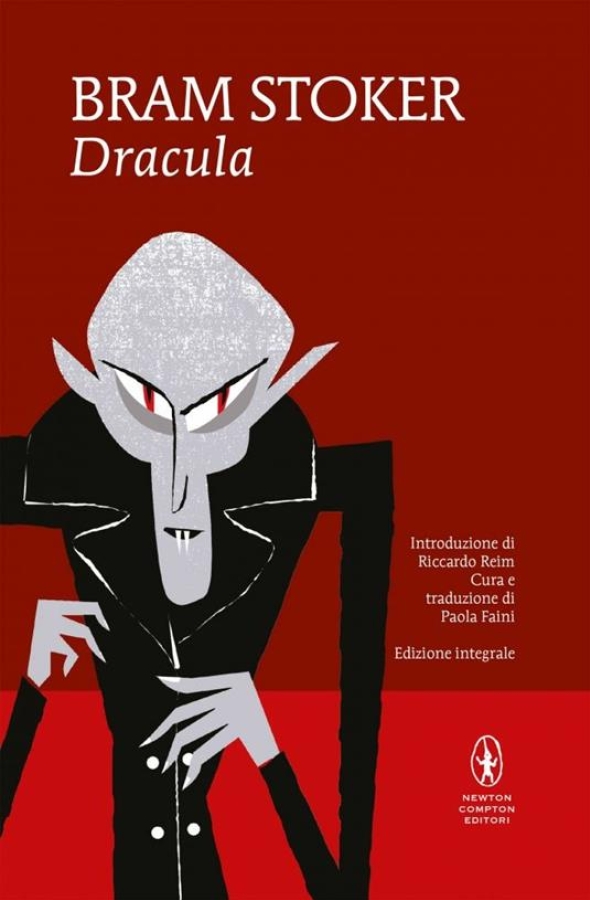
Dracula
The figure of Dracula has spawned a literary and cinematographic output that has exalted its horrific aspects, thereby distorting the complexity of Stoker's novel. The opening of the narrative reflects the preconceived notion we have of Dracula’s story. Jonathan Harker, a young real estate solicitor, travels to the Carpathians to conclude the sale of a property to Count Dracula, who intends to move to London. Much like in Conrad’s *Heart of Darkness*, the journey through these largely uncharted mountains is an immersion into the unknown of the human consciousness—one that the young Jonathan struggles to accept. One need only consider the physiognomic description, so dear to nineteenth-century anthropologists, of Dracula’s face: > had a very marked, very marked, aquiline face, with a thin and prominently protruding nose and particularly arched nostrils. (...) The eyebrows were exceptionally massive, almost meeting over the nose.(...) The mouth, so far as I could see it under the heavy moustache, was fixed and rather cruel-looking, with peculiarly sharp white teeth . With mounting dread, young Jonathan realizes he is caught in a nightmare, trapped inside a castle where he is a prisoner and could fall prey to the bloodlust of Dracula and four female vampires. Jonathan miraculously manages to escape (it is not clear how, and narrative gaps of this sort are frequent throughout the novel). The narrative then shifts to England with an opening reminiscent of Jane Austen. Mina, Jonathan’s bride-to-be, meets Lucy, who "looked sweeter and lovelier than ever": what follows is an idyllic description of the English countryside. The reader is initially taken aback, but then Stoker deftly prepares us for Dracula’s arrival aboard a phantom schooner and the transformation of the charming Lucy. It is difficult to fathom what is taking place; it is something inexplicable to a mindset steeped in scientism and rationalism. The mystery will be unraveled by a Dutch scientist summoned to the rescue by one of his disciples, a psychiatrist and friend of Lucy’s. Slowly yet stubbornly, the professor realizes that Count Dracula requires blood to secure his immortality and has come to London to create new vampires, thereby conquering the world. The professor also discerns the weaknesses of Dracula and vampires in general: their power exists only by night, by day they lie in a coffin, and they recoil before the Cross and the Host. To rid oneself of vampires, one must drive a stake through their heart and decapitate them. The group attempts to save Lucy. In a dramatic scene that alone justifies reading the book, Lucy—clutching at night a child whose blood she has drained—seeks refuge in her tomb, not before attempting to seduce her fiancé in order to turn him into a vampire as well. It will fall to the professor to stop her, and to the fiancé—at first incredulous, then devastated—to pierce her heart, thereby saving the girl's soul. The message is unmistakable: true love demands an extreme act, and what ultimately matters is the spirit, the Good that must be shielded from Evil. From this moment on, it becomes an all-out battle between the cohesive band of friends, led by the professor, and Count Dracula. The protagonist of this clash is Mina, Jonathan’s wife, who also falls prey to Dracula and runs the risk of becoming a vampire like her friend. It will be Mina’s determination, coupled with her resolute rational vision, that guides the group to their foregone victory—for now. The novel is read in a single breath; the episodes follow one another at a pace that is not always relentless, interspersed as they are by lengthy disquisitions from the professor—a pivotal figure in the plot, yet far too predictable in his erudition. The reader remains captivated by the gloomy atmosphere and by the secondary characters who are, in truth, central to the narrative, Mina in particular. As the story unfolds, Dracula recedes ever further into the background: a terrifying monster, yet "childish" in his reasoning and thus easily predictable in his conduct (notwithstanding everything, we Europeans remain superior from an ethical and rational standpoint). One can identify three narrative strands: the Gothic imprint typical of the nineteenth-century English novel, with its penchant for the exotic, the mysterious, and the gory; the reflection on a science that must stand ready to accept the incomprehensible and reckon with religion; and finally, friendship and love, seen not merely through a romantic lens, but as forces capable of driving human beings to fight and sacrifice themselves. Mention must be made of the narrative structure. It is built upon the accounts of the various protagonists through diaries and letters. The narrative 'I' shifts continuously, thus affording insight into different perspectives: the psychiatrist friend who can scarcely believe what is occurring and, for much of the novel, accepts events out of deference to the professor; Jonathan, who manages to leave a record of his journey into the Carpathians and subsequently expresses his love for Mina by keeping her vampiric impulses in check, preparing himself for the ultimate sacrifice—namely, driving a stake through her heart; and finally Mina, who fights desperately to avoid turning into a vampire, aiding the group by accepting a subordinate female role (she types up her husband's journals to make them available to the circle), ever anxious not to become an unwitting conduit of information for Dracula. Mina’s reasoning is subtle (astounding for a woman, remarks the professor!): she weighs the various alternative routes Dracula might take to return to his castle to find sanctuary; in doing so, she anticipates the monster’s moves—a splendid display of strategic thinking! As so often happens, multi-authored narration bogs down the narrative momentum, rendering it at times repetitive and redundant. Why read it? Compelling and evocative.
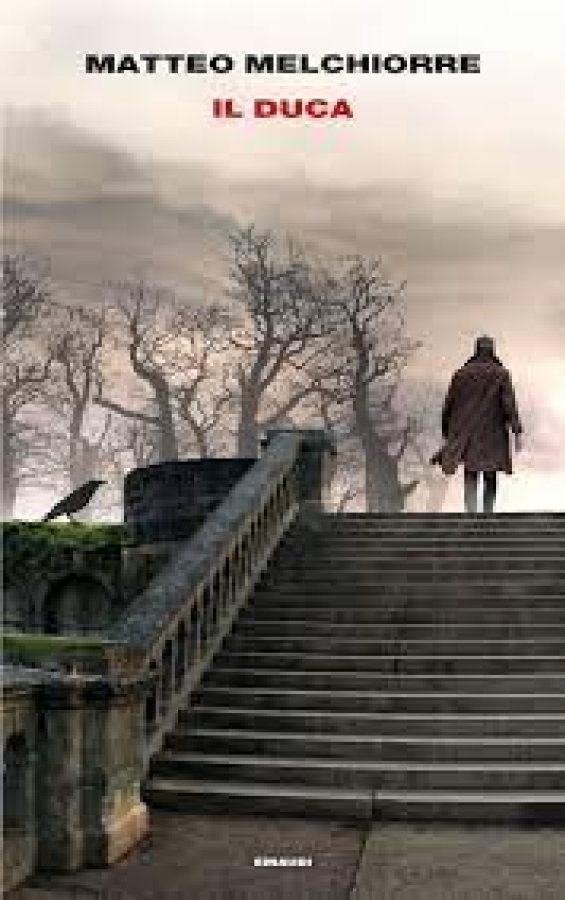
The Duke
> For ten years now I had been living up here in Vallorgàna alone, in the villa of my ancestors. (...) I was certain that I found myself in the best fortune I could desire. Nothing of importance occurred in my days. Nothing complex entangled my gaze. No disruption in daily life. No decision to hinder my stride . Such is the opening of the tale of the man we will come to know only as the Duke. Heir to an ancient noble family, the Cimamonte counts, the Duke belongs to the culture of the few, > that of those who, by means and tradition, live in a world of thoughts from which the majority are excluded . The Duke lives, or would like to live, on an island, formed by his villa and Vallorgàna. Two events intervene to shatter this "terrifying" isolation. Mario Fastrèda, the acknowledged head of the small community, has the trees cut down in a woodland owned by the Duke; it is a petty transgression, one that could be let pass, were it not that the Duke discovers an ancient codex recounting the history of the Cimamontes. Reading the deeds of his ancestors, the chronicle of Cimamonte abuse and violence, he realizes that the feuds were "fatuous and pretentious," yet for a nobleman they were instead "duties of respect," worthy of the utmost attention. And it is as if a dragon, dormant for centuries, > were rising up from the earth, from roots stretching taut, from rubble crumbling, from crusts breaking apart . A war begins between the Duke and Fastrèda; it is dictated by "a profound past, (...) the fruit of the ancient order of above and below." For page after page, the author retraces the events of this senseless feud, incomprehensible from a rational point of view, yet rooted in ancestral hatred. It is the setting that lends fascination to the story: the Mountain towering over the village like a sacred monolith, the woods, looming and menacing, advancing at the expense of the meadows, the small community, growing ever older and desperately anchored to traditions, grudges, and legends, and finally mysterious, ancient omens, such as the flight of a white-winged crow. We are not before Dino Buzzati's magical forest (see *Il segreto del bosco vecchio* reviewed on this site); Melchiorre is a historian of trees and of their land, and he knows full well that it is not true that "woods and mountains are a mirror of virtue," as naive naturalistic mythology would have it. Fortunately, the narrative of the feud is interrupted by Maria; against hatred, love supervenes. "It was an enchantment of an extraordinarily physical nature, entirely directed toward the body:" sweeping and utterly distinct, untamed, mercurial, irreverent, and with something, moreover, inexplicably wild." But Maria is the niece of Fastrèda, the enemy. The autumn wind, "dancing and whispering, showed me in its mirror shreds of myself and fragments of other things, and finally, embracing a beech stump, delivered a lash and began to whisper more insistently. It asked me whether I wanted to lose Maria or keep her. (...) Whether I was intoxicated by her body alone or whether in her I had grasped the inexpressible > . It is a dilemma that the Duke would probably not have been able to resolve on his own. First, a violent storm drives him from Vallorgàna, instilling in him a disillusionment with the past, the looming history of his ancestors; he no longer wishes to return to the village, he wishes to abandon the villa to ruin. He returns to take inventory of the things to be sold, encounters Maria, and through her brown eyes discovers this rare and yet raw and yet enclosed place, which can open only by braving steep slopes and ascents, skirting cliffs of woods.... > He realizes he belongs to Vallorgàna not by the will of his ancestors, but because this is his place, whose history towers over and transcends that of individuals. When he tells Maria, the alluring Maria replies: perhaps > . But why so much agonizing? Was it not enough to tell her that he was staying because he loved her? Estrangement, fury, love, disenchantment, and enchantment are the cadences of a great novel, unfolding within a confined setting over which looms the history of men and nature—a history that from remote past "continually risks becoming" present past." In the end, it will be the present that triumphs, but this long-awaited conclusion is reached only after many pages, numerous philosophical reflections, and frequent digressions. The plot loses momentum; at times it resembles a *zibaldone* in which the author sought to say too much about his own world at the expense of the narrative and the characters. What makes reading it a pleasure is the prose, rich in adjectives that never hinder the fluid cadence of the words, offering instead an enjoyable sense of the baroque. Why read it? Enjoyable, captivating, even if long.