Bram Stoker
Books by this author (1)
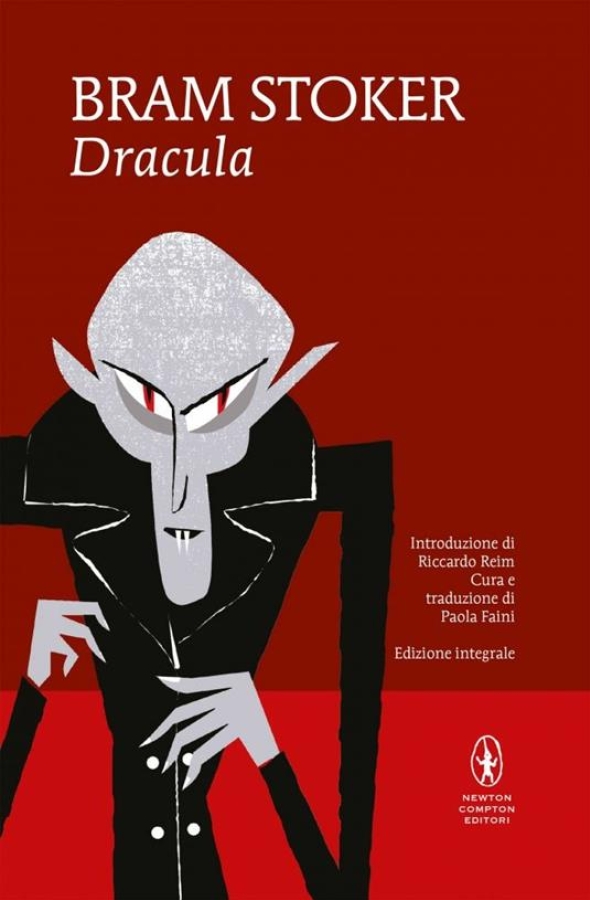
Dracula
The figure of Dracula has spawned a literary and cinematographic output that has exalted its horrific aspects, thereby distorting the complexity of Stoker's novel. The opening of the narrative reflects the preconceived notion we have of Dracula’s story. Jonathan Harker, a young real estate solicitor, travels to the Carpathians to conclude the sale of a property to Count Dracula, who intends to move to London. Much like in Conrad’s *Heart of Darkness*, the journey through these largely uncharted mountains is an immersion into the unknown of the human consciousness—one that the young Jonathan struggles to accept. One need only consider the physiognomic description, so dear to nineteenth-century anthropologists, of Dracula’s face: > had a very marked, very marked, aquiline face, with a thin and prominently protruding nose and particularly arched nostrils. (...) The eyebrows were exceptionally massive, almost meeting over the nose.(...) The mouth, so far as I could see it under the heavy moustache, was fixed and rather cruel-looking, with peculiarly sharp white teeth . With mounting dread, young Jonathan realizes he is caught in a nightmare, trapped inside a castle where he is a prisoner and could fall prey to the bloodlust of Dracula and four female vampires. Jonathan miraculously manages to escape (it is not clear how, and narrative gaps of this sort are frequent throughout the novel). The narrative then shifts to England with an opening reminiscent of Jane Austen. Mina, Jonathan’s bride-to-be, meets Lucy, who "looked sweeter and lovelier than ever": what follows is an idyllic description of the English countryside. The reader is initially taken aback, but then Stoker deftly prepares us for Dracula’s arrival aboard a phantom schooner and the transformation of the charming Lucy. It is difficult to fathom what is taking place; it is something inexplicable to a mindset steeped in scientism and rationalism. The mystery will be unraveled by a Dutch scientist summoned to the rescue by one of his disciples, a psychiatrist and friend of Lucy’s. Slowly yet stubbornly, the professor realizes that Count Dracula requires blood to secure his immortality and has come to London to create new vampires, thereby conquering the world. The professor also discerns the weaknesses of Dracula and vampires in general: their power exists only by night, by day they lie in a coffin, and they recoil before the Cross and the Host. To rid oneself of vampires, one must drive a stake through their heart and decapitate them. The group attempts to save Lucy. In a dramatic scene that alone justifies reading the book, Lucy—clutching at night a child whose blood she has drained—seeks refuge in her tomb, not before attempting to seduce her fiancé in order to turn him into a vampire as well. It will fall to the professor to stop her, and to the fiancé—at first incredulous, then devastated—to pierce her heart, thereby saving the girl's soul. The message is unmistakable: true love demands an extreme act, and what ultimately matters is the spirit, the Good that must be shielded from Evil. From this moment on, it becomes an all-out battle between the cohesive band of friends, led by the professor, and Count Dracula. The protagonist of this clash is Mina, Jonathan’s wife, who also falls prey to Dracula and runs the risk of becoming a vampire like her friend. It will be Mina’s determination, coupled with her resolute rational vision, that guides the group to their foregone victory—for now. The novel is read in a single breath; the episodes follow one another at a pace that is not always relentless, interspersed as they are by lengthy disquisitions from the professor—a pivotal figure in the plot, yet far too predictable in his erudition. The reader remains captivated by the gloomy atmosphere and by the secondary characters who are, in truth, central to the narrative, Mina in particular. As the story unfolds, Dracula recedes ever further into the background: a terrifying monster, yet "childish" in his reasoning and thus easily predictable in his conduct (notwithstanding everything, we Europeans remain superior from an ethical and rational standpoint). One can identify three narrative strands: the Gothic imprint typical of the nineteenth-century English novel, with its penchant for the exotic, the mysterious, and the gory; the reflection on a science that must stand ready to accept the incomprehensible and reckon with religion; and finally, friendship and love, seen not merely through a romantic lens, but as forces capable of driving human beings to fight and sacrifice themselves. Mention must be made of the narrative structure. It is built upon the accounts of the various protagonists through diaries and letters. The narrative 'I' shifts continuously, thus affording insight into different perspectives: the psychiatrist friend who can scarcely believe what is occurring and, for much of the novel, accepts events out of deference to the professor; Jonathan, who manages to leave a record of his journey into the Carpathians and subsequently expresses his love for Mina by keeping her vampiric impulses in check, preparing himself for the ultimate sacrifice—namely, driving a stake through her heart; and finally Mina, who fights desperately to avoid turning into a vampire, aiding the group by accepting a subordinate female role (she types up her husband's journals to make them available to the circle), ever anxious not to become an unwitting conduit of information for Dracula. Mina’s reasoning is subtle (astounding for a woman, remarks the professor!): she weighs the various alternative routes Dracula might take to return to his castle to find sanctuary; in doing so, she anticipates the monster’s moves—a splendid display of strategic thinking! As so often happens, multi-authored narration bogs down the narrative momentum, rendering it at times repetitive and redundant. Why read it? Compelling and evocative.