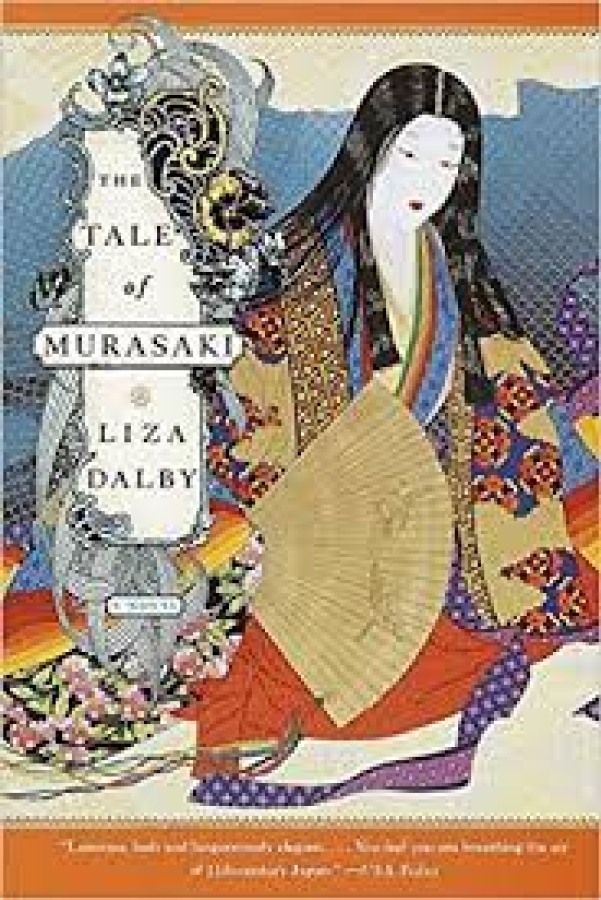
The Tale of Murasaki (the story of Murasaki)
As Wikipedia notes, Murasaki Shikibu (973–1014) was a Japanese poet renowned for the epic *The Tale of Genji*, likely written around the year 1000 when she served as a lady-in-waiting. Murasaki (Japanese for violet) is the name of the novel's female protagonist—a name also attributed to the poet herself, as her real name remains unknown. *The Tale of Genji* quickly achieved widespread circulation, turning Murasaki into an icon celebrated as the founder of the Japanese language, elevating it at last to the same rank as dominant Chinese literature: in short, Murasaki can be regarded as a kind of Japanese Dante. Attesting to Murasaki’s popular renown, legend has it that she began composing the work while in ecstasy before the full moon and, seized by frenzy, wrote on the backs of sutras (sacred texts of Japanese Buddhism)—a transgression that consigned her to hell. In her fictionalized biography, Liza Dalby retraces Murasaki's life: her youth and the study of Chinese despite women's exclusion from literary education (when her father praised his daughter to his friends, they pointed out it was time she married), her first sonnets with the invention of Genji, her stay in Echizen, where she finally came into contact with Chinese sailors, merchants, and diplomats, her marriage to an important imperial court official, her widowhood and role as lady-in-waiting to the empress, and ultimately her retirement to a Buddhist monastery. For those of us who know little of ancient Japan, the novel is of great historical interest: the economic and cultural relations with China; an approach to nature intent on capturing its "heart," transcending the naturalistic perspective of Chinese literature; the meticulous description of Japanese women’s varied, elaborate dress (the attention to colors and fabrics is astonishing); and the power struggles within the Imperial Court. Beyond these many impressions, the author addresses a central question through Murasaki: is "honest poetry" possible, as Umberto Saba phrased it? Is coherence between life and literature achievable? At the opening of the diary imagined by Dalby, Murasaki states that > life alone has never been quite enough. It becomes real to me only when I enrich it in stories. Yet somehow, despite everything I have written, the true nature of the things I sought to grasp in my novel still manages to slip between the words and lie, like little piles of dust, between the lines . It is an awareness the poet has held since her youth as a woman of letters, but one that finds dramatic confirmation as Murasaki accepts the painful destiny of women. Genji is a romantic figure, feminine and masculine all at once, to whom a woman can entrust herself completely, with trust and assurance. > Genji was meant to put an end to the draft of ill will that generally destroys relationships between men and women . It is a fantasy, devised to alleviate her own melancholy and that of her friends. Their choices immediately confront her with the contradiction between life and literature: the first friend marries an elderly official and her adolescent dreams dissolve into a drab solitude; the second kills herself rather than meet the same fate; the third, with whom Murasaki shares an intense intimate relationship, resolves to retreat into a monastery. The dream is shattered once and for all when Murasaki is raped. > I was vexed by how little literature prepares us for real life. (...) Uncertain whether it happened or not, sadly fading away, I scarcely noticed the laughing morning flowers . She could retire to a monastery like her friend, but ambitious and presumptuous, she remains convinced she can master her own destiny. Already acclaimed for her novel, she enters the imperial palace as a lady-in-waiting. > There was a dark side to that place. At times it reminded me of one of those monstrously large spiderwebs I had seen in Echizen . She becomes the mistress of the Regent, who uses her as a brilliant court chronicler and possesses none of Genji’s gentleness. She allows herself to become entangled in power struggles, in the rivalries and slander that permeate the women's quarters, and in the sexual harassment from men to which the court ladies must resign themselves. > I felt like the caterpillar that stays hidden in the shade, slowly digesting experiences in order to turn them into something else. (...) I could not deny that Michinaga (the Regent) had slowly influenced Genji's character, but it was not because of anything he had done directly. Genji had changed on his own. If he had become a bit coarse, well, that is what happens when one moves in the world. (...) I had come to the conclusion that my character Murasaki had outlived her usefulness. I had created a woman so perfect that there was nothing left for her to do but die. It took a long time to realize that I needed to sacrifice her to move forward. And it took me even longer before I realized that the problem did not lie with Murasaki, but with Genji. (...) The spider thrives, lost among the barren reeds glistening with frost, unable to foresee when it will weave its web anew . In the first part of the novel, before Murasaki enters the imperial palace, one has the impression that the author is writing about a Jane Austen heroine: resolute, independent, even within the confines of society. Then, slowly, that vitality withers, resignation sets in, and Murasaki bends, submitting to the power of men. The author's focus shifts to the context; the narrative becomes granular and repetitive, losing its rhythm, as if the writer were unable—or unwilling—to plumb the depths of Murasaki's soul. It is true that the poet often returns home to rest and concentrate on her work, but why does she agree to let herself be trapped once more: was it not possible that she was enticed by the allure of power, by the bewitching charm of the Regent? These are questions that would have been intriguing to answer. I have one: the pursuit of glory. The prose is elegant, refined, lexically rich within a linear syntax. The inclusion of short poems, in Japanese and English, evokes the romantic and sophisticated atmosphere of the Japanese literary world, of Murasaki, and of Dalby herself: the sonnets possess a distinctive beauty and resonance. It is regrettable that in the second part the narrative loses momentum and becomes verbose and tedious. Why read it? Historically interesting; Murasaki's figure is captivating.

Taras Bulba
For those of us who have dreamt of the battles and heroes of the *Iliad*, Gogol’s *Taras Bulba* recalls the great Homeric epic (see review on this site). There is a warrior people, the Cossacks, who arose from the “ancient, peaceful Slavic spirit” like a “burst of flame,” > an extraordinary manifestation of Russian strength, struck by the flint of misfortune from the breast of the nation. In place of the ancient principalities, of tiny towns filled with dog-breeders and hunters, in place of petty lords who feuded and traded with those towns, there arose formidable settlements, military units, entrenched camps, bound by the common tie of danger and hatred for infidel predators , the Ottoman no less than the Catholic Pole. Then there is a city that, like Troy, resists the Cossack siege, and there is Agamemnon with Achilles and Hector: namely, Taras and his sons, Ostap and Andriy. With superb brushstrokes, Gogol delineates their characters. > Taras was one of the genuine old colonels. (...) He loved the simple Cossack life. (...) Perpetually restless, he regarded himself as the legitimate defender of Orthodoxy. (...) Ostap was considered one of the finest comrades. (...) He was slow to yield to impulses other than those of struggle or a raucous, unbridled carouse. (...) Andriy too burned with the thirst to distinguish himself in feats of war, yet his soul was accessible to other feelings. (...) The image of woman began ever more frequently to rise in his ardent imagination , all the more so after he had met a young Polish noblewoman in Kyiv. In the background there are not merely military encampments, collective drinking bouts, looting, and combat; Gogol also sings of the Ukrainian plain, whose nature > had no beauty that could rival it; the entire surface of the earth appeared as a green-gold ocean, upon which millions of colorful flowers had burst forth. (...) Motionless, high in the sky, sparrowhawks hovered with wings outspread and eyes fixed upon the grass. The cry of a passing flock of wild geese echoed from who knows what distant lake. In an atmosphere at once epic and lyrical, the tragic events of Taras and his sons unfold, a sort of metaphor for the fate of the Cossacks, who would vanish from history under tsarist rule. Enamored of the beautiful Polish woman, Andriy betrays his comrades, but Taras is no Priam. > To betray like this? To betray the faith? To betray your comrades? cries Taras upon confronting Andriy, > stand there still and do not move! I gave you life, and I will kill you!. Overwhelmed by the Polish army, the Cossacks succumb; Ostap is sent to the scaffold. In the face of death the young man cries out, as if seeking one last aid from his father. > Father, where are you? Do you hear all this?, I hear it, was heard in the general silence, and in that same instant thousands of men shuddered. The voice of Taras is lost in nothingness, in death, while the great river flows between many inlets and sandbars, > the resonant cry of the swan echoes over it, and the proud wild duck darts swiftly across. Whoever has read the review up to this point may wonder what we are speaking of: who were these Cossacks? Whoever is interested in knowing may search the web; here it suffices to say that we are speaking of a history far removed in time and space, almost a legend. The events recounted by Gogol concern seventeenth-century Ukraine; yet *Taras Bulba* also speaks to our present day. Gogol is the bard of a people desperately yearning to be free, thus becoming the herald of all peoples fighting for their land and their destiny. Let us read his words, ringing with social grief, then as now, beneath manifold acts of violence and oppression. > There will be, there will be a bandura player with a gray beard spread across his chest; he may still be virilely human, aged only by his hoary head. (...) Thus their fame will spread high across the entire land, and all who are born thereafter into the light of the world shall speak of them, for the mighty voice of the singer reaches far, (...) calling all men without distinction to holy prayer. Gogol is renowned for an unfinished novel, *Dead Souls* (see review on this site), in which, with grotesque comedic tone and remarkable psychological subtlety, the author depicts provincial Russia—a sort of aimless reportage, devoid of moral designs, with no other interest than capturing the flow of life in all its immediacy. The contrast in style and motifs with *Taras Bulba* is striking: in the latter, the characters belong to a choral narrative, nearly prisoners of their tragic destiny, while a people and a land stand at the center of the writing—writing that seems to echo great epics, like Dante's own *Comedy*; for instance, in the similes Gogol employs, drawing on episodes of daily life to describe death on the battlefield. A Cossack is mortally pierced by a lance, > in streams gushed his young blood, like rich wine that careless servants brought up in a glass vessel from the cellar; (...) the master, rushing in at the noise, clutches his head in despair; he had saved that wine for a joyous hour of his life, (...) that he might recall (...) the past, another time when men took their pleasure differently and better. Why read it? A powerful book, a hymn to freedom.
All Our Secrets
According to verse 41 of Surah XXIX of the Quran, the house of those who do not follow Allah is as fragile as a spider’s web ( > those who have taken protectors other than Allah are like the spider that takes a house. But the frailest of all houses is the house of the spider. If only they knew! ). Huseyin and Emine have always strictly observed moral codes and fulfilled their duties, yet this did not prevent their family from disintegrating. After years of relentless labor in Germany, Huseyin bought an apartment in Istanbul, and just as he is ready to welcome his family, he dies of a heart attack. > Just one week, to stroll with them along the seafront, to offer your children a glass of çay, to take your daughter’s hand and tell her how much you love her, to tell your sons that you are proud of them, to call Sevda and ask her for forgiveness. If Huseyin is able to die still believing he was loved and respected (in his own eyes, he was a righteous and good father and husband!), his wife Emine will have to face her own faults mercilessly, after the author recounts the stories of their four children. > The phone call came in the middle of the night. A scream. At first, Umit could not tell whether that scream had come out of one of his dreams, which lately had been waking him continuously with a lump in his throat. Umit, still an adolescent, has just realized that he is in love with a boy his age, and his psychoanalysis sessions have unveiled the dark undercurrents of an outwardly serene family. > And then suddenly, almost out of nowhere, you start talking about when you used to wet the bed, (...) and then about those ugly, hushed quarrels between your parents, (...) the endless murmuring of your mother trying to calm herself by reciting surahs from the Quran, which terrifies you. Sevda, who arrived in Germany only at thirteen and never attended school, was forced into marriage while still an adolescent; when she returns to her parents wishing to separate, her father’s words are categorical: > “You’d better go back to Ihsan, Sevda.” “But I don’t want to.” (...) “He is coming to pick you up tomorrow.” These were the last words Sevda ever exchanged with her father. Peri is the daughter who went to university, the pride of her parents even though they do not understand her. And after all, how could they understand a daughter who studies Nietzsche and has met a peculiar Kurdish boy, Ciwan, to whom she manages to confess that within her family > a crack has formed somewhere and now it is shrouded in silence , as if there were secrets they refuse to reveal, that her parents keep bottled up inside, beginning with their language, Kurdish, which only they are permitted to speak. And the eldest son, Hakan: why does he decide to drive to Istanbul? Perhaps he does not wish to attend the funeral of the father he still resents for forbidding him from attending a film audition? > Hakan never had an opportunity, and now he gets by as best he can. The stories bring us to the novel’s final chapter, in which, during a dramatic confrontation between Sevda and her mother, the secrets of this family—seemingly so flawless under the guidance of Allah—are laid bare: it is a kind of catharsis where the voice within us, our conscience, demystifies all the rules that loom over us, the representations we construct of ourselves, to finally make us understand who we are. > You ask who I am? It doesn’t matter, Emine. The real question is who you are. Because I am only a part of you. Emine. I am the chasm between your faith and your deeds. I am the contrast between the image you have of yourself and the face you show to others. I am the gap between what you deem right and wrong, the fine crack in your morality, the rift between who you are and who you ought to be. And in the apartment where you thought you would live out your remaining years, rediscovering your love for Huseyin—an apartment now reduced to rubble by the earthquake—you imagine, Emine, opening the door. > your heart exults. You say: Ciwan. Even the greatest mystery of your life, your gravest fault, is unveiled, > and you will be able to forgive yourself. It would be reductive to read the novel solely through its social and anthropological lens: a Kurdish-Turkish family that emigrated to Germany, the outcome of an intertwining of stories, cultures, languages, and rifts hard to heal. Across all the characters, even the most educated and integrated like Peri, lingers the sense of being outsiders, people who could be cast out at any moment; all the more so because their Kurdish origins, carefully concealed by the parents, render them potential foreigners or even enemies within Turkey itself. All of this is certainly present; yet to appreciate the novel one must aim higher, looking to the unsaid within every family, to the difficulty of communication between parents and children, to the elders’ presumption to chart their offspring’s destiny, to the fact that home is as fragile as a spider’s web and cannot be saved by relying on God, moral strictures, money, and consumerism. The family must be > the place where you will always forgive one another. Because only forgiveness can alleviate our loneliness. Because only if you forgive will you be forgiven in return , thus speaks conscience to Emine. The novel is structured into chapters that correspond to the story of each protagonist. At first, the reader is disoriented, mistaking them for simple character sketches linked only by the fact that the figures belong to the same family. Only at the end does one realize there is a common thread, revolving around a tragedy of abandonment and rejection. The plot does not always sustain the same narrative momentum, particularly in the chapter devoted to Hakan, which feels somewhat trite and out of tune. The prose is forged from taut dialogue and psychological insight, at times remarkably effective, particularly in the narration of Sevda, undeniably a central figure. Notable is the shift from the third-person narrator to the second-person “you,” skillfully employed whenever the author addresses Emine and Huseyin—a literary device that evokes a blend of accusation and understanding, yet always maintains emotional proximity to these two tragic figures. Why read it? A truly fine work, bordering on a masterpiece.