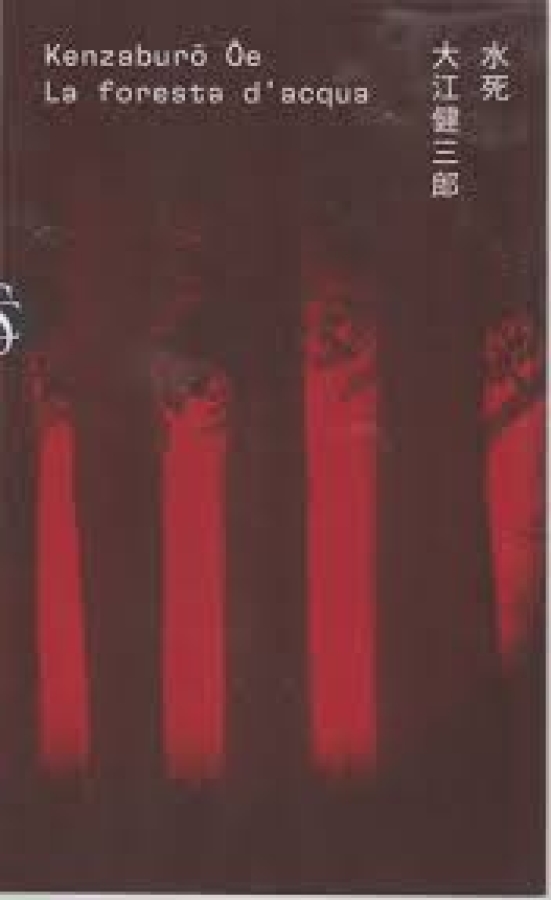
The Water Forest
A renowned septuagenarian writer, Choko Kogito, returns to his childhood home to examine the suitcase where documents said to reveal the reasons behind his father's suicide are supposedly hidden. We find ourselves in a forest on the banks of the waters where his father drowned on a stormy evening. Choko visits the memorial commissioned by his mother to commemorate the tragic event. > A large, rounded stone protruded from the bare earth, resembling a fragment of a meteorite. When I drew closer and tried to get a better look -- it also bore a likeness to a strange, sea-green cluster of vegetation -- I noticed that it carried an inscription of merely five lines. (...) > You did not prepare Kogii to climb into the forest/ And as though caught by the river's current you will never return./ In Tokyo during the dry season/ Memories surface in my mind in reverse/ From old age back to the years of childhood . The first two lines were written by his mother, urging Choko to prepare for death, but also to ready his son—her grandson, burdened with a severe disability—for the end of life. This is an initial leitmotif running through the entire novel: the contemplation of Death, the desperate clinging to life that manifests as the > lack of the courage needed to attempt writing his "final work" and upend his entire oeuvre. The remaining lines, composed by the writer himself, signal the other theme, likewise characteristic of old age: journeying back to the years of childhood, confronting the figure of the father, interrogating the manifold facets of Memory. Other novels come to mind, such as Salvatore Satta’s *The Day of Judgment* or Christine Dwyer Hickey’s splendid *The Cold Eye of Heaven* (see the reviews on this site). Kenzaburo does not wish to write an "I-novel," where the subject stands at the very center of the narrative, ceaselessly speaking of himself, reducing setting, events, and other people to a mere "mirroring ego." To avoid lapsing into the narcissistic ego so pervasive in our time, Kenzaburo resorts to accounts related by others and to theatrical representations, casting the writer as an astonished, admiring spectator. As in Dante, the protagonist-narrator remains in the background, overshadowed by characters and events. This preamble sidelines the plot, which nevertheless exists and will burst forth toward the end of the novel. Choko wants to recount his father's drowning, which he witnessed helplessly as a child. Why did his father kill himself? And why did Kogii, the imaginary friend, lure him toward the waters? What does memory hold? At first, everything seems distinct; then, everything blurs and vanishes between imagination and reality. > All at once I saw dozens of silvery dace before me, (...) and beneath that school of fish, enveloped in the silt of the dark riverbed, I had the distinct impression of catching sight of a large, naked body.... my father! His character gently floated, cradled by the underwater current. And there I was, watching him, trying to mimic his movements. (...) I took an index card and wrote: "I love my father desperately." The suitcase contains no clues to decipher his father’s suicide; Choko sinks into depression, withdraws into himself, mistreats his son, and might even kill himself. What saves him is a young actress, Unaiko, who involves him in the scriptwriting of an episode dating back to the mid-nineteenth century: a peasant revolt led by a woman, a rebellion bloodily suppressed, with the woman subjected to a gang rape before being executed. It seems an "innocuous" historical incident to commemorate, until Unaiko decides to declare during the performance that as a child she was repeatedly raped by her uncle, a powerful official, and that the entire matter was silenced. A scandal looms, the hypocrisy of Japanese society is laid bare, reality bursts onto the stage, and Choko is saved. It is difficult to summarize this complex novel in a review. Alongside the themes already noted, there are many others: the physical decline of the man and the writer, reminiscent of Thomas Mann's *Death in Venice* (see the review on this site); disability, and thus the burden of having a "different" child; the cathartic role of theater, which also enables the demystification of one of the seminal texts of modern Japanese literature, Natsume Sōseki's *The Heart of Things* [*Kokoro*] (review on this site); the magical allure of nature, a quintessential Japanese motif; and finally, the social and cultural transformations of contemporary Japan, still suspended between tradition and modernity. Many topics are present—perhaps too many. The reader presses forward, losing themselves in the meanders of the narrative, at once fascinated and fatigued. To his father, who was speaking to him of the *Great Dictionary of Chinese Characters*, the adolescent Kenzaburo Choko replied: > if all words are in a dictionary, then it will no longer be possible to find new ones, and there won't be any fun left! With an elegant, fluid style, drawing upon deft technical and stylistic devices, the writer explores numerous modes of expression, from epistolary exchanges to theater, from music to oneiric lyricism. It is a broad narrative keyboard (with a lexical one impossible to pin down), in which Kenzaburo indulges all too frequently, ultimately weighing down and protracting the tale, causing the central core to be lost from view. As the author himself observes, they seem like "fragments," as though the unity of Being were no longer attainable. Why read it? It is a stream of consciousness with an unobtrusive "I."
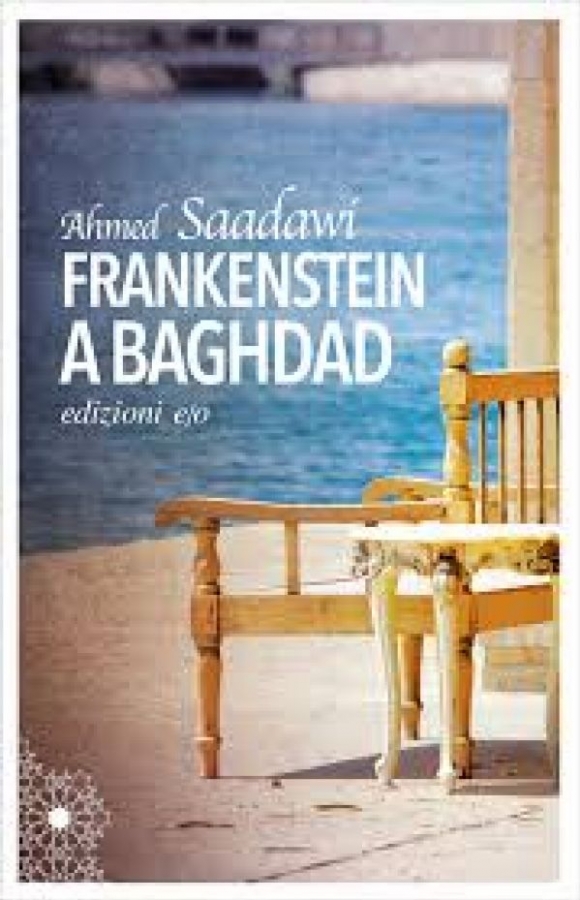
Frankenstein in Baghdad
An old junk dealer, a drunkard and charlatan, stitches together a corpse from the fragments of bodies torn apart by bombs—so frequent in Baghdad during the American occupation in 2005 and 2006. An old woman lives in contemplation of a painting of Saint George, who, in her eyes, has promised the return of her son, missing for twenty-five years in the Iran-Iraq War. Hasib, a young hotel security guard, is killed in an explosion triggered by a Sudanese suicide bomber. It is impossible to piece his body back together, and his family is left to weep over an empty coffin, as so often happens in Baghdad today. Yet the young man’s soul takes possession of the corpse reconstructed by the junk dealer, breathing new life into it. Is this the doing of Saint George, seeking by these means to fulfill the pledge made to the old woman, deceiving her for a greater good? Or > each member of the family dreamed something about Hasib, and those dreams, assembled and intertwined, contemplated one another, (...) giving birth to Hasib’s dream body. (...) And some of them went too far in their dreaming, pushing the tangled, compact skein of dreams with their own hands far away, farther than family, friends, relatives, and neighbors combined could have imagined, to a place that would never have crossed their minds ? Superstition, imagination, and lies are merely facets of history that one ultimately comes to believe, > forgetting that they were merely lies turned true at some point in the past . Be that as it may, a new being, dubbed the “Whatsitsname,” comes to life, stalking the streets of a Baghdad neighborhood; and we follow him along his trajectory: at first an avenger, determined to > mete out exemplary punishment, (...) for the innocents who have no support other than their own souls striving to defend themselves against death ; in the end a murderer, who kills simply to remain alive, replacing decaying parts (a hand, an eye, toes...) with fresh ones. > That was his only justification. He did not want to decompose and vanish. (...) This was why he clung to life, perhaps more than the others—those who surrendered theirs, their lives, and pieces of their bodies, just like that, out of fear . The Whatsitsname has much to tell; he harbors the memories of all who provided pieces of their bodies, yet the only person who listens to him is the old woman, who believes him to be the ghost of her lost son. Yet even she cannot comprehend him; she is weary, it is time for bed. > “Why don’t you rest, my son? Shall I lay out a small mattress for you in the courtyard?” she said, putting an end to his long, sprawling monologue. He felt he truly wanted (...) to lie down on the thin cotton mattress, gazing at the square of sky and counting the stars until falling asleep. But that life was not granted to him . Summarized thus, the novel might seem a cross between a macabre tale and a metaphysical parable, an allegory of today’s existential condition, in Iraq as elsewhere: the only way to reassemble one’s fragmented existence, both individual and collective, is to plunder parts from others, in an endless vicious circle that can sustain itself only through perpetual looting. Fortunately, around this main narrative thread unfold other subplots, leaving the reader unsure whether they are mere background color or the book’s true subject: the neighborhood life and its denizens; the tribulations of a brilliant young journalist ground down by the machineries of power, women, and easy money; a shadowy intelligence department that relies on astrologers and necromancers to divine the bombings that soak the city in blood and unmask their perpetrators; and finally the author himself, the accidental chronicler of a pervasive fear, of > an image that shifted and multiplied according to the number of heads resting on pillows in the night, anxious and alert . Numerous characters and diverse situations alternate and overlap, all rendered with an ironic and paradoxical touch, effectively turning the entire novel into a vast metaphor for power and for how > there are laws that operate only under specific circumstances, and when something occurs that obeys these laws, man is astounded and claims it to be an absurdity, a superstition, or, at best, a miracle . Delicate, elegant, light yet far from superficial, steeped in nostalgia and affection for Baghdad, the novel is near perfect; it lacks only narrative pace. The story unfolds slowly, fragmenting into too many episodes and characters, confusing the reader and depriving the work both of narrative surprises and of the psychological depth that would have lent substance to its protagonists. Why read it? It is an absorbing read despite confronting a harrowing reality.

Fire
The book is part of a series that explores social and civic issues through the lens of noir. In this case, the backdrop is the Camorra. Leonardo is a businessman colluding with organized crime. Seeking revenge for a slight, he attempts to kill someone under the protection of a powerful clan boss and is subsequently forced to go on the run, accompanied by his daughter, who remains entirely unaware of her father's true line of work. He takes temporary refuge in a holiday resort in Salento. In parallel, another story unfolds: Lu is a troubled youth sent by his father for a few days to stay with relatives, also in Salento, near the resort where Leonardo and his daughter are staying. A romance begins between Lu and the daughter, Cecilia. Meanwhile, in an effort to protect himself, Leonardo makes contact with another clan boss, a bitter enemy of the first mobster. As Leonardo sinks ever deeper into criminal complicity—to the extent of taking part in an arson attempt on a forest near the resort—Cecilia gradually comes to understand the true nature of her father, whom she had always believed to be an honest man. The Camorristi kidnap Leonardo and Cecilia, but Lu's intervention saves the girl, and love allows the young man to achieve an emotional balance he had previously lacked. The novel weaves together multiple themes: the crime narrative intertwined with the nexus between business and the Camorra, youth social alienation, parental absenteeism—parents perpetually consumed by their own problems and emotionally distant from their children—and the environment as an arena for the assertion of power (indeed, the motives for burning down a forest are inexplicable, save for those linked to prestige and organized crime’s pursuit of visibility). The narrative unfolds with a certain lightness, using irony without ever becoming heavy-handed. The result is an enjoyable, engaging read, further bolstered by an effective, fast-paced style. Why read it? It is a book that tackles crucial themes of social relevance in an accessible, engaging manner.