Finished reading on: February 21, 2016
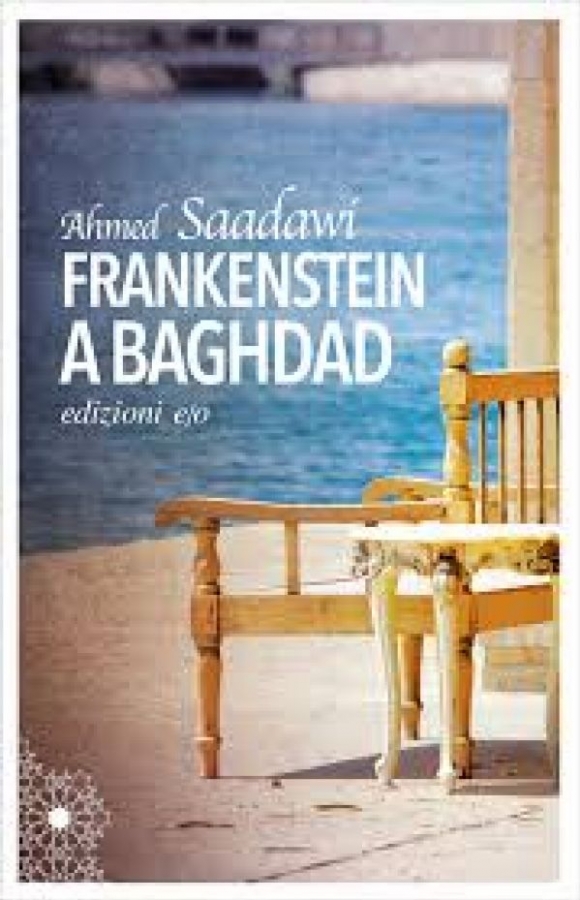
Frankenstein in Baghdad
Title of the original version reviewed: «Frankenstein a Baghdad»
AI Translation Notice: This review was translated from the original Italian using artificial intelligence. Book quotes and excerpts are translated interpretations and will not match the author's original English phrasing or official published translations.
An old junk dealer, a drunkard and charlatan, stitches together a corpse from the fragments of bodies torn apart by bombs—so frequent in Baghdad during the American occupation in 2005 and 2006.
An old woman lives in contemplation of a painting of Saint George, who, in her eyes, has promised the return of her son, missing for twenty-five years in the Iran-Iraq War.
Hasib, a young hotel security guard, is killed in an explosion triggered by a Sudanese suicide bomber.
It is impossible to piece his body back together, and his family is left to weep over an empty coffin, as so often happens in Baghdad today.
Yet the young man’s soul takes possession of the corpse reconstructed by the junk dealer, breathing new life into it.
Is this the doing of Saint George, seeking by these means to fulfill the pledge made to the old woman, deceiving her for a greater good? Or
each member of the family dreamed something about Hasib, and those dreams, assembled and intertwined, contemplated one another, (...) giving birth to Hasib’s dream body.
(...) And some of them went too far in their dreaming, pushing the tangled, compact skein of dreams with their own hands far away, farther than family, friends, relatives, and neighbors combined could have imagined, to a place that would never have crossed their minds
? Superstition, imagination, and lies are merely facets of history that one ultimately comes to believe,
forgetting that they were merely lies turned true at some point in the past
.
Be that as it may, a new being, dubbed the “Whatsitsname,” comes to life, stalking the streets of a Baghdad neighborhood; and we follow him along his trajectory: at first an avenger, determined to
mete out exemplary punishment, (...) for the innocents who have no support other than their own souls striving to defend themselves against death
; in the end a murderer, who kills simply to remain alive, replacing decaying parts (a hand, an eye, toes...) with fresh ones.
That was his only justification. He did not want to decompose and vanish.
(...) This was why he clung to life, perhaps more than the others—those who surrendered theirs, their lives, and pieces of their bodies, just like that, out of fear
.
The Whatsitsname has much to tell; he harbors the memories of all who provided pieces of their bodies, yet the only person who listens to him is the old woman, who believes him to be the ghost of her lost son.
Yet even she cannot comprehend him; she is weary, it is time for bed.
“Why don’t you rest, my son? Shall I lay out a small mattress for you in the courtyard?” she said, putting an end to his long, sprawling monologue.
He felt he truly wanted (...) to lie down on the thin cotton mattress, gazing at the square of sky and counting the stars until falling asleep.
But that life was not granted to him
.
Summarized thus, the novel might seem a cross between a macabre tale and a metaphysical parable, an allegory of today’s existential condition, in Iraq as elsewhere: the only way to reassemble one’s fragmented existence, both individual and collective, is to plunder parts from others, in an endless vicious circle that can sustain itself only through perpetual looting.
Fortunately, around this main narrative thread unfold other subplots, leaving the reader unsure whether they are mere background color or the book’s true subject: the neighborhood life and its denizens; the tribulations of a brilliant young journalist ground down by the machineries of power, women, and easy money; a shadowy intelligence department that relies on astrologers and necromancers to divine the bombings that soak the city in blood and unmask their perpetrators; and finally the author himself, the accidental chronicler of a pervasive fear, of
an image that shifted and multiplied according to the number of heads resting on pillows in the night, anxious and alert
.
Numerous characters and diverse situations alternate and overlap, all rendered with an ironic and paradoxical touch, effectively turning the entire novel into a vast metaphor for power and for how
there are laws that operate only under specific circumstances, and when something occurs that obeys these laws, man is astounded and claims it to be an absurdity, a superstition, or, at best, a miracle
.
Delicate, elegant, light yet far from superficial, steeped in nostalgia and affection for Baghdad, the novel is near perfect; it lacks only narrative pace.
The story unfolds slowly, fragmenting into too many episodes and characters, confusing the reader and depriving the work both of narrative surprises and of the psychological depth that would have lent substance to its protagonists.
Why read it? It is an absorbing read despite confronting a harrowing reality.