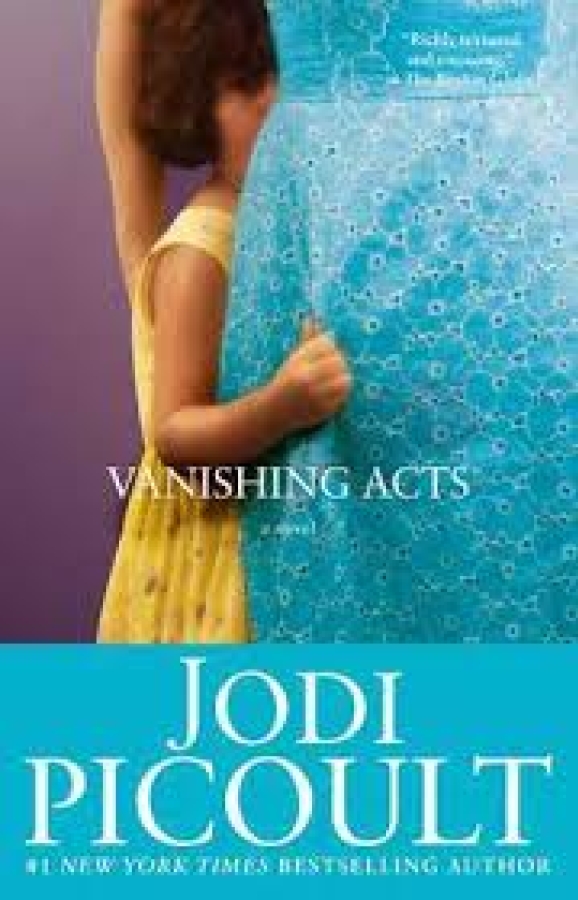
Vanishing Acts
Delia’s father had always told her that her mother was dead, so much so that she has become a memory continually resurfacing in her mind. > I used to imagine how my mother would come back. (...) In all of these daydreams, death was not as absolute as it was supposed to be, and we always found each other by accident. In all of these daydreams, my mother and I recognized each other without a single word. Delia's life has unfolded peacefully, with a loving father and two friends: Fritz and Eric, the latter of whom Delia falls in love with as a girl and with whom she has a daughter. Her only torments are that ever-present feeling of having lost something and the fact that Eric is an alcoholic. Until, suddenly, the police show up at the house to arrest her father, Andrew, accused of having kidnapped his daughter twenty-five years earlier. The novel tackles many themes—perhaps too many: Andrew's deceit, having concealed the existence of her mother, Elise, from Delia; Eric's alcoholism, resurfacing under stress and upon discovering that Elise had also struggled with alcohol addiction; the dynamics between the three friends, Delia, Eric, and Fritz, the latter having always been in love with her (serving in the novel as a kind of guardian angel); the new surroundings where Delia moves with her daughter to attend the trial and where she meets Rutham, a blend of Native medicine woman and hippie grandmother; the harshness and brutality of the prison where Andrew is incarcerated; potential childhood sexual abuse, repressed by Delia but brought back to light by her father's accusations against Elise during the trial (perhaps yet another lie); and finally the trial itself, recounted with the standard American police-procedural approach. To impose order on such a sprawling narrative, a review must select a single thread, even at the risk of stripping away the plot's richness. One might begin with a curious question the Native medicine woman poses to Delia: > What if the whole kidnapping experience wasn't Delia's story? What happens if disappearing wasn't the most catastrophic event in your life? What else would it be? (asks Delia). Ruthman raises her face to the sun. "Coming back," she says. And indeed, Delia is not happy when she meets her mother; Elise, tears in her eyes, realizes this and tells Delia that she has lost her once again, and forever. Too vast is the divide between fantasy and reality! > My mythical, imaginary mother was a god and a superhero and a comfort to me. (...) It took me twenty-five years to be able to admit that I'm glad I didn't know my mother until now. Not because, as my father suspected, she might have ruined my life, but because this way, I didn't have to witness her ruining her own. As the author states, through Delia's voice, > What matters is not what you have accumulated over the years, but those few things you can carry with you. It is a pity that such a compelling theme—the confrontation between memory and reality—is compromised by a plot overcrowded with narrative threads, superfluous characters, and redundant episodes. Why depict prison life only to traffic in clichés, and why become entangled in the interpersonal dynamics of childhood friends transitioning into adulthood? It would have been far better to examine in psychological depth Delia’s discovery of her mother as well as the mother's own emotions, which remain perpetually relegated to the background until fading away entirely. Further accentuating its melodramatic potboiler quality is the now ubiquitous technique of multi-voiced narration: each chapter recounts the story from the perspective of a different character, generating a redundancy of the "I" (is one not enough?) that renders the whole enterprise long-winded, repetitive, and tedious. The novel's merit lies in its prose: a syntactic structure that is straightforward yet far from trivial, and an elegant vocabulary enriched by idioms, adjectives, and verbs drawn from colloquial speech, marked by a distinctly American cadence. Distant from New York intellectualism and the overwrought virtuosity of certain contemporary American authors (one need only think of the much-celebrated Cormac McCarthy; see the review of *The Road* on this site), Picoult returns us to a style accessible to the general reader. Why read it? The prose is engaging; the premise, potentially intriguing.

Villages
Owen, the novel’s protagonist, grew up in a small town, where > sex and religion had distinct, antique smells; families were balanced like frail nests on knobby branches of preceding history . It is a world of vague certainties, which Owen leaves behind to study computer science at university. There he marries Phyllis, a brilliant mathematics student. Owen is captivated by his wife’s intellect and erudition, yet subconsciously senses a kind of detachment, as though she lived in a world of her own, populated by mathematicians and poets, while the real world were a “tedious and insignificant place of exile.” The couple moves to a small town, where Owen, together with a partner, launches a software company that proves to be a major success. Four children follow, Phyllis devotes herself to the family, and with the nineteen-sixties American customs shift, not least as a result of the sexual revolution; computer technology evolves rapidly, confronting Owen with a relentless technological challenge. The couple takes part in local high society, and in this gossipy, hypocritical milieu, Owen begins a succession of affairs—the first ones more emotionally involving, the later ones progressively confined to purely sexual encounters. Owen is an attractive, obliging man, yet scandal and gossip fail to destroy the marriage thanks to Phyllis’s determination to safeguard the family, and above all because she forgives her husband out of love. The marriage unravels when Owen, by now weary of these flings, meets Julia and asks for a divorce. In a confrontation—the only true argument of their marriage—Owen justifies this decision by claiming that Julia, a deeply religious woman, will save him from his own weaknesses. Phyllis rebels, but, disgusted by her husband’s hypocrisy, flees. Whether by accident or suicide, she dies in a car crash, and once again Owen is spared from having to make his life’s choices alone. One of the book’s central themes is undoubtedly the evolution of American society, observed from two distinct vantage points: the revolution in sexual mores (with Owen’s escapades becoming increasingly explicit) and the computer revolution, from mainframes to the personal computer. Another theme is the depiction of small-town American life, which in many respects recalls episodes of the television series *Desperate Housewives*. Then there is the figure of Owen himself—pliable, fragile, yet opportunistic—who merely drifts along with events while taking advantage of a protective cocoon (his mother, his two wives, and his business partner) that allows him to remain an adolescent all his life. It is no coincidence that the novel concludes with a description of Owen’s dreams, reminiscing nostalgically about his mother and the village of his childhood. Updike’s style is lush with adjectives and baroque constructions that lend musicality and expressive vitality to the narrative. Although the book is scarce in incident, it is the prose style that sustains the narrative rhythm, making for an enjoyable read. Yet such verbal redundancy does not favor economy, and the reader easily gets lost amid “so many fireworks.” Why read it? It is a thoroughly enjoyable read, especially in the original language.

A Visit from the Goon Squad (Time Is a Bastard)
The novel consists of 13 chapters, which could be read as stories in their own right, so disparate are they in genre and style. The connection between them is extremely fragile, resting merely on the fact that each chapter shares a character with another. There is, therefore, neither a unified plot nor a hierarchy of characters; the whole resembles the faint interplay of subatomic particles (in this case, the protagonists), with the author like a perplexed physicist wondering whether «a particle can know what is happening to the others». That is to say: is it possible, in our fractured and liquid society, to find a common ground of relationships, or does each individual live as a solitary, incommunicable monad? From this opening alone, one can grasp that this is a complex, sophisticated, fragmented, and in some ways incomprehensible novel. It is difficult to provide a cohesive overview of the narrative. I will try. The story is supposed to unfold from the 1980s to the present day, with the Bush era in between, and all that it meant for the American consciousness. Bennie is a former musician and now a record executive; his assistant is Sasha, a young woman suffering from kleptomania. From these two characters, several paths branch out, which only at the end, perhaps, converge once more. In a succession that is disjointed from both a chronological and narrative standpoint (the temporal leaps are numerous, just as the links between the stories remain unclear), we follow the fortunes of the band Bennie belonged to in his youth, the familial and romantic affairs of the record executive who discovered the group, the story of Jules—the brother of Bennie’s ex-wife—who served years in prison for attempting to rape Kitty, a young actress whom we find, many years later, collaborating with Dolly, a publicist who was herself, at another point in time, the employer of Bennie’s wife when the two were not yet separated.In other stories we follow Sasha, her transgressive life among a group of youths devoted to sex and marijuana, and then, no less, in Naples, where she lives in the Spanish Quarter. The book closes with the characters now advanced in years, far removed from their reckless, confused lives. Bennie and Alex, an old friend of Sasha’s from whom she had once stolen a wallet, go looking for her to find out what became of her. They do not find her, and so we are left to conclude that a stable relationship between people is impossible—that we are like «blind» individuals knowing nothing of one another. Yet the generation of the 1980s, to which the characters belong, is now gone, swept away by the Bush era: new lifestyles are emerging, embodied by Lulu, Bennie’s assistant and, as it happens, Dolly’s daughter—willful, cold, decisive, technological. The novel, with which the author won the Pulitzer Prize in 2010, was presented in Italy under the title *Il tempo è bastardo*, placing the emphasis on one of the book’s central themes: memory as an extreme, confused attempt to return to youthful egocentrism, when «nothing was decided yet». Time—not chronological, but that of memory—could be the novel’s unifying element. Yet perhaps, to make sense of the book, a near-literal translation of the title is more fitting: a visit from a squad of reckless fools (literally, it would be from a squad of thugs). Indeed, the novel seems to narrate the retreat into a bourgeois, conformist lifestyle of a generation that wanted to live «over the top», free and transgressive: nostalgia for that happy age is all that remains. The author displays formidable writing talent, through the richness and elegance of her language and the multitude of literary genres in which she has successfully tried her hand. In one chapter, she even abandons prose in favor of a PowerPoint presentation. What is evident is the courageous pursuit of approaches capable of constructing the form of the novel upon new rules and styles. Innovation, however, got the better of her when it comes to the overall structure: an incomprehensible mosaic, a lack of narrative momentum, a redundancy of characters, and a dispersion of plotlines. What remains, then, are a few exquisite stories alongside others that are far less compelling, but the whole proves unreadable. Why skip it? It is a book too intellectualized to be an enjoyable read.