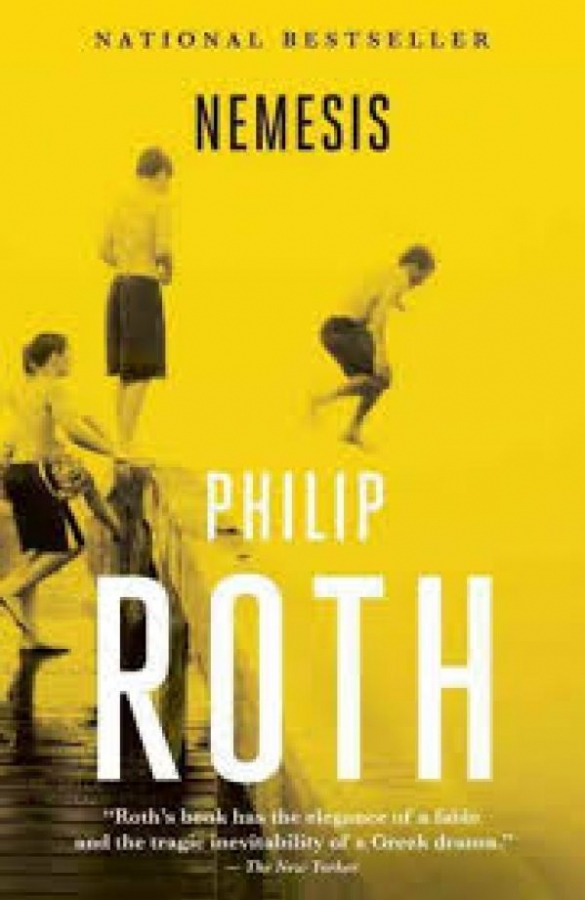
Nemesis
In Greek mythology, Nemesis is the goddess of just and fatal retribution for unpunished transgressions. How many times have we thought that illnesses, accidents, misfortunes were fateful events that had to originate in some guilt? We inevitably have to find someone to blame in a tragedy; we cannot accept that what happens is not a necessity, that it lacks a reason; we refuse to admit that God > is the echo of all our vain crying. (...) He who knows the before and the after and the reasons for everything, and yet unfortunately cannot tell them to us for this single, so futile reason!: that He does not exist (Sebastiano Vassalli *La Chimera*). Philip Roth addresses this, and he does so by recounting the polio epidemic that swept through an American city in 1944, at the height of the Second World War. > Because this was a real war, too, a war of slaughter, ruin, loss, and grief, war with the casualties of a war, war upon the children of Newark . Bucky Cantor is a very young athletic director, a javelin champion, a solid and strong young man; he was kept from going to war by a severe visual defect. Motherless, abandoned by his father, he was raised by his maternal grandfather with a devotion to hard work, moral values, and an outsized sense of responsibility. He is a summer supervisor. With the schools closed, his duty is to look after the boys and girls of Newark’s Jewish neighborhood, and he does so with great commitment, coaching them in sports, training them in team games, and teaching them loyalty and determination. His qualities are widely recognized by both the pupils and their families. An epidemic of polio, then incurable and without a vaccine, spreads across the neighborhoods and begins striking even the children entrusted to Bucky’s supervision. The polio cases, some severe and fatal, multiply, and the young man cannot comprehend the reasons behind the calamity: he is shattered, convinced that he is not doing enough, yet he strives to maintain his composure and convey it to the children. His girlfriend is spending the summer at a camp on the shores of a lake. She has secured him a post as a swimming instructor, a discipline in which Bucky excels. Why not leave a city tainted by polio and instead spend the summer in a safe, idyllic setting alongside the woman he loves? Bucky hesitates; already burdened by guilt for not having been drafted, he is loath to abandon his boys, but ultimately he accepts. Yet he cannot escape guilt (which guilt?). A few days after his arrival, the first cases of polio break out at the camp; is he, then, the contagion bearer? Does the responsibility lie with him for the children who died or were severely disabled under his watch in Newark? Did he bring the terrible pestilence to the camp? He must serve his just punishment; and he will do so with stubborn resolve, forgiving himself nothing: he too contracts polio, remains crippled for the rest of his life, rejects the devotion of his girlfriend—who loves him regardless—and condemns himself to a solitary existence. > He smiled (...) with a smile closely resembling a pained wince, indicating fatigue and not joy. There was no light in him. What was missing was the energy and the competence that had once been at the center of his character. And certainly his athletic component was completely gone. It was not merely that an arm and a leg were useless. His original personality, all that vital purposefulness that would have struck you the moment you met him, seemed torn away as well. It is a tale that is read in a single breath: the prose is fluid, the narrative tempo pressing despite the philosophical digressions. Roth skillfully succeeds in tracing the protagonist’s trajectory: everything is already written in his fate, in the sins of his father, and yet for the reader it comes as a surprise to realize how futile it is to struggle, and how virtue counts for nothing when an invisible hand, a cruel God, pulls the strings of our lives. Are we, then, not free? Roth attempts to salvage this in the final chapter, through the confrontation between Bucky and another young man also disabled by polio, who nevertheless managed to lead a normal, happy life. Unfortunately, it is a somewhat tacked-on, redundant, and prolix chapter: a misstep in the narration, an effort to offer, at all costs, a conclusion that is not entirely bleak. The novel closes with a mesmerizing description of Bucky throwing the javelin—an exaltation of the beauty of an athlete’s motion, but also the melancholic acknowledgment of a gesture no longer possible: a breathtaking stylistic gem. Why read it? It reads exceptionally well and prompts profound reflection on good and evil.
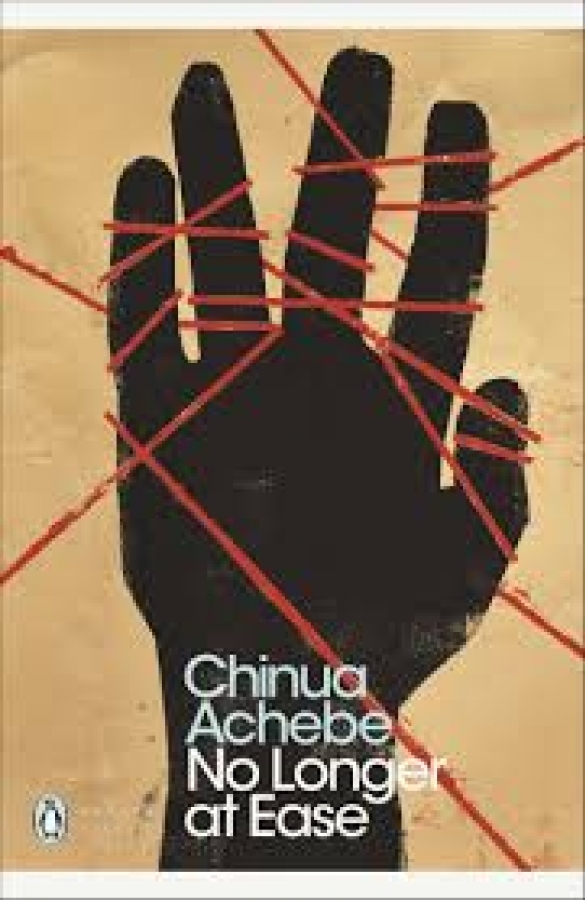
No longer at ease (no longer at peace)
The novel is part of a trilogy, a vast fresco of Nigeria’s recent history; the review of the first book, *Things Fall Apart*, can be read on this site. *No Longer at Ease* takes its title from a line in Eliot’s poem (“The Journey of the Magi”), which reads: > we returned to our places, these kingdoms/ but no longer at ease here, in the old dispensation/ with an alien people clutching their gods/ I should be glad of another death . Just as the three Magi, having returned to their palaces, are no longer as they once were and can no longer adapt to the old ways, so Obi, the grandson of Okonkwo, the protagonist of *Things Fall Apart*, can no longer understand Nigeria—seemingly Westernized, yet still anchored to ancient ancestral morality. At the expense of the Umuofia Progressive Union, an association bringing together the notables of the native village of Obi and his family, the young man was sent to study in England; he earned a degree in English literature, and upon his return he was hired in an office of the nascent Ministry of Education (we are in the 1950s, shortly before independence). He must repay the eight hundred pounds received from the association; Obi asks for an extension and an additional allowance, intoxicated by the intense life of Lagos, teeming with people, a melting pot of ethnicities and tongues, straining toward the future. The young man himself firmly believes in the new Nigeria destined to emerge from colonialism. He indignantly rejects every offer of money to favor a candidate in examinations and civil service competitions. The city is full of temptations; Obi also has a taste for luxury (he hires a car to drive around), and takes no account of taxes and the advances he has received. These are all venial sins that would be forgiven him, were it not that Obi falls in love with Clara, a young woman belonging to the "osu > , regarded by the Igbo as akin to lepers. With great naivety, the young man informs his father of his intention to marry Clara. His father laughed. And it was the kind of laughter that was sometimes heard from someone masked as an ancestral spirit. (...) We are Christians, but that is no reason to marry an "osu > . (...) Our fathers in their darkness and ignorance called an innocent man osu > , a thing given to the gods, and from then on he became an outcast, and his children, and his children's children forever . Obi is angry, but he is also convinced that he can persuade his father—at heart a good and submissive man, a sincere and devout Christian. In a second conversation, after a long silence, the father recounts to his son the story of Ikemefuna. > He began slowly and quietly, so quietly that it was difficult to hear the words. It seemed as if he were not really speaking to Obi. His face was turned sideways so that Obi saw him in dim profile . Ikemefuna was killed by Okonkwo to uphold ancestral rules; Obi's father abandoned his family and became a Christian; Okonkwo hanged himself out of shame. What did the father mean by recounting this tragedy to his son? Whoever abandons their "chi > , god, role, and destiny, brings terrible consequences upon themselves and their family. This message is not explicit, but that is how Obi interprets it. As often happens in Achebe's novels, the characters are granted freedom of choice and are therefore responsible for their own actions; indeed, the story could also have been an invitation to the son to forge his own path with courage, just as the father had done by becoming a Christian. Obi returns to Lagos, convinced that he cannot marry Clara; but the young woman is pregnant, and so the pregnancy must be terminated. Obi accompanies her to an obliging doctor and returns to the car. When he sees them come out to go to the clinic, where the abortion will be performed, he would like to get out of the car and shout: Stop! Come on, let's get married now, but he could not and did not do it. The doctor's car slid away. (...) Clara looked in Obi's direction and immediately looked away > . The boy is a coward: in anger he tears up the manifesto of the new Nigeria, but it is he who failed to fight to the very end for his country's future. And since, as Stevenson says, evil possesses its own fascination and begets further evil, Obi begins to take bribes shamelessly, captivated by the pile of cash. As the elders of Umuofia said, "you see this thing called blood. There is nothing like blood. That is why when you plant a yam it produces another yam, and if you plant an orange tree it produces oranges. (...) But I have not yet seen a banana tree produce a yam." A curse hangs over Obi: "it is a strange and surprising thing, but I can tell you that I have seen it before. His father did it." Charmed by the elegiac tone of *Things Fall Apart* > , by the power of its plot and its characters, one is left somewhat disappointed by this novel. Obi is a small man; he has none of the tragic stature of Okonkwo; the urban setting evokes no mysteries like the pre-colonial village of Umuofia. The style, based on tight, concise dialogue, plunges us into a bourgeois comedy", into an ostensibly flat and banal story. The characters are merely sketched, not fleshed out, in particular the figure of Clara: a subtle irony creeps in alongside an overriding sense of resignation. Everything seems already written: Obi’s story as well as the future of Nigeria. Were the elders of Umuofia right: can a banana tree not produce a yam? Why read it? I do not know why, but reading the novel brought Italy to mind.

Northanger Abbey
> A heroine returning, at the close of her story, to her native village, in all the triumph of a won reputation.... is an event on which the pen of a writer might well delight to linger.... But my story is very different; I bring my heroine back home in solitude and disgrace, and no sweet exhilaration of spirits can induce me to give a detailed account . Austen writes a book that skillfully plays on the boundary between reality and imagination to amiably mock the fashion for romantic novels that was beginning to spread among the young women of polite society. Catherine, a seventeen-year-old girl, leaves her family for the first time for a holiday in a renowned spa town. With naivety and trust, she forms friendships and makes acquaintances. She meets a brother and sister, Eleanor and Henry, whose father, a prominent general, invites her to extend her stay at their ancestral residence. An avid reader of medieval-themed novels, Catherine allows herself to be swayed by the rooms, the corridors, the seemingly secret doors, and the chests of drawers that appear to conceal mysteries and sinister tales. Catherine’s imagination runs wild. It is above all the figure of the general, whose deceitful and authoritarian nature she intuitively senses, that impels her to investigate suspicions of crimes and abuses. A clarifying conversation with Henry, who catches her wandering through the grand residence, brings her abruptly back to reality: “the novel is over”; perhaps violence and murder happen in other countries, > among the Alps and the Pyrenees, where one is either an angel or a demon. In England it is not so; among the English, she thought, in their hearts and their habits, there is a general, though unequal, mixture of good and bad . And Catherine stumbles upon this very truth: the general discovers that the girl does not come from a wealthy family, is not a good match, and rudely sends her back home. The novel really is over. The novel is an initiation. Catherine emerges from adolescence and enters the adult world, where young people are only momentarily permitted to forge relationships that disregard their families’ standing in society. The moment friendship turns into romance, social differences and money put everyone back in their place. If this is reality, it is above all hypocrisy and deceit that trample human dignity. With a skillful and pleasing syntactic construction, Austen delves into the young girl’s feelings, capturing the nuances of a character in the making. Why read it? At first, the novel seems distant in time, but as we read it, we grasp its contemporary relevance, and one comes to appreciate the depth of its psychological and social inquiry.