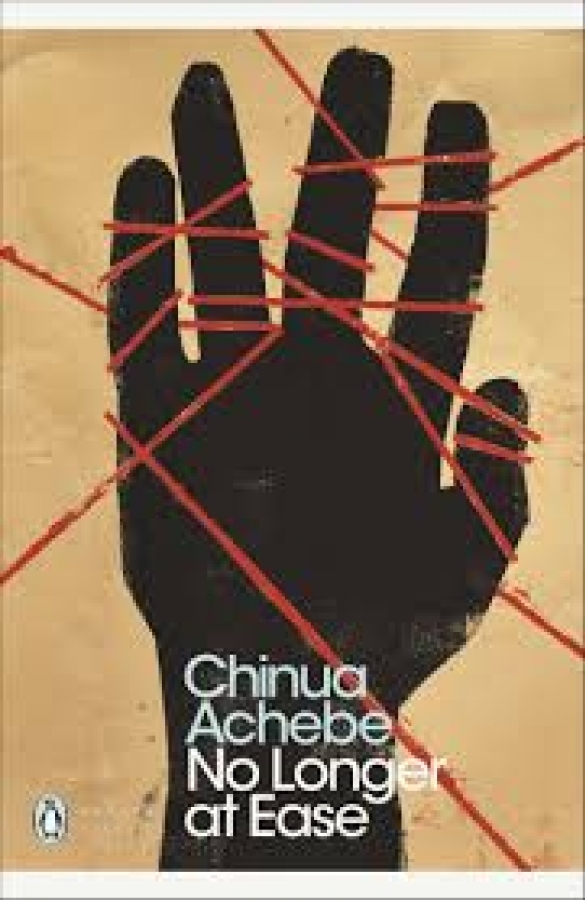
Finished reading on: August 15, 2019
No longer at ease (no longer at peace)
Title of the original version reviewed: «No longer at ease (non più tranquilli)»
AI Translation Notice: This review was translated from the original Italian using artificial intelligence. Book quotes and excerpts are translated interpretations and will not match the author's original English phrasing or official published translations.
The novel is part of a trilogy, a vast fresco of Nigeria’s recent history; the review of the first book, Things Fall Apart, can be read on this site. No Longer at Ease takes its title from a line in Eliot’s poem (“The Journey of the Magi”), which reads:
we returned to our places, these kingdoms/ but no longer at ease here, in the old dispensation/ with an alien people clutching their gods/ I should be glad of another death
. Just as the three Magi, having returned to their palaces, are no longer as they once were and can no longer adapt to the old ways, so Obi, the grandson of Okonkwo, the protagonist of Things Fall Apart, can no longer understand Nigeria—seemingly Westernized, yet still anchored to ancient ancestral morality. At the expense of the Umuofia Progressive Union, an association bringing together the notables of the native village of Obi and his family, the young man was sent to study in England; he earned a degree in English literature, and upon his return he was hired in an office of the nascent Ministry of Education (we are in the 1950s, shortly before independence). He must repay the eight hundred pounds received from the association; Obi asks for an extension and an additional allowance, intoxicated by the intense life of Lagos, teeming with people, a melting pot of ethnicities and tongues, straining toward the future. The young man himself firmly believes in the new Nigeria destined to emerge from colonialism. He indignantly rejects every offer of money to favor a candidate in examinations and civil service competitions. The city is full of temptations; Obi also has a taste for luxury (he hires a car to drive around), and takes no account of taxes and the advances he has received. These are all venial sins that would be forgiven him, were it not that Obi falls in love with Clara, a young woman belonging to the "osu
, regarded by the Igbo as akin to lepers. With great naivety, the young man informs his father of his intention to marry Clara.
His father laughed. And it was the kind of laughter that was sometimes heard from someone masked as an ancestral spirit. (...) We are Christians, but that is no reason to marry an "osu
. (...) Our fathers in their darkness and ignorance called an innocent man
osu
, a thing given to the gods, and from then on he became an outcast, and his children, and his children's children forever
. Obi is angry, but he is also convinced that he can persuade his father—at heart a good and submissive man, a sincere and devout Christian. In a second conversation, after a long silence, the father recounts to his son the story of Ikemefuna.
He began slowly and quietly, so quietly that it was difficult to hear the words. It seemed as if he were not really speaking to Obi. His face was turned sideways so that Obi saw him in dim profile
. Ikemefuna was killed by Okonkwo to uphold ancestral rules; Obi's father abandoned his family and became a Christian; Okonkwo hanged himself out of shame. What did the father mean by recounting this tragedy to his son? Whoever abandons their "chi
, god, role, and destiny, brings terrible consequences upon themselves and their family. This message is not explicit, but that is how Obi interprets it. As often happens in Achebe's novels, the characters are granted freedom of choice and are therefore responsible for their own actions; indeed, the story could also have been an invitation to the son to forge his own path with courage, just as the father had done by becoming a Christian. Obi returns to Lagos, convinced that he cannot marry Clara; but the young woman is pregnant, and so the pregnancy must be terminated. Obi accompanies her to an obliging doctor and returns to the car. When he sees them come out to go to the clinic, where the abortion will be performed,
he would like to get out of the car and shout: Stop! Come on, let's get married now, but he could not and did not do it. The doctor's car slid away. (...) Clara looked in Obi's direction and immediately looked away
. The boy is a coward: in anger he tears up the manifesto of the new Nigeria, but it is he who failed to fight to the very end for his country's future. And since, as Stevenson says, evil possesses its own fascination and begets further evil, Obi begins to take bribes shamelessly, captivated by the pile of cash. As the elders of Umuofia said,
"you see this thing called blood. There is nothing like blood. That is why when you plant a yam it produces another yam, and if you plant an orange tree it produces oranges. (...) But I have not yet seen a banana tree produce a yam." A curse hangs over Obi: "it is a strange and surprising thing, but I can tell you that I have seen it before. His father did it."
Charmed by the elegiac tone of Things Fall Apart
, by the power of its plot and its characters, one is left somewhat disappointed by this novel. Obi is a small man; he has none of the tragic stature of Okonkwo; the urban setting evokes no mysteries like the pre-colonial village of Umuofia. The style, based on tight, concise dialogue, plunges us into a bourgeois
comedy", into an ostensibly flat and banal story. The characters are merely sketched, not fleshed out, in particular the figure of Clara: a subtle irony creeps in alongside an overriding sense of resignation. Everything seems already written: Obi’s story as well as the future of Nigeria. Were the elders of Umuofia right: can a banana tree not produce a yam?
Why read it? I do not know why, but reading the novel brought Italy to mind.