Finished reading on: May 26, 2016
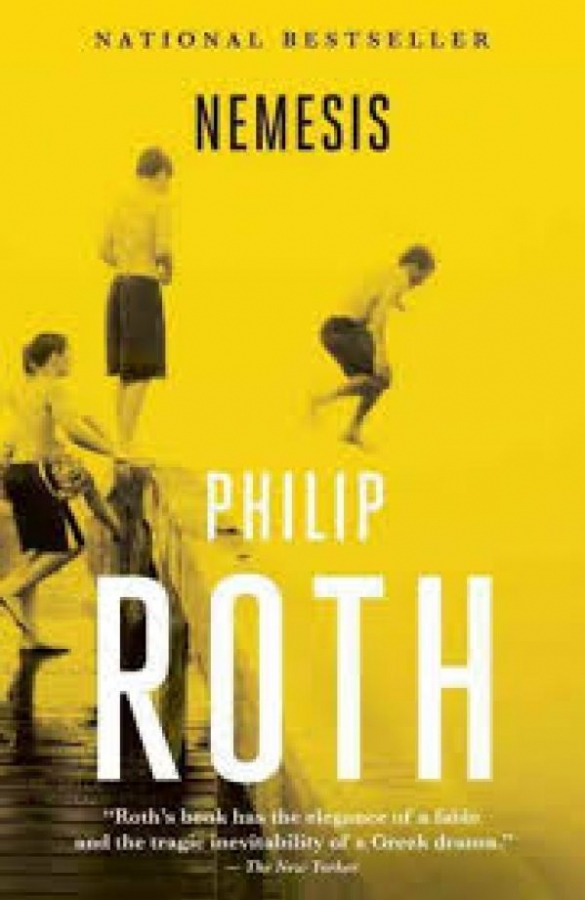
Nemesis
AI Translation Notice: This review was translated from the original Italian using artificial intelligence. Book quotes and excerpts are translated interpretations and will not match the author's original English phrasing or official published translations.
In Greek mythology, Nemesis is the goddess of just and fatal retribution for unpunished transgressions. How many times have we thought that illnesses, accidents, misfortunes were fateful events that had to originate in some guilt? We inevitably have to find someone to blame in a tragedy; we cannot accept that what happens is not a necessity, that it lacks a reason; we refuse to admit that God
is the echo of all our vain crying.
(...) He who knows the before and the after and the reasons for everything, and yet unfortunately cannot tell them to us for this single, so futile reason!: that He does not exist
(Sebastiano Vassalli La Chimera).
Philip Roth addresses this, and he does so by recounting the polio epidemic that swept through an American city in 1944, at the height of the Second World War.
Because this was a real war, too, a war of slaughter, ruin, loss, and grief, war with the casualties of a war, war upon the children of Newark
.
Bucky Cantor is a very young athletic director, a javelin champion, a solid and strong young man; he was kept from going to war by a severe visual defect.
Motherless, abandoned by his father, he was raised by his maternal grandfather with a devotion to hard work, moral values, and an outsized sense of responsibility.
He is a summer supervisor.
With the schools closed, his duty is to look after the boys and girls of Newark’s Jewish neighborhood, and he does so with great commitment, coaching them in sports, training them in team games, and teaching them loyalty and determination.
His qualities are widely recognized by both the pupils and their families.
An epidemic of polio, then incurable and without a vaccine, spreads across the neighborhoods and begins striking even the children entrusted to Bucky’s supervision.
The polio cases, some severe and fatal, multiply, and the young man cannot comprehend the reasons behind the calamity: he is shattered, convinced that he is not doing enough, yet he strives to maintain his composure and convey it to the children.
His girlfriend is spending the summer at a camp on the shores of a lake.
She has secured him a post as a swimming instructor, a discipline in which Bucky excels.
Why not leave a city tainted by polio and instead spend the summer in a safe, idyllic setting alongside the woman he loves? Bucky hesitates; already burdened by guilt for not having been drafted, he is loath to abandon his boys, but ultimately he accepts.
Yet he cannot escape guilt (which guilt?).
A few days after his arrival, the first cases of polio break out at the camp; is he, then, the contagion bearer? Does the responsibility lie with him for the children who died or were severely disabled under his watch in Newark? Did he bring the terrible pestilence to the camp? He must serve his just punishment; and he will do so with stubborn resolve, forgiving himself nothing: he too contracts polio, remains crippled for the rest of his life, rejects the devotion of his girlfriend—who loves him regardless—and condemns himself to a solitary existence.
He smiled (...) with a smile closely resembling a pained wince, indicating fatigue and not joy.
There was no light in him.
What was missing was the energy and the competence that had once been at the center of his character.
And certainly his athletic component was completely gone.
It was not merely that an arm and a leg were useless.
His original personality, all that vital purposefulness that would have struck you the moment you met him, seemed torn away as well.
It is a tale that is read in a single breath: the prose is fluid, the narrative tempo pressing despite the philosophical digressions.
Roth skillfully succeeds in tracing the protagonist’s trajectory: everything is already written in his fate, in the sins of his father, and yet for the reader it comes as a surprise to realize how futile it is to struggle, and how virtue counts for nothing when an invisible hand, a cruel God, pulls the strings of our lives.
Are we, then, not free? Roth attempts to salvage this in the final chapter, through the confrontation between Bucky and another young man also disabled by polio, who nevertheless managed to lead a normal, happy life.
Unfortunately, it is a somewhat tacked-on, redundant, and prolix chapter: a misstep in the narration, an effort to offer, at all costs, a conclusion that is not entirely bleak.
The novel closes with a mesmerizing description of Bucky throwing the javelin—an exaltation of the beauty of an athlete’s motion, but also the melancholic acknowledgment of a gesture no longer possible: a breathtaking stylistic gem.
Why read it? It reads exceptionally well and prompts profound reflection on good and evil.