
Family dancing
The central theme of the story is the family, viewed by Leavitt as a closed, central nucleus in which relationships among members are vitiated by convictions and hypocrisies. A family reunion is organized, serving, however, as an occasion for each to expect roles and behaviors from the other that often bear no relation to the individual’s true desires. Not even the discovery of one of the family members’ homosexuality manages to break this pattern, as the gay condition is subsumed within the roles and rules of the bourgeois family. David Leavitt has often been regarded as the writer of homosexuality. In truth, he is the chronicler of the bourgeois family in an open society, which accepts anything provided it is reabsorbed into established frameworks. The elegant and effective prose cannot conceal the passage of time on this story, now dated against the neoconservative wave that has restored to homosexuality its status as an otherness and a threat to the family. Why not read it? Because it is predictable and stale.

Red Leaves
For William Faulkner, the short story is akin to poetry, "almost every word must be the right one"; and indeed, the narrative is dense, hermetic, rich in symbolism, and difficult to interpret. As in *Red Leaves*, the very choice of title raises numerous questions: what does it signify? For some commentators, the writer intended to refer to the cycle of the seasons, thereby emphasizing that what suffocates and destroys the Negro people is a natural destiny. The red leaves are said to express an existential, cosmic condition, as in Giuseppe Ungaretti’s poem addressed to the soldiers of the First World War: "Like leaves on trees in autumn." A great Indian chief has died; as tribal tradition dictates, those who served him in life (the dog, the horse, and his Negro slave) must follow him into the grave. Two Indians head to the slave quarters to retrieve the man. What disgusts them is the stench of the bodies, a revolting smell. The Negroes > seemed to be suspended as upon something remote, inscrutable. (...) They were like the roots of a great uptorn tree, the earth momentarily sheared away from the contorted, thick, fusty maze of its outraged and despairing life. From what the two men say, we learn that slavery is a burden, the fruit of the pure Indian people’s contamination by the white man. Born of a mixed marriage between an Indian and a white woman, the deceased himself had been to Europe and returned with several objects whose utility he did not understand; among them, a pair of red slippers; whenever his son tries to put them on, he falls into an unconscious state. What does this mean? Perhaps because > this world (...) is being ruined by white men. We got along fine for years and years, before the white men whooped us into using negroes. In the old days the old men sat in the shade and ate parched corn and venison slowly over the fire, and smoked and talked about honor and big things; and now what do we do? Contamination does not break the absurd ritual of death, as if to say that white, technological, and advanced society reinforces ancestral customs rather than evolving them toward civilized forms. It is mere corruption in an immobile society; it is not progress. Faulkner’s reflection does not concern only the American South, which, at least from what we know, seems trapped in nostalgia for the past; consider certain phenomena that strike us as inexplicable—femicide, infibulation, brutal exploitation—so widespread in our advanced Europe, despite proclaimed laws and values. Only individual acts of Resistance can overcome corruption and generate new visions and moral rules. Paradoxically, this is what the victim in our story does. The Negro, destined to follow his master into the grave, flees into the forest and, when captured, fights for life until the very end: he amputates an arm to survive the bite of a venomous snake; he accepts water on the brink of death. > It’s just that I didn't want to die, he said. Then he said again, it’s just that I didn’t want to die, in a quiet tone, of slow, faint wonderment, as if it were something which, until the words had formed themselves, he had not known, or not known the depth and measure of his desire . The death endured, without resignation yet with equanimity, bears witness to a moral strength absent in the story’s other characters, corrupted by white society while trapped in ancestral rituals. > The Negro was still about to step, his knee raised and bent, his head up as if he were looking into the teeth of a millrace. The pupils of his eyes were wild and cold, like a horse’s . Ralph Ellison, the first great African American writer, said that Faulkner > has actually explored the nature of man. (...) Faulkner, more than most men, was aware of human strength as well as man's weakness. He knew that understanding and overcoming fear was a large part of a writer's reason for being. Faulkner’s narrative is imbued with a strong ethical tension, a desperate quest for human goodness, for that which is deepest in the human being. He pursues this aim within his world, the American South, where everything in reality seems static and violent; yet what he narrates concerns us all; and quoting Ungaretti once again, one could say: "I seek an innocent country." At the center of his writing is the word, not the plot or the characters; and this is precisely its limitation, at least in the short stories: it is difficult to understand, it must be read too many times to grasp its manifold meanings, it demands too much imagination to interpret. Why not read it? It is difficult to interpret and, in fact, boring.

For whom the bell tolls
The novel is set in Spain during the Civil War and unfolds over the course of a few days. Jordan, an American, is dispatched behind enemy lines to blow up a bridge in support of an offensive by the Republican army. To carry out this mission, he makes contact with a band of guerrillas, among whom he meets Maria, with whom he falls in love. The group is led by Pablo, who clashes with Jordan, and Pilar, a fiercely strong and energetic woman. Despite internal friction, the group accomplishes the mission and Jordan destroys the bridge, but is killed during the escape. The novel’s true theme seems to be the futility of war, its inherent cruelty, manifested on both sides of the front. Powerfully tragic are the pages describing the capture of a town by Pablo’s band and the slaughter of the Fascists: one by one, they emerge from the church where they have been imprisoned and are forced to pass between the ranks of villagers and partisans, only to be hurled into a ravine. At first the crowd hesitates, but soon hatred and bloodshed take over. The same cruelty is pursued by the Fascists in the murder of a group of partisans who are decapitated. The anticipation of the final assault, the presence within the partisan group of a boy still very young who, shortly before dying, defends the integrity of a Communist party leader whose son has taken refuge in Russia, and the tragic impossibility of Jordan’s band to intervene and help represent magnificent moments in the novel that, more than any others, convey the cruelty of war. Yet war is not only cruel, it is also futile; moreover, it is senseless, and it always ends in death: > whether one is afraid or not, death is difficult to accept: there is no sweetness in its acceptance . The characters are caught in a machine whose futility and absurdity they grasp, yet from which they cannot break free. The destruction of the bridge is utterly pointless, as Franco’s army is aware of the Republican attack and possesses superior air power, thus making it highly probable that they will repel the offensive. Jordan tries to warn the Republican army commander, but bureaucracy, mistrust, and infighting prevent the message from arriving in time. And Jordan knows that «he will still have to destroy the bridge». Except for Pablo, who is a murderer, all the other characters are conscious of this cruelty: from old Anselmo, who does not want to kill yet finds himself forced to do so, to Jordan, who reads the letters of a slain soldier, making it starkly evident that he was a young man, with his own loved ones, likewise swept up in a senseless civil war. War overwhelms personal feelings as well. One must not dwell on loved ones or newly found love; the absurdity lies in Jordan, at the point of death and having had to leave Maria behind, deeming himself fortunate to have lived his final days with Maria’s love. Hemingway’s style is highly articulated, more effective in its descriptions than in its dialogue, which at times proves repetitive and tedious.

Freedom
Among the possible meanings of the word *Freedom*, one defines it as > being able or having the opportunity to do what one wants without being restricted by something or someone (Collins Dictionary). The characters in this novel have always lived poised between the “set of possibilities” and events (what used to be called destiny), which push inexorably toward a specific direction in life. There are no externally imposed constraints; rather, it is the very nature of things that leads down one path rather than another. And life is made up of the complexity of interpersonal structures, of conformism, and of the pursuit of realizing ideas that are often theoretical and generic. The story unfolds between the Reagan and Obama presidencies, set within an increasingly frightened American middle class, riddled with divisions, moral and political dilemmas, and a burgeoning awareness of the nation’s decline. As in all good bourgeois stories, it begins with a triangle: Walter, an earnest young man brimming with environmentalist ideals, loves Patty, a star basketball player who feels rejected, on account of this passion, by her politically prominent, establishment family. Patty, in turn, is drawn to Richard, a musician and Walter’s close friend. Patty and Richard take a car trip together to join Walter, and for Patty it becomes a missed opportunity: Richard, a consummate womanizer, refuses to sleep with his best friend’s fiancée. The bond between Patty and Richard feeds on regret. > in all these years, (Patty) had treasured the memory of their little trip, had kept it locked in a deep interior space, letting it age like wine, so that, symbolically, what might have happened between them remained alive and grew older with the two of them . Within Richard there grew “envy of his friend for his unwitting possession of his wife.” Walter and Patty’s marriage drags on wearily (“they could not live together, but could not imagine living apart”), until a vacation by Patty and Richard in Walter’s beloved old lake house, set in a stunning natural landscape, precipitates events: the two sleep together. Walter cannot accept being betrayed by his best friend: the couple separates, doing so just as Walter finally realizes he cannot pursue abstract environmental ideals with the money of American capitalism. And it is precisely from the breakdown of false interpersonal relationships and the undoing of vague ideals that Patty and Richard find each other again and can rebuild the family. In truth, the book is not confined to these three characters; it also involves the younger (Walter and Patty’s children) and older generations, chronicling the histories of their families of origin. There are also numerous forays into the political and social issues that have characterized America in recent decades; the author is particularly invested in environmental themes, which are also framed as an emblem of the hypocrisy and vacuity of much of the bourgeoisie. The message seems invariably the same: it is impossible to change the world; we must learn to live with ourselves and our problems. Emblematic in this regard is the final chapter. Walter has retreated into nature, finding his life’s mission in the defense of migratory birds, particularly against a domestic cat prone to murderous rampages. This stance puts him in conflict with the small middle-class community bordering the nature reserve. The tensions are resolved when Patty returns; she nurtures social ties with the neighbors (the conformism of the American bourgeoisie) and eventually brings Walter back to New York, back to the family. At that point, the organization managing the reserve erects a dividing wall between the natural habitat where the migratory birds nest and the small community. Is the world, then, composed of countless walls, within which each person seeks their own freedom? And does true freedom perhaps lie in that other possible meaning of the word *Freedom*: “the condition of being able to move around,” even within separate worlds? The book’s greatest strength undoubtedly lies in its style—marked by tight, highly effective dialogue—and in the depth of its psychological and existential exploration of the characters and their mutual relationships. The narrative pacing is slow, and the story unfolds sluggishly. Overall, it is dominated by that intellectualized, erudite, yet often evanescent approach typical of many contemporary American writers. Why read it? It is interesting, but recommended only to a very patient reader.
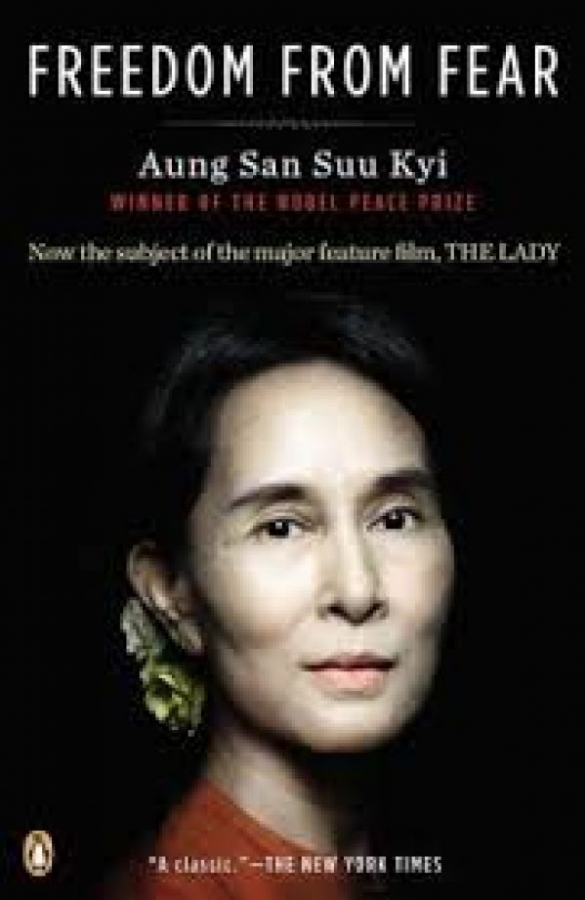
Freedom from Fear and other writings
San Suu was born in 1945, two years before the assassination of her father, founder of independent Burma and national hero. This biographical detail is essential to understanding this collection of essays, speeches, letters, and interviews, published between 1984 and 1994. Aims and prose vary, circumstances change, yet San Suu’s concern always shines through: to understand her father’s legacy, > to communicate what she has understood and to apply it to the problems of her own country . The essay that lends its title to the collection (*Freedom from Fear*) must not mislead: San Suu is not a moral philosopher, a sort of modern holy figure; she is, first and foremost, a political persona, characterized by a strong and prevailing ethical dimension. When the Burmese dissident calls for liberation from fear and corruption, she intends to assert > the firm conviction in the sanctity of ethical principles combined with a historical vision: despite setbacks, the human condition is placed on an ultimate path of spiritual and material progress . In a recent speech at the International Women’s Forum, San Suu defined politics as > the means to change society, and the change must be effective, not symbolic. And how effective it is depends on how correctly we evaluate the needs of the people and the country (quoted in *La Stampa*, 9 December 2014). That this is a long-pondered reflection emerges from a key essay included in the collection (*Quest for Democracy*). In it she affirms that > the true measure of the justice of a system is the amount of protection it guarantees to the weakest. Where there is no justice there cannot be a secure peace . We are speaking, therefore, of social justice, certainly not of abstract concepts belonging to the realm of philosophy and religion. To properly interpret San Suu’s thought, one must read the insightful analysis the author provides of intellectual life in Burma and India during colonialism. It is impossible to summarize such a complex essay: suffice it to say, in short, that the comparison with India allows San Suu to advance a severe critique of Burmese culture, of Buddhism itself, a “monolithic religion (...) with inflexible barriers”; to identify the sources of the regime’s consensus not so much in repression as in ethnic differences and chauvinism against Chinese and Indian communities; and to clarify how her inspirations are Gandhi and, above all, Nehru, her true spiritual father: a great politician, therefore, is her touchstone. If one does not stop at the vacuous, banal words of *Freedom from Fear* (but why does it lend its title to the collection?), one realizes that San Suu has no intention of locking herself within the spiritualist and Buddhist persona that the West would like to assign to her; she wants to be judged by what she manages to achieve for her country. To those urging her to leave Burma, > I replied that I would do nothing from abroad, and that if I wished to commit myself to a political movement, I would have to do so from within the country . Having read the entire collection, one asks oneself: has San Suu truly reckoned with her father? The answer is no. The daughter, San Suu, continues to idealize the father figure, without asking herself why the dictatorship originated in an army forged by her father: a man educated in monasteries, yet trained militarily and politically by the Japanese. As often happens, filial love compromises the lucidity and detachment that are, in any case, necessary in a political figure. Why not read it? It is dull, perhaps pointless. fragmentary, repetitive, and prolix.

From the Land of Green Ghosts (The Boy Who Spoke to the Wind)
I have always wondered why Italian editions do not retain the original title. It often conveys the sense of the book far better, as in the case of *From the Land of Green Ghosts*, which became, who knows why, *Il ragazzo che parlava col vento*. The title "from the land of green ghosts" neatly encapsulates the autobiography of one who, to save himself, had to forfeit his own identity through detachment from the spirits of an ancestral world made of lush fruits, rice paddies, forests, water, birds, and animals. Then again, misunderstanding must be this novel's destiny, if in his preface John Casey himself—Pascal's savior, mentor, and friend—offers this definition: > this is less a book of politics and history than a spiritual autobiography, in which, uniquely, (Pascal) writes from the perspective of a member of a Bronze Age tribal society, recently opened to the outside world, and at the same time of someone who ultimately managed to receive a Western education at a famous English university . Truly an arrogant and reductive assessment for someone who endured terrible atrocities, witnessing the material and social destruction of Burma! The novel is divided into three parts. The first part, "Tribal Idyll," depicts a tribal, agrarian world on the fringes of the great forests. > We were Padaung, we were Catholic, and we seemed to live in a world of our own, with our ceremonies and traditions. We had no sense that anything different could break in. The feeling of being safe showed me that we were living in paradise . The author describes for us, as meticulously as an anthropologist, the customs, way of life, and natural environment of the Padaung, even detailing, with a wealth of particulars curious to us, the food and the manner of cooking it. We discover ancestor worship, the formidable authority of the elders, and the spiritualistic and magical elements that characterize every moment of life. Even though Catholic—and the same holds true for Buddhists—the tribe jealously continues to preserve its traditions, all while observing the precepts of the new religion. His paternal grandmother's tales permeate Pascal's childhood: they are grim stories, like all folklore of peasant societies, yet in them animals, particularly birds, seal the fate of men. One day, the young Pascal catches an owl and wishes to cook it, but his grandmother tells him to speak to it and release it, so that one day he might call upon it for help. > Years later, when I was in the greatest danger, that memory became fraught with meaning for me . Through his involvement with the parish, Pascal receives an initial education and develops a passion for learning. He leaves the village to attend first a seminary, then university. He becomes a student, which places him in the most dynamic and politicized segment of Burmese society. Toward the regime—authoritarian, cruel, mendacious, and corrupt—Pascal has yet to take a stand. There is no political consciousness, and even the grief over the imprisonment and death of his girlfriend does not seem to translate into a deliberate taking of sides. Yet he is a student, and therefore an enemy of the regime. He must flee and hide in the jungle. The second part, "Revolution and Struggle," recounts Pascal’s experiences among the rebels, who have entrenched themselves in the border areas between Burma and Thailand. Through Pascal’s pen, we witness countless atrocities; suffice it to say that Burmese soldiers advance through minefields—laid, moreover, by themselves—by herding beaten, terrorized, and starving civilians ahead of them, clearing a path through bodies torn apart by explosions. Such is the cruelty that even > the animals and birds, which regularly drank from the river, fled, leaving only the human beings trapped in a fit of madness . The third part, "Rescue," recounts how Pascal managed to escape to Thailand and reach England, where he would become a professor of English literature. The story has a happy ending, yet there is a disturbing revelation. In Cambridge, at a dinner party at the home of English friends, he learns that he was singled out for rescue because years earlier his hosts had attended a circus performance of "giraffe women"—Padaung women with elongated necks adorned with metal rings; in short, Western man delights in preserving specimens of rare and endangered species. Yet is Pascal aware of this? No, because as the closing lines tell us, by now his dreams are > images all jumbled together, the elements overlapping. Snow might fall on the jungles, or palm trees grow on the Alps. The visions are often blurred by mist . It is a long novel, dominated by a flat narrative style incapable of conveying sensations and emotions. It is as if he were a reporter investigating, describing, filing an account. While the facts undeniably speak for themselves, it is not the writing that grips us; it is the history of Burma itself. It is no coincidence that the narrative engages the reader in the second part, as the tempo accelerates and the episodes of war and violence cannot fail to shatter us. Yet even here, the narrating "I" and protagonist, Pascal, appears almost as a bystander, a social scientist. Could it be that the author is forced to write in a language not his own? Or is this apparent detachment a psychological shield to survive, to defend against memory, against a destructive existential grief? Why skip it? The book is worth reading only if one harbors a deep interest in the landscape and history of Burma.