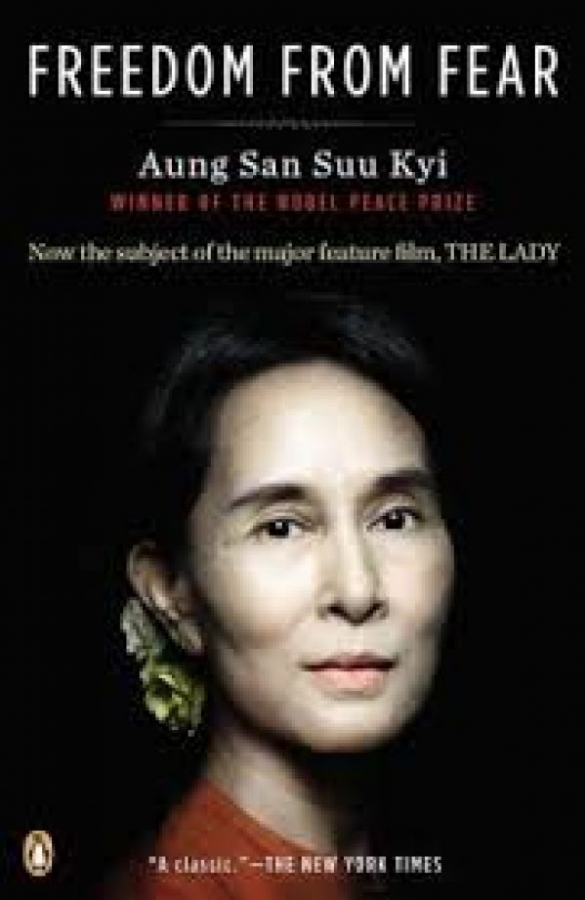
Finished reading on: December 10, 2014
Freedom from Fear and other writings
AI Translation Notice: This review was translated from the original Italian using artificial intelligence. Book quotes and excerpts are translated interpretations and will not match the author's original English phrasing or official published translations.
San Suu was born in 1945, two years before the assassination of her father, founder of independent Burma and national hero.
This biographical detail is essential to understanding this collection of essays, speeches, letters, and interviews, published between 1984 and 1994.
Aims and prose vary, circumstances change, yet San Suu’s concern always shines through: to understand her father’s legacy,
to communicate what she has understood and to apply it to the problems of her own country
.
The essay that lends its title to the collection (Freedom from Fear) must not mislead: San Suu is not a moral philosopher, a sort of modern holy figure; she is, first and foremost, a political persona, characterized by a strong and prevailing ethical dimension.
When the Burmese dissident calls for liberation from fear and corruption, she intends to assert
the firm conviction in the sanctity of ethical principles combined with a historical vision: despite setbacks, the human condition is placed on an ultimate path of spiritual and material progress
.
In a recent speech at the International Women’s Forum, San Suu defined politics as
the means to change society, and the change must be effective, not symbolic.
And how effective it is depends on how correctly we evaluate the needs of the people and the country
(quoted in La Stampa, 9 December 2014).
That this is a long-pondered reflection emerges from a key essay included in the collection (Quest for Democracy).
In it she affirms that
the true measure of the justice of a system is the amount of protection it guarantees to the weakest.
Where there is no justice there cannot be a secure peace
.
We are speaking, therefore, of social justice, certainly not of abstract concepts belonging to the realm of philosophy and religion.
To properly interpret San Suu’s thought, one must read the insightful analysis the author provides of intellectual life in Burma and India during colonialism.
It is impossible to summarize such a complex essay: suffice it to say, in short, that the comparison with India allows San Suu to advance a severe critique of Burmese culture, of Buddhism itself, a “monolithic religion (...) with inflexible barriers”; to identify the sources of the regime’s consensus not so much in repression as in ethnic differences and chauvinism against Chinese and Indian communities; and to clarify how her inspirations are Gandhi and, above all, Nehru, her true spiritual father: a great politician, therefore, is her touchstone.
If one does not stop at the vacuous, banal words of Freedom from Fear (but why does it lend its title to the collection?), one realizes that San Suu has no intention of locking herself within the spiritualist and Buddhist persona that the West would like to assign to her; she wants to be judged by what she manages to achieve for her country.
To those urging her to leave Burma,
I replied that I would do nothing from abroad, and that if I wished to commit myself to a political movement, I would have to do so from within the country
.
Having read the entire collection, one asks oneself: has San Suu truly reckoned with her father? The answer is no.
The daughter, San Suu, continues to idealize the father figure, without asking herself why the dictatorship originated in an army forged by her father: a man educated in monasteries, yet trained militarily and politically by the Japanese.
As often happens, filial love compromises the lucidity and detachment that are, in any case, necessary in a political figure.
Why not read it? It is dull, perhaps pointless.
fragmentary, repetitive, and prolix.