Finished reading on: December 09, 2006
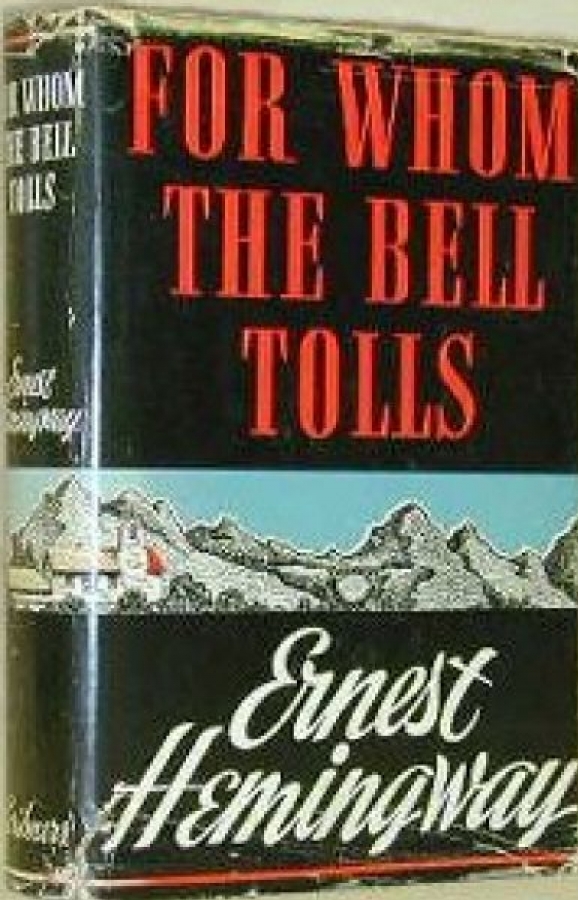
For whom the bell tolls
AI Translation Notice: This review was translated from the original Italian using artificial intelligence. Book quotes and excerpts are translated interpretations and will not match the author's original English phrasing or official published translations.
The novel is set in Spain during the Civil War and unfolds over the course of a few days.
Jordan, an American, is dispatched behind enemy lines to blow up a bridge in support of an offensive by the Republican army.
To carry out this mission, he makes contact with a band of guerrillas, among whom he meets Maria, with whom he falls in love.
The group is led by Pablo, who clashes with Jordan, and Pilar, a fiercely strong and energetic woman.
Despite internal friction, the group accomplishes the mission and Jordan destroys the bridge, but is killed during the escape.
The novel’s true theme seems to be the futility of war, its inherent cruelty, manifested on both sides of the front.
Powerfully tragic are the pages describing the capture of a town by Pablo’s band and the slaughter of the Fascists: one by one, they emerge from the church where they have been imprisoned and are forced to pass between the ranks of villagers and partisans, only to be hurled into a ravine.
At first the crowd hesitates, but soon hatred and bloodshed take over.
The same cruelty is pursued by the Fascists in the murder of a group of partisans who are decapitated.
The anticipation of the final assault, the presence within the partisan group of a boy still very young who, shortly before dying, defends the integrity of a Communist party leader whose son has taken refuge in Russia, and the tragic impossibility of Jordan’s band to intervene and help represent magnificent moments in the novel that, more than any others, convey the cruelty of war.
Yet war is not only cruel, it is also futile; moreover, it is senseless, and it always ends in death:
whether one is afraid or not, death is difficult to accept: there is no sweetness in its acceptance
.
The characters are caught in a machine whose futility and absurdity they grasp, yet from which they cannot break free.
The destruction of the bridge is utterly pointless, as Franco’s army is aware of the Republican attack and possesses superior air power, thus making it highly probable that they will repel the offensive.
Jordan tries to warn the Republican army commander, but bureaucracy, mistrust, and infighting prevent the message from arriving in time.
And Jordan knows that «he will still have to destroy the bridge».
Except for Pablo, who is a murderer, all the other characters are conscious of this cruelty: from old Anselmo, who does not want to kill yet finds himself forced to do so, to Jordan, who reads the letters of a slain soldier, making it starkly evident that he was a young man, with his own loved ones, likewise swept up in a senseless civil war.
War overwhelms personal feelings as well.
One must not dwell on loved ones or newly found love; the absurdity lies in Jordan, at the point of death and having had to leave Maria behind, deeming himself fortunate to have lived his final days with Maria’s love.
Hemingway’s style is highly articulated, more effective in its descriptions than in its dialogue, which at times proves repetitive and tedious.