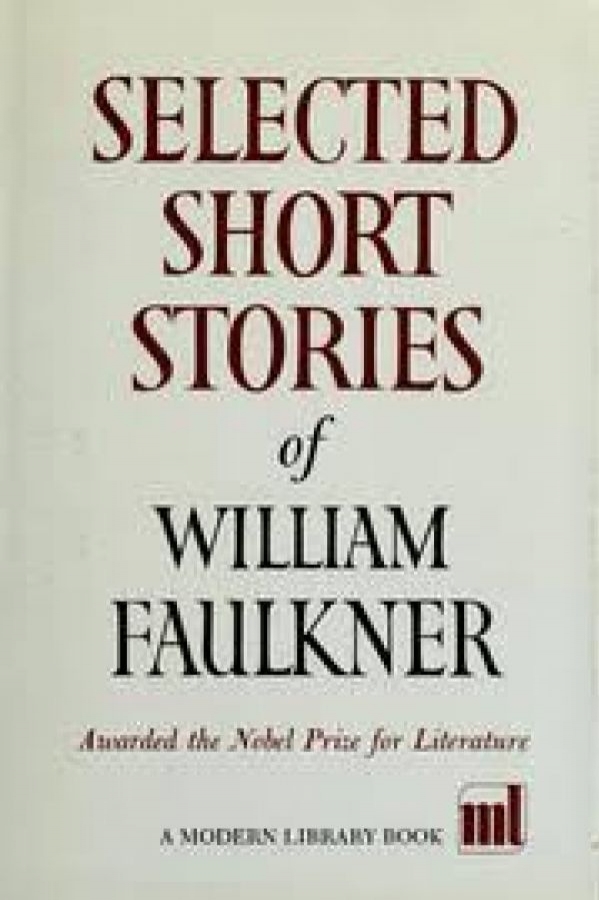
Finished reading on: August 28, 2017
Red Leaves
Title of the original version reviewed: «Foglie rosse»
AI Translation Notice: This review was translated from the original Italian using artificial intelligence. Book quotes and excerpts are translated interpretations and will not match the author's original English phrasing or official published translations.
For William Faulkner, the short story is akin to poetry, "almost every word must be the right one"; and indeed, the narrative is dense, hermetic, rich in symbolism, and difficult to interpret.
As in Red Leaves, the very choice of title raises numerous questions: what does it signify? For some commentators, the writer intended to refer to the cycle of the seasons, thereby emphasizing that what suffocates and destroys the Negro people is a natural destiny.
The red leaves are said to express an existential, cosmic condition, as in Giuseppe Ungaretti’s poem addressed to the soldiers of the First World War: "Like leaves on trees in autumn."
A great Indian chief has died; as tribal tradition dictates, those who served him in life (the dog, the horse, and his Negro slave) must follow him into the grave.
Two Indians head to the slave quarters to retrieve the man.
What disgusts them is the stench of the bodies, a revolting smell.
The Negroes
seemed to be suspended as upon something remote, inscrutable.
(...) They were like the roots of a great uptorn tree, the earth momentarily sheared away from the contorted, thick, fusty maze of its outraged and despairing life.
From what the two men say, we learn that slavery is a burden, the fruit of the pure Indian people’s contamination by the white man.
Born of a mixed marriage between an Indian and a white woman, the deceased himself had been to Europe and returned with several objects whose utility he did not understand; among them, a pair of red slippers; whenever his son tries to put them on, he falls into an unconscious state.
What does this mean? Perhaps because
this world (...) is being ruined by white men.
We got along fine for years and years, before the white men whooped us into using negroes.
In the old days the old men sat in the shade and ate parched corn and venison slowly over the fire, and smoked and talked about honor and big things; and now what do we do?
Contamination does not break the absurd ritual of death, as if to say that white, technological, and advanced society reinforces ancestral customs rather than evolving them toward civilized forms.
It is mere corruption in an immobile society; it is not progress.
Faulkner’s reflection does not concern only the American South, which, at least from what we know, seems trapped in nostalgia for the past; consider certain phenomena that strike us as inexplicable—femicide, infibulation, brutal exploitation—so widespread in our advanced Europe, despite proclaimed laws and values.
Only individual acts of Resistance can overcome corruption and generate new visions and moral rules.
Paradoxically, this is what the victim in our story does.
The Negro, destined to follow his master into the grave, flees into the forest and, when captured, fights for life until the very end: he amputates an arm to survive the bite of a venomous snake; he accepts water on the brink of death.
It’s just that I didn't want to die, he said.
Then he said again, it’s just that I didn’t want to die, in a quiet tone, of slow, faint wonderment, as if it were something which, until the words had formed themselves, he had not known, or not known the depth and measure of his desire
.
The death endured, without resignation yet with equanimity, bears witness to a moral strength absent in the story’s other characters, corrupted by white society while trapped in ancestral rituals.
The Negro was still about to step, his knee raised and bent, his head up as if he were looking into the teeth of a millrace.
The pupils of his eyes were wild and cold, like a horse’s
.
Ralph Ellison, the first great African American writer, said that Faulkner
has actually explored the nature of man.
(...) Faulkner, more than most men, was aware of human strength as well as man's weakness.
He knew that understanding and overcoming fear was a large part of a writer's reason for being.
Faulkner’s narrative is imbued with a strong ethical tension, a desperate quest for human goodness, for that which is deepest in the human being.
He pursues this aim within his world, the American South, where everything in reality seems static and violent; yet what he narrates concerns us all; and quoting Ungaretti once again, one could say: "I seek an innocent country."
At the center of his writing is the word, not the plot or the characters; and this is precisely its limitation, at least in the short stories: it is difficult to understand, it must be read too many times to grasp its manifold meanings, it demands too much imagination to interpret.
Why not read it? It is difficult to interpret and, in fact, boring.