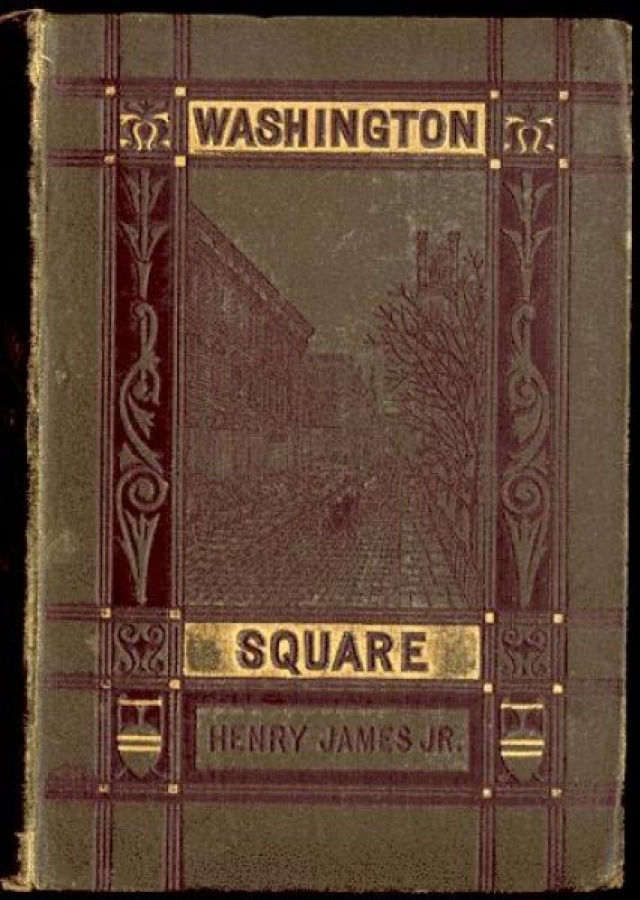
Washington Square
The book is set in late nineteenth-century New York. Catherine, the daughter of a prominent physician in the city, is courted by a young man who is interested in her dowry. Catherine’s father refuses and declares that he will not grant the girl her inheritance. A romantic drama unfolds, in which Catherine’s aunt assumes an important role: a woman who, driven by a romanticized conception of love and the futile pursuit of extraordinary occurrences, wishes the girl would abandon her father and marry the young man regardless. Following a journey to Europe with her father, Catherine realizes that he holds no esteem for her whatsoever, and decides to marry the young man even against her parent’s will. Yet the young man, who had hoped the father would change his mind, abandons the girl, knowing he cannot gain access to the doctor’s fortune. Years pass, Catherine does not marry, and after her father’s death the young man reappears—now an aging man—hoping to resume their former relationship. But Catherine turns him away. The underlying theme of the book is the story of a young woman who is the object of the aspirations and notions of others. The father believes his daughter to be foolish, devoid of qualities, and maintains toward her until the very end a contemptuous attitude, aimed more at asserting his own intellect and foresight (he had grasped from the outset that the young man was after the dowry) than at considering his daughter’s feelings. The aunt is in search of emotional thrills to fill her life and does not consider that her actions (her friendship with the young man, her attempt to manipulate the girl, etc. ) might cause harm to the point of ruining Catherine’s life. The young man is patently a scoundrel, a vacuous figure who seeks until the very end to use the girl to secure a position for himself, unconcerned about returning after so many years to wound her anew. Throughout this story, Catherine’s personality gradually emerges; she finds the strength to take a solitary stand, determined not to compromise with anyone, even at the cost of her own happiness. She has been and continues to be manipulated; her father holds an opinion of her shaped by stereotypes, yet she lives her own life, now indifferent and in opposition to those around her. To the young man, now a mature man, who asks if she is angry, Catherine replies: > no, I am not angry; anger does not last that way for years. But there are other things. Impressions that endure, when they have been strong. But I cannot speak... Catherine picked up her knitting needles, sat down with them again, for life, as it were .

We need new names
The author was born in Zimbabwe and has lived in the United States since the age of eighteen. The novel unfolds across these two worlds, so different yet fundamentally similar, because in both the individual is torn apart and oppressed by the violence of circumstances and of men. The first part of the narrative, undoubtedly the most accomplished, is set in a Zimbabwean village: > Paradise is a cluster of tin cans spread out in the sun like wet sheepskin pegged to the ground to dry; the shacks have the muddy color of dirty puddles after the rains. The shacks themselves are hideous, but from here they look much better, almost pretty even, as if looking at a painting . Darling, protagonist and narrator, guides us through a succession of episodes, scenes of the country’s material and moral devastation. It is a story told through the eyes of a gang of children, who reenact through play the dramatic circumstances they are forced to witness. When two BBC reporters ask with astonishment what they are doing among the graves of the village cemetery, simulating death and burial, the leader of the little gang replies with equal astonishment: “Can’t you see this is reality?” On the other hand, through play, the children manage to rid themselves of the anger that oppresses the helpless adults like “a big, terrible, toothless dog.” At a certain point, nothing remains but flight. > Look at them leaving in droves, the children of the land, just look at them leaving in droves. (...) Moving, running, emigrating, going, abandoning, walking, leaving, flying, fleeing; everywhere, to countries near and far, to countries never heard of, to countries whose names they cannot pronounce. (...) Look at them leaving in droves despite knowing they will be received with suspicion in those strange lands to which they do not belong, knowing they will have to sit on one buttock because they must not sit comfortably, so as to be ready to get up and leave, knowing they will have to speak in whispers because their voices must not drown out those of the natives . Darling goes to America, taken in by an aunt. It is still she who tells us the story of a young girl becoming an adolescent in a world that is not hers, but inevitably must become so. It is not the America she had dreamed of when she lived in Zimbabwe. > This place doesn’t feel like my America, it isn’t even real. It is as if we were in a terrible story, as if we were in some crazy part of the Bible where God is busy punishing men for their sins and making them miserable. (...) In America the streets are like the devil’s hands, like God’s love, reaching everyone, only the sad thing is that these streets don’t really take me home . The young Darling grows up like any Black American teenager: she integrates seamlessly, yet the events involving her, the friendships and the people she encounters, continually draw her back to her childhood, to her playmates, to her native land. One day, to return home—if only via the internet—she connects via Skype with her mother in Zimbabwe; instead, a childhood friend answers. Darling adopts the typical attitude of Westerners toward Africa, expressing our solidarity from afar, comfortably and complacently, with the suffering of these peoples. > But you are not the one suffering (her friend reacts). You think watching on the BBC means you know what is happening? No, you don’t; (...) it is us who are here who truly feel the suffering, so it is us who have the right to say something (...) If it were your country, you would have loved it enough to live in it and not leave it. You had to fight for it (...) You left it, Darling, my dear, you left the house burning and you have the nerve to tell me with that stupid accent (...) that this is your country? (...) Her sarcastic tone (...) slaps me in the face, catching me by surprise. I am so shocked that I don’t know what to say . One must belong somewhere; one cannot remain suspended between too many worlds, as an outsider. We must have new names, live new experiences intensely, become involved, feel part of something. > When someone speaks about their home, you have to listen carefully because that way you know exactly who they are . This complex and profound book conveys something else as well. In the final pages, Darling remembers (or perhaps merely dreams of) when, as children, they used to play at catching Bin Laden. It was not a very amusing game, so at a certain point the little gang turned their attention to an old dog, solitary and cantankerous, standing in the middle of the road. Suddenly a truck came along and ran over the animal, crushing it to a pulp without killing it instantly. And it is with this terrible image—of laceration and incomprehensible death—that the author closes the book. Then we understand what the novel’s title means: we need new names to speak of displaced peoples, to integrate with other cultures and customs, but we also need new words to narrate the blind violence that oppresses and divides us all, Westerners and non-Westerners alike, binding us to a common destiny. The prose is the fundamental triumph of this splendid book. The author moves across two worlds that are distinct from a stylistic standpoint as well. In the first part, the English language is interwoven with vocabulary and idioms from the native tongue, leading the reader to identify with the places and the people not merely through the story, but above all through the use of language. When she turns instead to Darling’s adolescence in America, the author frequently resorts to youth slang, without overlooking the linguistic hybridity of the diverse ethnicities that comprise the vast immigrant populace. There is, moreover, a stylistic nuance that reveals the meticulous craft of the writing. When Darling speaks in America of her homeland, she no longer uses that creative blend of English and native words: her gradual estrangement from her land is mirrored in her language, increasingly detached and sterile. It is reflected, ultimately, in her consciousness. Why read it? It is a book of exceptional caliber, truly beautiful.
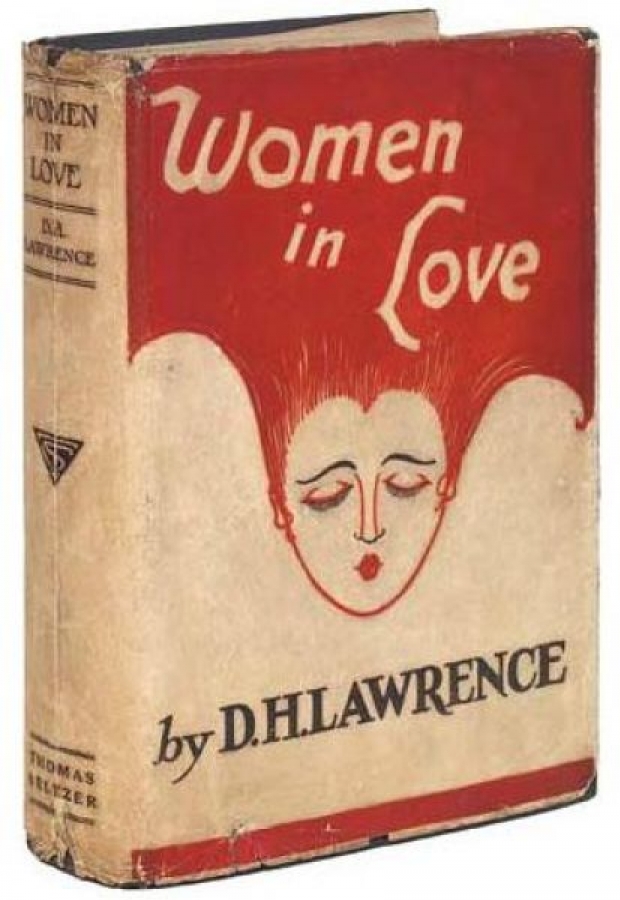
Women in love
The narrative unfolds within a framework of relationships among four protagonists: two men bound by a close friendship, and two sisters, both young schoolteachers. The historical context is England in the second half of the nineteenth century, marked by the advent of machines, positivism, and a yearning for a poetic world, epitomised by the English countryside. The two men operate within the roles assigned to the male by English society. Birkin is a romantic young man who seeks in woman a submissive companion (a wife and a mother), believing that true friendship, essential to a man's completeness, is that shared with other men. One might say his touchstone is Plato's *Symposium*, even if he does not go so far as a homosexual relationship—which, in fact, he gently declines when proposed by his friend. Gerald is a young engineer, a wealthy industrialist who has radically overhauled the organisation of the mines he owns, defying his father’s authority. A horrific childhood incident (he inadvertently contributed to his brother's death), a troubled relationship with his father, and a positivist world-view—which nevertheless conflicts with profound inner torment—conspire to lend him an outward confidence while driving him to seek comfort and solace in woman. In him, male friendship borders, almost overtly, on the pursuit of a homosexual relationship. While the men serve as a point of reference, locked as they are within their social roles and their egos, it is the two women who shatter convention entirely: and this not out of an impulse toward social emancipation, but because sensuality and physical restlessness contribute to subverting the concept of woman as wife and mother. It is Ursula, one of the sisters, who entices Birkin, drawing him into a sexual relationship—intensely erotic even by contemporary standards—that the man himself perhaps did not seek. It is Ursula, once again, who resists marriage, prevaricates, and, when she finally yields, finds herself in conflict with her parents. Gudrun's personality appears more complex: she too is driven by a powerful sensuality, which is sublimated into an intellectual quest for freedom, for an unconventional life. Her relationship with Gerald develops precisely around this contradiction: on the one hand, she experiences a fierce physical attraction; on the other, she disdains him for his prosaic nature, for his conventional view of gender roles. From this contradiction the final tragedy erupts, in which Gerald attempts to kill the young woman before taking his own life. Alongside the protagonists stands nature, which forms an integral part of the tale. It is a kind of pantheism, a living nature that merges with the protagonists: > nothing else would work, nothing else would give satisfaction, except this coolness and this netting of vegetation, which penetrated into the blood. How fortunate he was that there was this pleasant, subtle vegetation interacting, waiting for him as he waited for it; what a fullness, what a joy! . Yet nature also leads toward dissolution, toward death. > A small, bright moon shone just ahead, a brilliant thing, a bearer of sorrow, that was always there, eternal, from which there was no escape. He (Gerald) wanted to go to the end, he could bear no more. Yet he could not sleep . The plot unfolds slowly. At the outset, there is the depiction of the small English town along with the introduction of the protagonists. In truth, these appear as standalone scenes, unframed by a broader narrative arc. Each of these scenes is meant to introduce certain interior themes, tied to the web of relationships, which will later erupt in the second half of the story. At times, the author embarks on digressions into social philosophy, using the protagonists (Birkin in particular) as mouthpieces. The death of Gerald's father and the erotic scene between Ursula and Birkin mark the turning point of the novel, which moves, ever slowly, toward Ursula's marriage to Birkin, Gudrun's decision to enter into a romantic relationship with Gerald, and ultimately the journey to Austria, amidst the snow and cold. Here, Gerald's jealousy of Gudrun, his realisation that he cannot master the young woman, and her decision to leave him drive everything toward the final tragedy. The writer writes exquisitely, with a style steeped—both in its diction and in the cadence of its prose—in a pantheistic sensualism reminiscent of D'Annunzio. The two authors appear remarkably similar in the elegance and refinement of their language as well.