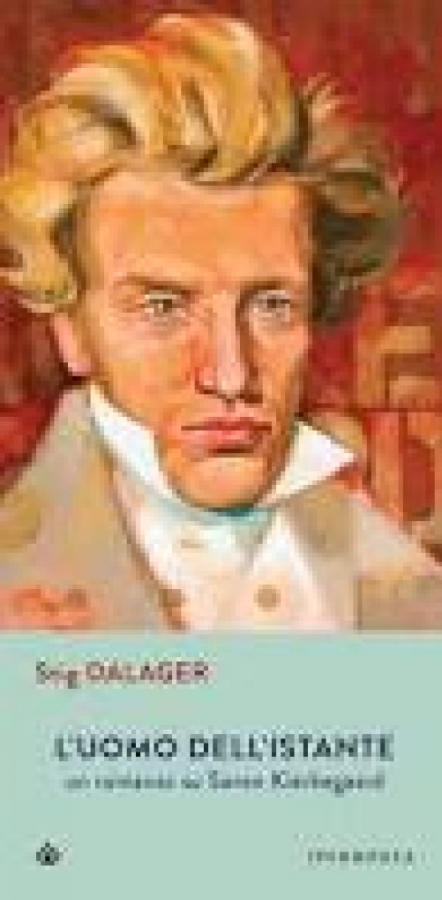
The Man of the Instant
> My illness is fatal and death is necessary to the cause to which I have long dedicated all my spiritual resources, for which I alone could fight and I alone was designated . Dalager imagines that with this sentence Søren Kierkegaard encapsulates the diagnosis of his ailment, and his destiny, at the moment he has himself admitted to the hospital in Copenhagen, in 1855. He is a broken man: alone, reduced to destitution, despised and derided by his fellow citizens, persecuted by the Lutheran Church, which considers him a madman and a heretic. In his brief life—he was born in 1813—Kierkegaard produced a vast body of work revolving around a concept revolutionary both then and now: man's essence lies in choice and in the "ardour of freedom" that underlies it. > If a man could always maintain himself upon the pinnacle of the moment of choice, if he could cease to be a man, if in his inmost being he were merely an ethereal thought, (...) it would be foolishness to say that for a man it might be too late to choose, because, in the deepest sense, one could not speak of a choice . Yet man > constantly rushes forward and poses the terms of the choice now in one way, now in another, so that the choice in the following moment becomes more difficult, (...) because when choice is deferred, the personality chooses unconsciously, and the dark powers decide within it . To avoid being dragged along, one must choose oneself, > as a free spirit (...) born of the fundamental principle of contradiction, born by virtue of having chosen himself. (...) This troubles him, yet so it must be: for when the ardour of freedom has awakened within him, (...), he chooses himself and the struggle for this possession as for his supreme salvation, and this is his supreme salvation . (*Either/Or*, pages 39, 40 and 93 Ed. Mondadori 1956). It was no easy task to fictionalize the life of a philosopher seemingly alien to his time, almost detached from reality, concerned with another realm: consciousness. Dalager succeeds brilliantly because Kierkegaard is captured in a state of extreme vulnerability, in the days preceding his death, when the courage to live is now bound solely to memory, not to the present instant. > To him, memory is exceedingly young, like water meandering through the desert of life; it always tells the same story and soothes his pain, (...) but his remembering is not that of the old, of things distant in time. For me (Kierkegaard writes to his beloved, Regine) every harmonious contact between the idea and life is instantly transfigured into memory. (...) In memory (Dalager adds) there is something distant that has lost the sting of grief and retained the sweetness of melancholy . Now dying, frail, subjected to humiliations like all terminally ill patients, reduced to his fragile physical nature, in his mind Kierkegaard retraces the fundamental milestones of his life: his severe and authoritarian father, an affectionate mother who would die far too soon, the many brothers and sisters who would not reach the age of thirty; his promising studies that already pointed to an independent and overly brilliant student; the engagement to Regine and the decision to break it off (the pivotal episode of his life, to which he would constantly return in memory); the sojourn in Berlin, officially to attend lectures on German philosophy, but in reality to write desperately and in solitude; and finally the last chapter of his life, ever more steeped in spirituality and faith, yet ever more critical of ecclesiastical authorities and official religion. The lengthy biographical digressions, frequently underpinned by passages from Kierkegaard's works, alternate with glimpses of hospital life, returning us to the reality of a suffering, terminally ill patient. > In the dark he feels a hand succouring him, helping to lift his frail body just enough, (...) for a moment he thinks once again that he is near death. Instead, he succumbs to a deep sleep that leads him into a hidden room of the soul, similar to the room of his childhood (...) yet different, because along the walls are the beds of all his brothers and sisters (...) voices and laughter blend together. until suddenly their mother appears, singing something to lull them to sleep. (...) Where are you going? his mother asks him. Toward my death. And already here, she replies, you are in eternity. The narrative is very well written, and this is its primary virtue. Its flaw lies in the work's spurious nature: it is not a biography, because there is too much fictionalization, beginning with the brilliant literary device of the dying Kierkegaard; it is not a synthesis of the Danish philosopher's thought, even though Dalager frequently delves into illustrating his major writings, rendering the narrative long-winded and intricate; it is not a novel, because the psychological analysis of the protagonist is deficient and the characters are flattened into their historical dimension. In particular, one theme of great interest remains unexplored: the narrative reveals how Kierkegaard regrets the choices he made, especially the breaking of his engagement to Regine. The desire to choose breeds anxiety, and it is better to be carried along by events—this is part of the Danish philosopher's thought. Yet why did Kierkegaard make certain choices that he would later, in some way, perceive as detrimental to his happiness? What prevented him from giving tangible form to his love for Regine? Was it enough for him merely to fantasize and write about it, as he did in *The Seducer's Diary*, moreover without the slightest regard for Regine? Is there not in Kierkegaard a narcissistic desire for manipulation and complacent superiority that makes him resemble a cynical seducer more than the noble moral figure he purported to be? It would have been interesting to investigate these aspects of Kierkegaard's character and life, for what would have emerged is a far more complex personality than the one portrayed in this novel. Why not read it? It is not an introduction to Kierkegaard; it is a middle ground that leaves one unsatisfied.