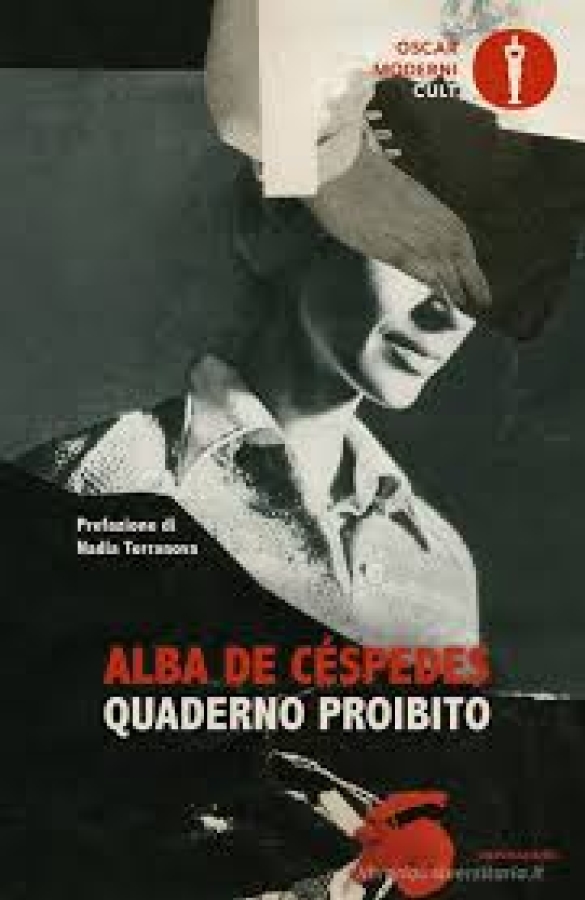
Forbidden Notebook
If in Dan Sijie's *Balzac and the Little Chinese Seamstress* (see the review on this site) a country girl > learned from Balzac that a woman's beauty is a treasure beyond any price , for Valeria it is the purchase of a notebook through which a mother and homemaker, by now known to everyone simply as “mammà,” can guiltlessly live out > her secret of still being Valeria. It is not merely a diary, but a “forbidden” hiding place; on the other hand, > all women conceal a black notebook, a forbidden diary. And they must all destroy it. It is from the vantage point of a notebook—a singular and magical perspective—that a story unfolds set in the 1950s, in an impoverished and traditional Italy, yet already transforming through nascent economic development. The first-person narrator is Valeria herself, of course; an efficient and busy mother, she discovers that > learning to understand the smallest things that happen every day is perhaps learning to truly understand the most hidden meaning of life. But I do not know if it is a good thing; I fear not. (...) This notebook, with its blank pages, attracts me and at the same time dismays me. Through the forbidden diary, Valeria realizes that her husband, on the surface so attentive, has encased her in the stereotype of the good wife and mother, while concealing from her, he too, that he has written a novel and hopes to publish it. Her two children as well, the rebellious Mirella and the fragile Riccardo, see her in that same role, never imagining that another life could be possible for “mammà.” She realizes how within the family, > despite loving each other so much, we defend ourselves from one another like enemies. To her daughter, who sees she is tired and would like to help her, Valeria says: > do not trouble yourself with these things, Mirella. (...) Then more softly, I added: “Leave,” (...) I fear there are many ugly things here, many lies. Perhaps I will never tell you again, but remember that I told you tonight: save yourself, you who can do so. Leave, hurry. (...) No, I am petty-bourgeois, and I am more familiar with sin than with courage and freedom. As Maria Luisa Spaziani says in the poem *The Present*, > now I know what living is: a cruel game that nails every fiber deep to the wheel of time. In *There's No Turning Back*, upon leaving the boarding school and taking different paths, all the friends will in some way betray the fullness and multiplicity of female nature, resigning themselves to the role—traditional or transgressive—that we assign to women. In *Her Side of the Story*, only an extreme act, the murder of her husband, saves Alessandra from a life that fails to satisfy the depth of the female soul (see the reviews of these two novels on this site). In *Forbidden Notebook*, there is no way out: the family is a cage too powerful and cruel to allow a woman to fulfill herself as an individual, outside the role of wife and mother. As Nadia Terranova says, > writing is always a subversive act, the reappearance of conflicts even when one seeks to erase them. Beyond the plot and characters, which are fundamentally ordinary, this is the truest meaning of the novel; > writing is never innocent, it refuses to stay in its place, and it is anything but abstract: it overflows onto bodies, it reverberates across faces. Only by throwing “the book” into the fire is it possible to prevent women and men from winning their freedom. De Céspedes' writing is elegant and airy. The plot frequently turns back on itself, waiting for a resolution that arrives, perhaps, too late; a love of detail often drives the author to repeat herself, in elaborations and episodes that are redundant and unnecessary to the narrative. It is the point of view, “the forbidden notebook,” that prevents the novel from being a typical family story, giving it a cohesion and originality that it would otherwise lack. Why read it? It is the desire of us all to keep a diary, but we are afraid to. , Mire
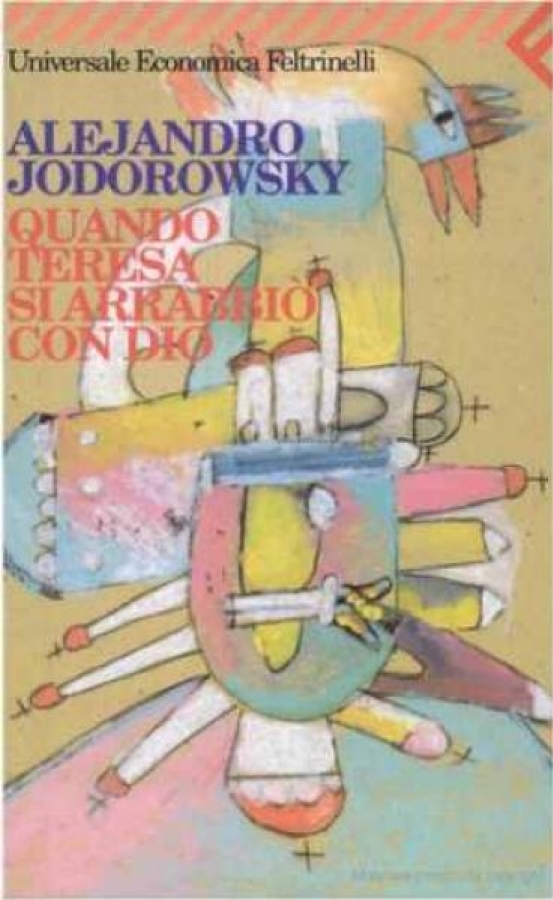
When Teresa grew angry with God
It is the story of Alejandro’s ancestors, from their European-Jewish origins to their South American tribulations. They are all incredible characters with equally implausible life stories. The novel unfolds from the stories of the great-grandparents to the meeting of the parents, tracing a trajectory that moves from a delirious irrealism to an increasing verisimilitude of events and protagonists. It is impossible to summarize the contents of the novel in a few words: its fundamental themes can be clarified through the author's own words: > we are not the anarchists who rebel against God, Science, and the state. Nothing of the sort. Nothing can change the course of the Industrial Era... the important thing is to survive, and to do this we need no raw material other than the imagination . History, current reality, humanity, the entire world (present, past, and future) must be seen through imagination and myth, which exalts the traits of individuals, making possible situations and events that, if reduced to a concrete realism, would make living an extremely heavy burden; > do not ask yourself who you are, because you are no one. You have never existed. Like me... We are impostors in this world that is inauthentic, where there is nothing true and reality is a mirage. Uniforms everywhere, copies of copies of copies, every garment, every body, every soul is a disguise... we have been dead since the beginning of time. No one was ever born... Strangle me, deliver me from this lie ; > I do not know whether the memories prior to my birth correspond to the truth or are merely dreams. It does not matter. In any case, reality is the progressive transformation of dreams, there is no other world than the oneiric . The style and narrative rhythm correspond to the expressed content: it unfolds rapidly and convulsively, undoubtedly engaging, yet ultimately so delirious as to become, in certain stretches, tedious and superficial.