
The Day of Judgment
A few years before his death, an illustrious jurist retraces his childhood in a timeless Nuoro; and > as in a developing negative, distant faces reappear, (...) and perhaps, as I think of their life, because I write their life, they sense me as a ridiculous god, who has summoned them on the day of judgment, to free them forever from their memory . It could easily be a mundane autobiography, interesting merely for its depiction of a Sardinia (between the nineteenth and twentieth centuries) where there still existed > a magical sense of things, whereby every act was a ritual, every word the echo of another word, every occurrence a mystery , and the only hope was «to create ghosts to cling to». Were it only this, the book could rest forever on dusty shelves, alongside all too many family chronicles and nostalgic, often folkloric descriptions of a society that no longer exists and can never return. The novel endures, however, beyond its context, because it speaks of another matter altogether: death as the dissolution of memory. Since > each of us, even if we merely look within ourselves, sees ourselves in the fixity of a portrait, not in the succession of existence , the novel is likewise composed of characters and episodes that appear, at first glance, isolated and repetitive; the reader derives from it a sense of fragmentation and incompleteness, of a confused and superficial narration. One longs for more, especially when the author addresses the core of the narrative: the patriarch father, authoritarian and absent; the mother, seemingly marginal yet pivotal in the care of hearth and children; the numerous siblings; the manifold books gathered with love, through which > fantasy entered the austere house (...) and operated silently, touching men and things with its magic wand . We would like to know more of young Sebastiano (behind whom the author conceals himself), of his bond—both joyous and unhappy—with his brother Peppino, of their shared passion for bookbinding, of «a childish industry», meaningless perhaps, yet an expression of the «imagination of the gratuitous». Instead, we are left disappointed, for the myriad stories and characters must converge upon a single objective, both narrative and existential: the day of judgment, the extinction of memory, and with it, of existence itself. Sebastiano is on the verge of leaving Nuoro to study in Sassari. The author treats this episode fleetingly, almost as if he wished to forget it. Donna Vincenza, the mother of many children, > prepared his provisions with good breaded cutlets and sugar-dusted fritters. Sebastiano left it all behind, ashamed of his mother, (...) and departed in the dark of night, like someone eager to belong to others . And what of Pietro Catte, who had gone to the mainland to make his fortune, and who one day stepped off the coach, «amid sneers and taunts», and «like an automaton joined the procession», following the summons of the driver, > the devil himself, with horns and a pointed beard and a twisted tail , who led him to hang himself from a great oak tree. And Gonaria, who spoke with God and was betrayed because God let her brother, the canon, die; whereupon the poor woman locked her brother’s room forever, only to open it twenty-five years later and discover it had become a nest of mice, woodworms had devoured the furniture, and clusters of cobwebs hung from the ceiling. > If one does not die, one lives. And this truth, which seems obvious, is on the contrary fraught with consequences, because life transforms everything; nothing withstands its implacable truth. (...) To know oneself, one must play out one’s life to the very end, to the moment one is lowered into the grave. And even then, there must be someone to gather you up, resurrect you, recount you to yourself and to others, as in a final judgment . It is not an easy book: numerous characters and stories follow one another without any apparent order. Often one must pick up the thread of the narrative again; if instead one surrenders to it, the mind turns to oneself, to one's own life, to the memory of those who shared it with us, and to how this memory has dissolved over time, because «if one does not die, one lives». And then one realizes that it is not so important to keep a «chronicle» of existence as it is to wander in remembrance, because, as the author says, it is not a matter of another’s destiny, but of our own; and there comes a moment when we too face our final judgment. Aiding the reading is a refined, simple, and elegant prose: traces of juridical language can be glimpsed; far from being a flaw, this lends slowness and deliberation to the narrative; it is what one expects, and it keeps the portraits, their characters, and their stories from being trivialized. One must allow oneself to be ensnared by the tale, just as our memory, clouded by time, runs along the course of our life. Why truly remember the past, when it is better to be guided by the imagination? Only myth opens our hearts to mystery. Why read it? Pleasurable and profound.

A Golden Age: Days of Love and War
The novel is set in Bangladesh during the brief yet bloody war of liberation from Pakistan, from March to December 1971. The author traces the events from the perspective of Rehana: a woman who wishes merely to be a wife and mother: > she had married a man she did not expect to love; she lived a life of composure, a life with few surprises. She had asked her father to find her a husband with few ambitions. Someone whose wealth would not suddenly dissolve . And yet the woman finds herself widowed, without an income. Fragile and defenseless, she lacks the strength to prevent her brother-in-law from taking away her two children, Sohail and Maya. The desperate longing to have them back leads her to commit an act inconceivable for her, a religious woman observant of traditional norms: she steals jewels from a blind man and manages to reclaim her children by proving she has sufficient income to raise them. Having allowed her children to be taken from her, even if only briefly, leaves a deep wound; it fosters a sense of guilt in Rehana that shapes her relationship with them. She is a widow; she has left the children fatherless, having chosen not to give them a new parent. When the people in revolt declare the independence of Bangladesh, Rehana > felt certain that everything would resolve itself: (...) the country would become her home, and the children would continue to be her babies. Suddenly the world would be righteous on its own, and they would go on living ordinary, unexceptional lives . Yet, > a war had come to find them. Whatever was going to happen had already happened; now they would have to live in its shadow. We might wish to live in peace, leading an existence made up of small things (cooking, tidying the house, tending the garden, raising children, delighting in their love), but war arrives, and nothing is ever the same again. The novel does not grapple with the grand theme of war and peace; rather, it chronicles the inner journey that leads a slight, thirty-five-year-old woman to take an active role in her people's struggle for freedom, against a cruel and ruthless repression. At first, Rehana does so for her son, who has joined the Resistance; later, she acts out of a commitment to fight for the independence of Bangladesh. Rehana allows the partisans to hide ammunition and dynamite in her garden, shelters an officer of the liberation army critically wounded in an attack, and finally, courageously frees a prisoner by showing up alone at the prison and bribing the guards. Why does she risk her life? > I want to do my part. Maybe it isn't for my son, maybe it is something else. You don't think I can love anything other than my children? I can, I can love other things. Along this journey there are two pivotal moments in which a sort of stripping away of her innermost essence takes place. At her daughter's request, she decides to use her most precious fabrics to make blankets for the partisans: > the saris lay before Rehana like images in a photo album, evocative, a little accusatory Yet why not do it, if Maya dressed in white (the color of widowhood) to signify her contempt for luxury, and perhaps also an everlasting mourning for her father? > We are at war, (...) To prove that I belong here. That is why I am doing something . She severs ancestral ties as well. At the war's end, she visits her brother-in-law in prison—he who had fought and tortured partisans, and who now appeals to family ties in asking her to secure his release. > She is about to utter the obvious, expected words—“out of respect for my husband”—but then the sight of all of them, Joy and Aref and Mrs Sengupta, appeared before her. Yet even so, she might have forgiven him, but then she remembered the look on Maya's face when she learned of Sharmeen (her daughter's best friend, raped and slaughtered), and those first days of the war when she realized she would not emerge from it with her entire world intact And she said: > I cannot forgive you, brother. For my daughter's sake, I cannot forgive you. It is an intense book, in certain passages rich in action, which lends pace and suspense to the narrative. The author skillfully navigates two planes: family relationships and grand History, which, as is often the case, is compressed into a few months. The pivot around which the tale revolves is the mother-daughter relationship. For Rehana, it is taken for granted that Sohail will commit to the struggle, even if she is overwhelmed by fear for his life. She does not accept Maya's behavior. Toward her daughter, social prejudices and difficulties in communication and mutual understanding converge. When Maya leaves her mother to cross the border, intending to fight from there for the revolutionary cause, Rehana expresses her anguish and urges her to be careful. Yet her daughter tells her that it is she who is always worried about her mother. > Rehana was surprised to hear these words, but she understood that it had to be true, (...) a small window into her daughter's sealed heart. It was not that she was distrustful; she was burdened. Burdened by her beloved father, by the one who was gone, by her own widowed mother . It is a pity that this splendid book falters in its ending, which is muddled, rushed, and in certain respects implausible. The book is sustained by an elegant style, simple and effective syntax, and vocabulary that is refined in English while simultaneously enriched by words and idioms native to Bengali. Here we encounter that long-awaited blending of English with the local tongue, rare among writers of the Indian subcontinent. Why read it? A magnificent read, which transcends the specific history of Bangladesh to become a tale of all wars of liberation.
The Great Heist of Crimson City
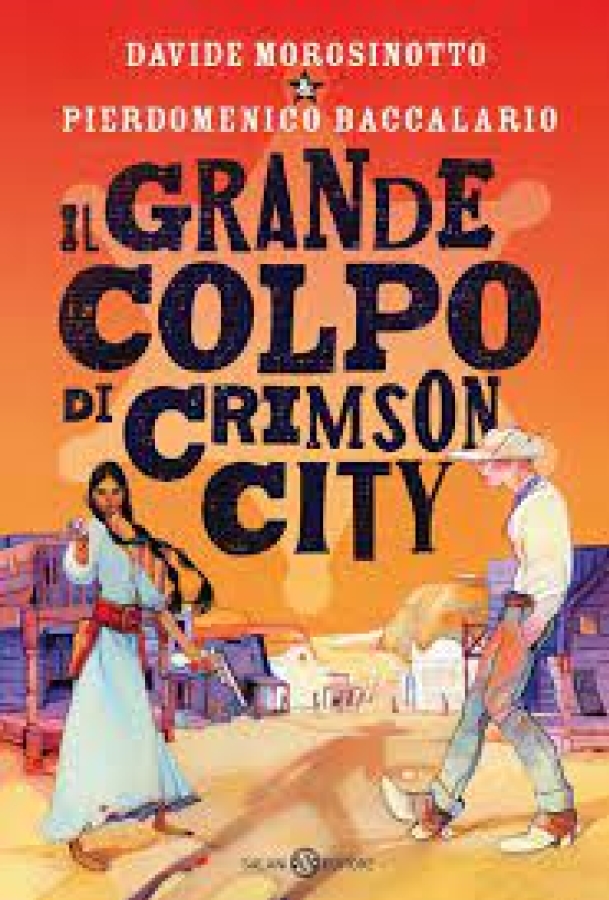
Crimson City > had only a single dusty street that branched off at one point into a single dusty crossroads. A church, a laundry, a post office, a general store, a bank, a hotel, a saloon. Everything had a rundown, filthy appearance, bleached by the sun, as if the surrounding desert were trying to swallow the town one bite at a time, (...) as if into the space of twenty houses and three streets they had crammed an assortment of wreckage and remnants of a real city, one with a plan, an intention, a future. Roy had arrived a few years ago. > He's a good kid, the sheriff said hastily. > Just think: he stepped off the train all by himself eight years ago, and he’s been here ever since. (...) He works hard, never a complaint. He’s become one of our own. One day, two people arrived from the desert: a man, whom everyone took to be the famous Sheriff Pickett, and a half-breed girl, who introduced herself as his sister. Piper > was so swaggering, tough, sleek, with two pistols strapped to her thighs, slender bones, spring-loaded muscles, and a devilish glint shining in her eyes. They had received a letter from the sole survivor of the Gordon brothers' outlaw gang—men cut down by Sheriff Pickett, evidently all except one, who was now seeking vengeance in a duel, right in this miniature town. While the townsfolk, trembling yet thrilled, awaited the killer's arrival, love blossomed between Roy and Piper: the boy seemed timid and apprehensive before the brazen, weapon-savvy gunslinger; Piper began to be drawn to Roy’s gentleness and naivety, apparently fragile and defenseless. Are we facing the classic tale of a romantic boy who falls for a mysterious, strange, and stunning girl waiting to be rescued by a knight? Will Roy realize that passion alone is not enough to save his beloved? Much like what occurs in Fabio Geda and Marco Mugnone’s *Il lato oscuro della Luna* (see the review of the novel on this site). Then, suddenly, we discover that Roy is far different from who we believed him to be. The boy is the sole survivor of the Gordon brothers, and he has come to Crimson City to slaughter those who destroyed his family: Sheriff Pickett and his daughter. Will love prove stronger than vengeance, or will Roy press on toward his goal, seeking Piper’s life as well? I leave it to the readers to choose their preference. For my part, I would have welcomed an ending akin to *Il Corsaro Nero*, who fell in love with his enemy's daughter yet pursued his revenge, abandoning his beloved in a boat adrift at sea. > Amid the moans of the wind and the roar of the waves, muffled sobs could be heard at intervals... Look up there! The Black Corsair is weeping! (you can read the review of Emilio Salgari’s novel on this site). Are we certain Roy came to Crimson City merely for revenge, or did he harbor other motives? The plot is well-constructed. In the first part, the premise of a miniature town cut off from everything—where the sole link to the civilized world is a train passing every two weeks—is compelling: an insular community governed by its own dynamics, waiting for unlikely change. Still, the narrative proves somewhat tedious and flat. Then comes an unexpected twist, and the novella turns into a suspense-laden thriller. Perhaps the resolution should have been less cloying; instead, it lapses into a Hollywood-style "happily ever after." The prose is very simple, perhaps overly so, even for a novel aimed at young adults; the narrative framework relies predominantly on dialogue and action, to the detriment of vivid descriptions and nuanced psychological depth, leaving the characters' choices and motives rather thinly drawn. Why read it? It becomes genuinely gripping after a sluggish start.
The Grapes of Wrath (Furore)
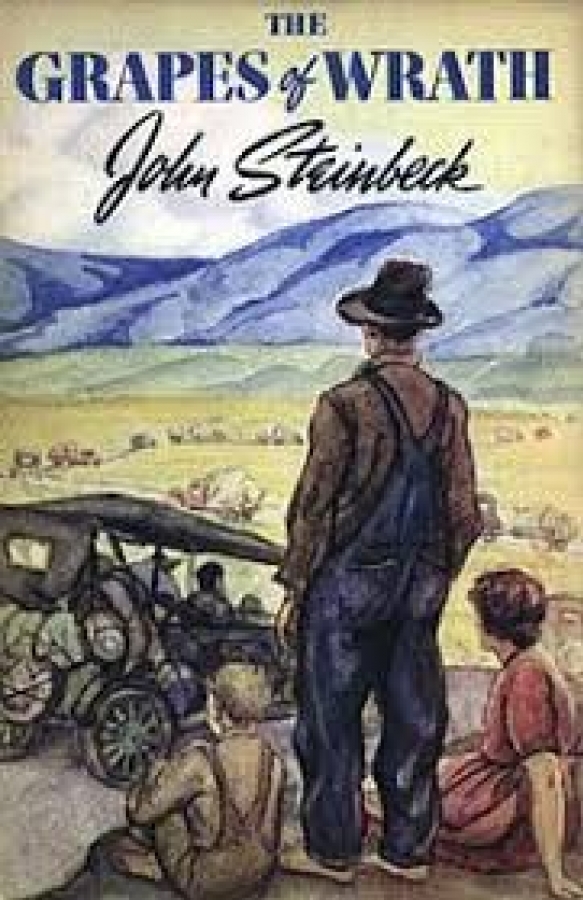
> In the dust there were little craters where the rain had fallen, and there were clean spots on the corn, and that was all. (...) The dust-filled air hung over everything with a softer sound than fog had. (...) The men were silent and did not move often. And the women came out of the houses to stand beside their men—to see whether this time the men would break. Faced with the destruction of the harvest, the farmers and their families stand struck dumb and resigned: an inexorable fate against which, nonetheless, one must fight. The evocative, intense opening foreshadows the novel's two levels: a political manifesto calling workers to unity, organization, and struggle; and a family engulfed by economic crisis yet determined to pursue a dream, setting out toward the promised land, California. > The stars disappeared, little by little, toward the west. And still the family lingered like dreaming wanderers, their eyes cast upon the whole, not seeing the details, but the entire dawn, the entire earth, the complete weave of the countryside, in a single glance. In this review, I will follow the exodus of this family, for this is the very heart of the novel. We can divide the plot into four movements: the abandonment, the journey, the camps and the work, and the final catastrophe. The first, from chapter one to chapter ten, serves as a sort of preamble: with great power, it depicts the despair, the looming and violent eviction with bulldozers crushing the home, the hurried decision to leave, the frantic sale of their few possessions, the slaughter of the pig and chickens to secure the necessary provisions for the trip, and finally the waiting before departure, amid mingled feelings of dread and hope. “The abandonment” allows the author to introduce the characters: the elderly, stubborn and frail all at once; the head of the family, already struggling to fully assume his role; the uncle, constantly on the verge of collapse from guilt (he let his wife die); the numerous offspring (four sons and two daughters, one of whom is pregnant); and a strange preacher who has decided to pray no longer because it serves no purpose (“all this holiness, everything I didn't understand”). Then there is Ma: a tragic, towering heroine. > She was heavy, but not fat. (...) Her strong, sun-browned arms were bare to the elbow, and her hands were round and delicate, like those of a plump child. Her full face was not soft; it was controlled, with kindness. Her hazel eyes seemed to have lived through every possible tragedy and to have borne them with pain and suffering as passages toward an infinite serenity and a superhuman understanding. She seemed to know, accept, and gladly assume her role: the citadel of the family, an impregnable stronghold. And it is she who will emerge as a pillar during the “journey,” the great exodus (chapters 11 to 18). > The people in motion, searching, were migrants now. These families who had lived on a little piece of land, who had lived and died on forty acres, who had eaten or starved to death on forty acres, had now the whole West to traverse. On the road, an anthropological transformation takes place: not everyone is able to confront the change; one son flees, the pregnant daughter’s husband abandons her, the old folks die and are buried far from their land, wretchedly like all the poor who no longer have a homeland; the eldest sons, Tom and Al, react differently, the former yearning for rebellion and the latter chasing girls, as if nothing were happening. It becomes increasingly difficult for Ma to hold the family together, yet she fights on, indomitable and indestructible, even as she is often submerged by memories. > I go back to the sad things—that night Granpa died and we buried him. I was all set on the road, and struggling and moving, and it wasn’t so bad. But now I’m here. And Granma—and Noah walking off like that! (...) I can remember how the mountains looked, sharp like old teeth beside the creek where Noah went. I can remember how the weeds looked where Granpa lies. I can remember the chopping block by the front door with the feather stuck in it, all scarred with cuts, and black with chicken blood. At last, the family reaches California. “The camps and the work” (chapters 19 to 29) are far removed from what the migrants expected: the camps where wagons are parked are squalid, putrid, unlivable; work is scarce, wages are starvation-level, and all attempts by the workers to organize are crushed. People literally starve to death; Ma fights desperately to support the family and keep it together, driven by a deep conviction: > woman carries all of life in her arms. (...) Woman is all one flow, like a river, a few rocks, a few waterfalls, but the river keeps on going in the right direction. Woman looks at it that way. We aren’t going to disappear. The people keep on going—changing a little, maybe, but keeping right on in the right direction. The determination and endurance of the proletariat are personified in Ma, who reflects through her own strength that of all women. And finally, we arrive at the catastrophe (chapter 30). It is no longer man who oppresses, but nature, unleashing all its fury upon the most vulnerable, upon those living in camps exposed to the rising waters. A torrential downpour, an outright flood, engulfs the camp where the destitute migrants have settled. An attempt is made to build a dyke, only for it to be swept away by timber carried in the torrent. It is the end for the family; in despair, they scramble for safety along the road and seek shelter. They enter a barn, but as they step into the dark, an emaciated boy steps forward, crying out that his father is starving to death. And then the daughter, who had just lost the child she was carrying, approaches the dying man. > Then slowly she lay down beside him. (...) She bared her breast. (...) She moved closer and pulled his head toward her. “There,” she said, “there.” Her hand moved behind the man’s head to support it. Her fingers gently stroked his hair. She looked up and across the barn, and her lips came together in a mysterious smile. Medea, Antigone, Cornelia: all the great women of tragedy come to mind while reading this intense novel. Certainly, the social theme is central; we are presented with a fresco of 1930s America, of the proletariat and migration, analyzing with great clarity the mechanisms of class exploitation: the concentration of wealth, mechanization and the displacement of labor, the creation of a desperate reserve army to drive down wages and impose harsh working and living conditions, police brutality, racism. Many viewpoints are possible; I offer my own particular interpretation: the family’s tragic story reflects an underlying, dark pessimism, redeemed only because the woman stands fast like a “rock,” fighting without ever yielding. The ending—so magical and mysterious, in which the daughter, whiny throughout the narrative, takes charge of a dying man—reveals the novel as “a hymn to the female heroine.” Is this an overly naive and simplistic reading? Perhaps; for me, this is precisely where the novel’s power lies. Steinbeck adopts “the language of the speakers,” to borrow a phrase from Pasolini. This makes translation difficult, as one must immerse oneself in an idiom undeniably far removed from classical English. On the other hand, the author’s very aim was to give voice to rural America, in contrast to the language of the upper bourgeoisie. It is a revolutionary novel in its prose as well: a pity, then, that it is weighed down by an essayistic vein that is in many respects declamatory and redundant. Some critics have suggested that the novel’s structure resembles that of *Moby-Dick*, in which long digressions on whaling complement the story of Ishmael and Ahab. I disagree: in *The Grapes of Wrath*, the essayistic strand is superfluous, whereas the novel would have been far more powerful had it remained confined to the family’s saga, making it compact and less sprawling. Why read it? Intense, magical, and realistic all at once—an innovative feat of writing.