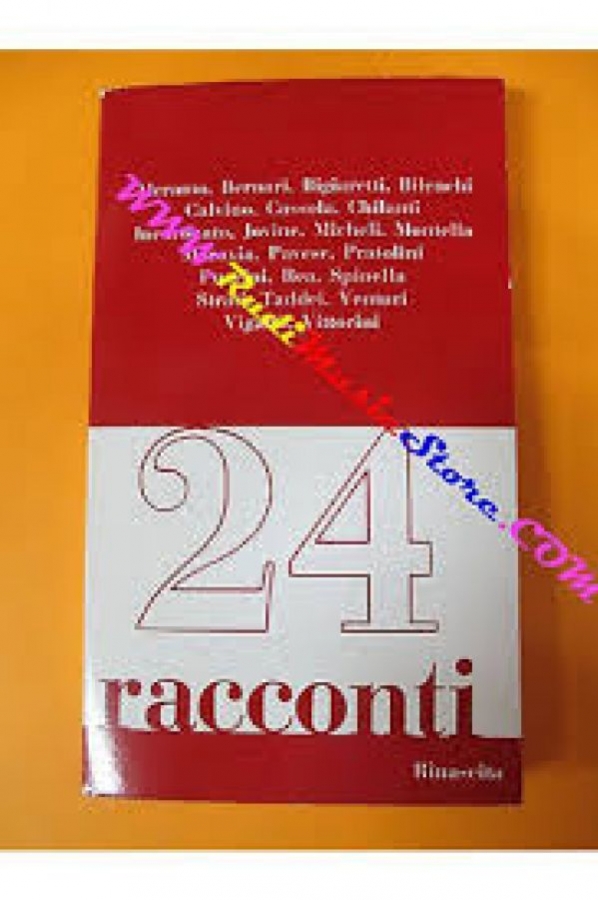
24 stories
Under the title *La Rinascita*, in June 1944 the first issue of the Communist Party’s monthly journal was published. Italy is not yet free; the partisan struggle is underway, and yet from its very first issue the journal devotes several pages to literature. There are poetic works (by Umberto Saba and Salvatore Quasimodo), texts by foreign authors, and contributions from Italian writers as well, from Alberto Moravia to Cesare Pavese. This book collects some of these short stories, published between 1945 and 1956, during a period of fierce political struggle and in the full bloom of Neorealism. The stories are steeped in social themes; many deal with the Resistance, featuring contributions from Renata Viganò, Italo Calvino, Marcello Venturi (an important and forgotten chronicler of the partisan struggle), and Mario Puccini—the latter with a moving tale about a father’s anxieties for a son engaged in operations against the Germans. I have chosen three to review, not only because they are the finest, in my judgment, but also because they are representative of our country—of peasant Italy and of an urban middle class that would carry forward from Fascism the indelible marks of superficiality. Francesco Jovine is the author of a novel, *Le Terre del Sacramento*, which chronicles a South forever condemned to exploitation and forever betrayed by its ruling class: a writer of resignation and defeat. In the short story *La morte del patriarca*, published in 1949, a grandson speaks of his grandfather, a justice of the peace in a southern village and trusted confidant of the primary landowner, the quintessential southern *latifondista*. The grandfather is a patriarch to his family and the entire community: he does not exploit the owner’s absenteeism to enrich himself, but rather stands as a defender of the peasants. He is a bulwark and a mythical figure. > On summer nights he would wander the moonlit streets together with his fellow peasants, enchanting them by softly playing his flute. (...) Often, when he was away, the young men would be seized by sudden rages and reach for their hatchets. But when the grandfather was there, nothing occurred that was not placid and gentle; one could hear those notes taking flight, like turtledoves in love, accompanied by the hornet-like drone of a *chitarra battente*; the old peasants would awaken from their sleep and imagine summer fields laden with heavy ears of wheat, and succulent fruits bathed in the morning dew. What will become of the village after the patriarch’s death? > Suddenly an old woman from the back began to weep aloud and sing her sorrowful lament for the impending loss. Slowly, in a rhythmic voice, she spoke: you are departing, our honour and our defense; you are departing, brilliant sword. Without you, a youthful voice took up on the final laisse of the song, we have neither light nor judgment left. In *Il mondo salvato a spalle*, published in 1951, Felice Chilanti recounts the dramatic flooding of the Polesine, offering a realistic and evocative sketch of peasant solidarity. "Run, people, the water is overflowing along the entire embankment!" Giovanni and his fellow peasants rush to rally the men and rescue the women and children. And the village shopkeeper shouts, "And you, Giovanni, and you, Gabana, and you, Tabanin, weren't you already thrown in jail a year ago for this kind of work? Do you really want to save Cané's land and cattle?" > Canè is the great landowner of the area, whose brother, the cripple, screams like a madman at the peasants laboring to save the Cané family and their household goods. "You want to start a revolution, you wretches! Come and get me, you'll taste the lead of my pistol... (...) Giovanni and his companions carried the world on their shoulders to safety: the entire world just as it was, friends and enemies, the society in which they lived and fought; they carried to safety the landlord and his property, the priest and his prayers, the maresciallo of the carabinieri and his handcuffs." The title of Libero Bigiaretti’s short story (*Un altro destino* > 1951) echoes Jack London’s *Martin Eden*. Two young men strike up a friendship because they work together on a construction site: Renato comes from a working-class background, intelligent, combative, capable of asserting his views with clarity and energy > , Giulio comes from a bourgeois family, restless, he dropped out of school and would like to publish his poems in *La Fiera Letteraria*. Unlike Giulio, thoroughly steeped in fashionable names and trendy books," Renato "read whenever he had the chance, with a stubborn desire to understand things to the very core > . Giulio meets Elena, Renato's sister, with whom he begins a relationship. We parted, I full of dismay and confusion, she calm; she told me to wipe my lips, for they must be smeared with lipstick. (...) I can't help laughing, looking back on it. When I think how, throughout the evening and the night, that most ordinary of adventures got tangled up in my head. "What if I had to marry her?" "Did you know that Giulio goes walking around the Mercati Generali with a greengrocer girl?" (...) Then I met Loredana with whom, between kisses, one could discuss literature. And Loredana also knew how to kiss me much better than Elena." The stories are certainly no masterpieces; behind a veneer of Neorealism there emerges a melodramatic and bombastic streak, originating from Fascist literature and from even deeper roots within a provincial Italy, alien to European culture. It is remarkable how one can already detect a sense of weariness, of resigned acceptance of what Italy would become: inward-looking, mellifluous, and hypocritical. A touch of nostalgia arises when reading these stories. Back then, a party journal made room for literature, for Italy's foremost writers; today we are reduced to reading disjointed remarks on Facebook and Twitter, while writers speak of other matters, far removed from politics. Is it perhaps from here that the by now tiresome crisis of the Left originates? Why read it? It is worthwhile for reminding us what the culture of the Left once was.
3012
In 1795, Immanuel Kant drafted a "project for perpetual peace" designed to eradicate war forever. For the German philosopher, as for all of us, only peace guarantees well-being and happiness. And what if this were not so? What if war were the ideal condition for humanity? In the year 3012 AD, men have lived in peace for centuries; yet feelings of solidarity, loyalty, and friendship have dissolved, replaced by a pervasive and immense hatred that requires a ruthless repressive apparatus to be kept in check. The author imagines that, after twenty centuries, a researcher discovers a manuscript by an anonymous writer recounting the advent of the Prophet, the one who preached "perpetual war." According to the anonymous chronicler (doubt is necessary, as legend and historical fact intertwine), the Prophet was a young *vitellone* named Antalo, who lived in Fellinia working as a porn star. He fell in love with a splendid woman who convinced him to follow her to the "Capital of the World," a megalopolis of fifty million inhabitants. It was a trap: his body was meant to rejuvenate wealthy old men, desperate to regain their former vigor. Antalo managed to escape and would become the protagonist of numerous adventures—some amusing, others chilling, all of them astonishing, and often serving as a metaphor for today's world, Italy in particular. At a writers' competition (Antalo was the author of incomprehensible poems, the subject of constant and conflicting interpretations), the future Prophet met a young woman who had entered with war novels and introduced him to a fourteenth-century poem describing chivalric clashes, massacres, and quartered bodies, extolling war, martial courage, concord among fighters, and magnanimity toward the vanquished. It was a revelation. > He put down the book. He held his head in his hands and a Voice spoke within him, saying: go and announce to the world that the accursed age of peace has ended. (...) The darkness will be torn asunder, the virtues believed lost will shine once more, and the brightest among those virtues will be generosity, the love of justice, and mercy toward the weak . But what will be the rules of this new era of war? Chivalric customs and respect for nature. And indeed, in the "memorable sayings" through which the Prophet outlined his vision, it is written: > the war that God wills is just and holy, as long as it is waged against true enemies. But if an enemy, to escape me, climbs a tree, I cannot cut down the tree to bring him down, for the tree is not my enemy . The editor informs us that a new era dawned, but of the "beautiful, just, holy, and necessary" war, little remained. Men > began slitting one another's throats with such enthusiasm that no natural or supernatural force could have stopped them anymore. The human race, then, lived through an unrepeatable season of violence and bloodshed, but was no unhappier than it had been in the past. On the contrary, it was almost happy . And so the anonymous chronicler was right to conclude, > and thus all that is born of man on this Earth is destined to pass away. (...) Amen . It should be made clear that the book is not an essay, but a fully fledged novel, set in a fantastical yet not improbable future. It is a sequence of events over the course of which poor Antalo, a naive young man, finds himself, in spite of himself, the victim of mysterious and incomprehensible forces, all of them violent and cruel. Even when he kills, he does so because he is forced to, refusing to become a manhunter (one of the pastimes in the era of peace), despite knowing that this choice would save his life. Likewise, he rejects rampant corruption and longs to love, not merely to have sexual encounters. He is, in short, "a fish out of water" in the > Great Capital of the World; and it is precisely this innocence that makes him a visionary, capable of giving humanity and the world a sense of perspective. Through an ostensibly ironic and cynical novel, Vassalli wants to tell us that utopia is necessary, but it demands free and naive spirits. The prose is very far removed from that of *The Chimera*, but this is as it must be, for it is an account aimed at capturing the bare essence of the Prophet's story. The flaw of the narrative lies in its excessive references to contemporary Italy—amusing at first, but ultimately tedious and predictable: it almost seems as if the author wanted to settle so many scores". Why read it? It is astonishing.
7-7-2007
In four years, from 2013 to the present day, the author has published 6 novels, all featuring the figure of Rocco Schiavone as their protagonist. Perhaps haste has precluded the necessary care: the narrative is muddled, intertwining the noir genre with personal stories and depictions of social contexts without ever arriving at an effective synthesis. We are in Aosta; a woman has been murdered in the protagonist's apartment. In the lengthy interrogation that ensues, Deputy Police Chief Rocco clarifies the backstory, albeit not entirely. Back in Rome, he had led an investigation into the brutal murder of two youths. Drugs are involved, but we will not delve into the details, leaving it to the reader to discover how Rocco manages to untangle the affair. Alongside the main plot, numerous narrative windows open up, chief among them the tormented love affair with his wife and the close friendship with three childhood companions. Marina > was beautiful. With focused eyes, teeth barely biting her upper lip, hair gathered in a bun held by a pencil, or was it a chopstick? Beautiful, in her immaculate white coat reflecting the lamp's light and creating a halo all around her. Her hair looked blonder and the few specks of dust dancing around her face seemed like stars and comets . Marina left home when she learned that Rocco was corrupt: he had exploited his position as deputy police chief to enrich himself. Responsible for these petty dealings are his childhood friends: a sort of Three Musketeers, congenial, hearty eaters and drinkers, always ready to help their pal, but genuine scoundrels—terrible company for a police officer. It will be Marina who returns home, because she loves Rocco and accepts him as he is. The reconciliation between the two is one of the novel's many disappointments. Consider this dialogue: > Marina stroked his chest. Did you really have to close your eyes to come back home? (Rocco) A little. Now they are wide open and I see beside me the man I love and whom in all likelihood I will always love (Marina). I have an erection (Rocco). Could you for once think of something else? (Marina) Like what? (Rocco) . In short, for Rocco it was all just a matter of sex! Why draw us into a love story if everything boils down to a trite and resigned acceptance on the woman’s part? Rocco manages to find the culprits; behind the murders lies a powerful criminal syndicate which attempts to assassinate Rocco, killing Marina instead. That July of 2007 > had been strange days. Days of heat and sudden downpours, of anxiety and, above all, of stench. The stench of basements, the stench of violent deaths, of vile people, crouching in the sewers, ready to strike... A noir novel demands an intense narrative pace; the reader must be gripped by the plot, participate in the investigation, or be swept along by events and their tension. All of this is missing from the book: sluggish, often predictable, cluttered with unnecessary characters and subplots, the story is trite and dull. The “three musketeers” serve in vain as foils to the protagonist: Rocco, let us be frank, is a failed Marlowe, a character incapable of sustaining the assigned role of the corrupt yet decent cop, an avenger on his own terms. The writing also contributes to the novel's failure; the excessive use of full stops and the frequent recourse to dialogue fragment the narrative, rendering it more akin to a screenplay than to the prose flow of a narrative, which requires room for description and psychological depth. How is it possible that this novel has topped the Italian bestseller lists for weeks? Why not read it? It is tedious and banal.