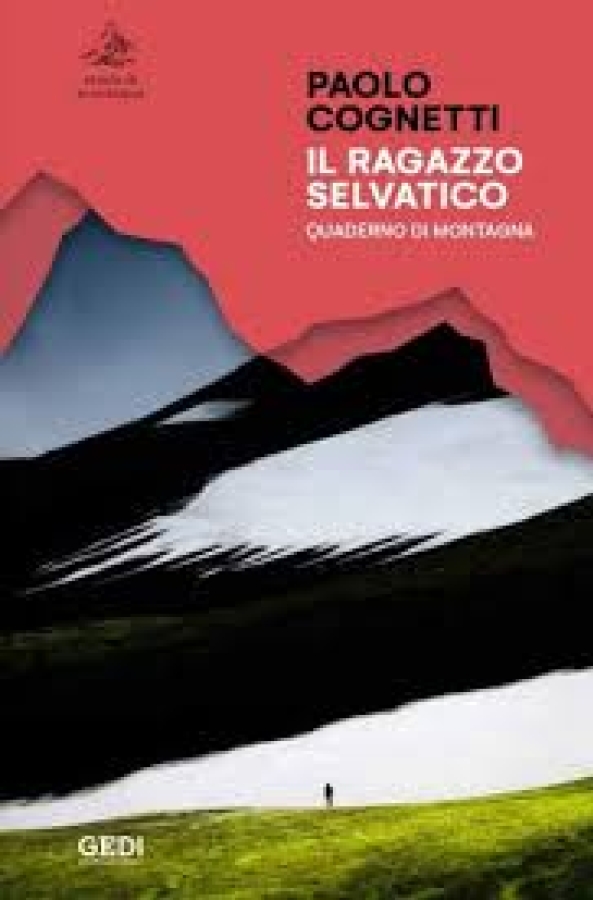
The Wild Boy: A Mountain Notebook
It is difficult not to be swayed by the news of the severe depression that struck Cognetti (see the *Corriere della Sera* website, 20 December 2024). The long “mountain notebook” (the story’s subtitle) seems to herald that “bipolar syndrome with manic episodes” which required involuntary psychiatric treatment. Or rather, was leaving the city to go live in an isolated cabin the last illusory attempt to overcome a void that > I had never experienced?. The story is written in the form of a diary, following the cycle of the seasons, each corresponding to a state of mind for Cognetti: winter is solitude, spring the company of others, summer exploration and the end of the adventure, autumn the return to the city. The first stage of this redemptive journey is solitude, in a house in the woods, far from the noise of other human beings. Then came neighbors, the shepherds and the livestock of the alpine pastures, > so I had something to watch, besides the clouds bringing endless rain. (...) If I woke up early in the morning I could spy on the elderly shepherd moving the pasture’s boundaries, advancing the stakes by a few meters each day so as to ration the grass. (...) And then seven calves and some thirty adult cows would come rushing down, toward the new strip of tall grass. (...) But the biggest change in my daily life was brought about by the dogs, (...) they had a bell hanging from their neck thanks to which I could hear them coming from afar. (...) After almost two months at the cabin, along with spring my season of solitude was coming to an end. These neighbors—the shepherds, the dogs, the goats, and the “baracche,” that is, the cows—are described minutely, yet without evoking any sort of atmosphere; they seem alien to the psychology of the author-narrator, useless secondary players in an inner drama. Indeed, with the arrival of summer Cognetti takes another step. > I wanted to push beyond the area I knew, to discover what lay two or three days’ walk away. I set off weighed down with gear, and yet shutting the door behind me, I felt as though I were unburdening myself. (...) What else are we fleeing from if we flee from home? Farewell, the wild boy said to the domestic one, then turned his back on him and once again took the path that climbed upwards. Here, once again, is the trap of the mountain! Imagining there is something magical up there, something capable of freeing us from the mystery within us. It is not so! The much-fancied lake at an altitude of 2,700 meters is nothing more than a mundane body of water, > you could easily walk right by without even noticing it. (...) It was then that I felt a lump rise in my throat, my eyes blurring. Go ahead and cry, I thought, nobody is watching you. I began to sob, lying on that rock because I was exhausted, I missed everyone, and I no longer knew where I was. (...) More than a cabin in the woods; solitude was like a hall of mirrors: wherever I looked, I found my own reflection, distorted, grotesque, multiplied ad infinitum. Why is the notion that the mountain elevates the human spirit and imparts balance and serenity so widespread? Pastures, alpine lakes, wooded paths, and towering peaks are merely places that we mythologize out of romanticism, or because we are desperate, immersed as we are in the chatter of the city, or, more banally, because we are driven by a competitive urge to exalt our own power. Cognetti chronicles the collapse of this mirage: there is no peace except by working upon oneself. The prose is straightforward, facile, and fluid. These are indisputable virtues; yet they neither succeed in probing the author’s inner world nor do they manage to kindle the reader’s imagination. One reads on through sheer inertia, wholly unengaged. Why not read it? It is pointless.
Distant Relations
The novel is set in Paris and recounts the strange parallel story of two homonymous families: a peculiar Mexican figure living in France in a secluded villa, and the young, unlikable son of a friend of the narrator. It is a surreal narrative that unfolds in a tedious and prolix manner. I was unable to finish the novel.
The Human Resources Manager
The novel revolves around the affairs of the human resources manager of a large company. An employee is killed in a terrorist attack, and the personnel director is tasked with overseeing the identification of the body and its transport to her native land: a nation of the former Soviet Union. Thus begins a journey that constitutes, in some sense, a path of purification and at the same time an escape from a state of war, such as the one in which Israel finds itself. The protagonist undergoes a rebirth from an existential condition—both private and collective—of uncertainty and anxiety: confidence in life and in one's own abilities is regained. As usual, the novel is very well written, but it is exceedingly weak in terms of content and narrative pacing, so much so that it proves tedious and insipid.
Regenesis
The novel hinges on the daughter’s account of her parents’ story, of their love and how the latter dissolved into incommunicability. I did not finish the book because I found it tedious and difficult to understand. According to the Encyclopedia: > Madsen has centered his inquiry on literary experimentation and on the exacerbated problem of identity, incommunicability, and the futile pursuit of reality; he fits squarely within the sphere of a literature—the Danish one—that seems profoundly focused on the existential themes of a society in crisis .
Red as a Bride
The book is by an Albanian writer who writes in Italian. In the first part of the novel, the author retraces the history of her family in a small mountain village. It is a story of female characters, and in particular of the author’s grandmother: Saba. > It is a life caught in the boundless web of silence of the mountain. Disturbed only by the murmuring of trees stirred by the wind. People went about their usual chores. They occupied themselves with past stories that continually returned to life as though they had occurred the evening before . In this motionless and timeless world, the griefs and the burden of life fall upon the women: courageous, hardened, determined to defend their families, yet also ruthless toward other women when any of them fail to abide by the community’s rigid rules. In this world, “which begins and ends here,” the fate of women is inexorable, and they are not permitted to experience love. Only death establishes a powerful bond between men and women. Before her dying husband, who never knew how to love her, Saba > weeps thus, for the time, right or wrong, that has passed... lies down beside him, takes his face in her hands. Strokes his wrinkles, strokes the years lost without love . The first part of the novel is undoubtedly the most effective, not least because the author did not experience it directly; memory thus breathes life into imagination and into a lyrical, deeply evocative style. The second part is more autobiographical and recounts the dissolution of old Albania, showing how a country steeped in strong traditions loses its identity upon contact with Western society, particularly Italian. The loss of the mother tongue, Albanian, in favor of Italian epitomizes this dissolution and renders any dialogue with the past impossible. The author wishes to speak with Saba, her beloved grandmother, but can no longer manage to do so. > I speak an idiom unknown to her, and so we chase one another from one side to the other. Yet her tongue, azure, green, yellow, like the seasons of her fields, the one she would wish to hear from me, is no longer mine . It is a novel composed of numerous vignettes, often very fine, but which come at the expense of the overarching narrative. The pursuit—stylistic as well—of individual fragments compromises the novel’s cohesion. While in the first part the reader is captivated by the individual stories, by the intense emotions arising from the depiction of a harsh and atavistic society, in the second part of the book the events feel predictable, at times banal, and fail to convey the profound social and personal transformations that defined Albanian society. Ultimately, there is a rift, also in the narrative’s efficacy, between a peasant world, now distant and clouded by nostalgia, and the new urban, industrial life, which cannot help but be Italian. Why not read it? Certain fragments of the narrative are very beautiful. On the whole, however, the narrative fails to sustain interest precisely when it shifts to depict the transition of Albanian society toward the West: consequently, even the representation of the peasant world remains suspended, reduced to a kind of folkloric anthropology.
The Noise of the World
The novel is set between 1838 and 1848 in Savoyard Turin, poised between the Restoration and Risorgimento values, between conservatism and the desire for change, not least economic. In those years, Great Britain—and London in particular—served as a touchstone for technological innovation, the growth of trade and manufacturing, and the dissemination of new ideas, which also encompassed the condition of women. The author imagines Anne, the young daughter of a wealthy cloth merchant, given in marriage to Prospero, a Piedmontese nobleman raised under the most rigid and traditional Savoyard tenets: military discipline, an obtuse allegiance to the crown and to social conventions, and a disdain for economic matters—even for the very landed estates from which, nonetheless, he derives handsome revenues. It is an improbable match, one might say; it allows the author to investigate how to “recognize something of oneself in a country that is not one's own,” how to remain oneself while forced to adapt to foreign customs and to languages so vastly different from English as Italian and the Piedmontese dialect. Anne, moreover, grew up frequenting warehouses and shops, accustomed to discerning the quality of textiles from across the globe, to speaking of fabrics, innovations, and trade. These are modern values, fostered by a grandfather with Jacobin leanings and a governess who grants the utmost intellectual freedom to her charges, Anne and her sister—independent spirits receptive to the new. The first question Anne's father posed to Prospero was the following. > “So tell me, are you interested in silk?” (...) An expression of disdain crossed Prospero's gaze. While he knew nothing of commerce, he was well versed in good breeding, and he was at a loss as to how to take his father-in-law's vulgarity. (...) In Turin, he thought, tradesmen enter through the service door and wait in the anteroom . It is not smallpox, then—which strikes Anne on her journey to Turin and mars her skin—that ruins the marriage; rather, it is the cultural divide between her, forced to adapt, and Prospero, obtuse and aloof. In a letter to her sister, Anne confesses that > several months had to pass before I came to understand that the journey meant to deliver me to Prospero was not an approach, but a departure—both from all I held immensely dear and from the person I had been until that moment. No one parts willingly from what they love and know, so you can imagine my state of mind now that I have understood that the person I was about to abandon once and for all was myself. To be estranged from oneself is the deepest sorrow . And yet, in the Piedmont of the 1840s, swept by a quest for innovation in agriculture and manufacturing, Anne—pragmatic, tenacious, economically adept, and immensely wealthy—could well find her way; and for a moment we dare to hope, when she strikes up a friendship with Enrico, an adventurous entrepreneur, and when the obtuse Prospero dies on the battlefield in 1848. Instead, the frail and overly faithful Anne > ever since arriving in Piedmont has had but a single desire: to be left alone, to fade. As happens with bitter griefs, generously tempered by time . Anne belongs to the multitude of characters who marked the transition from the Restoration to the new Italy: > their opinions, their hopes—often naively grand—their desires and their failures belong to that twilight realm that is literature . The book suffers from numerous flaws, both in content and narrative structure, which compromise its quality despite starting from an interesting premise and a potentially intriguing protagonist. The author attempted to say too much: to paint a sweeping fresco of 1840s Piedmont, to recreate the allure of Italy in the English imagination by introducing the theme of the “Grand Tour,” to flesh out the differences between London and Piedmont with a painstaking detail that obscures the broader picture, and to crowd the canvas with secondary characters who overshadow the protagonist, herself rigidly immobilized in her sorrowful fate. The narrative structure lacks rhythm: it unfolds in a slow, verbose manner, fragmented by ceaseless leaps in time and space, and above all weighed down by an excessive reliance on the literary device of correspondence—not only the protagonist’s, but that of the other characters as well. In the end, it all becomes redundant; the novel ought to be rewritten with sweeping cuts. Why not read it? The premise is interesting, but the narrative structure renders it prolix and tedious.