Finished reading on: May 06, 2010
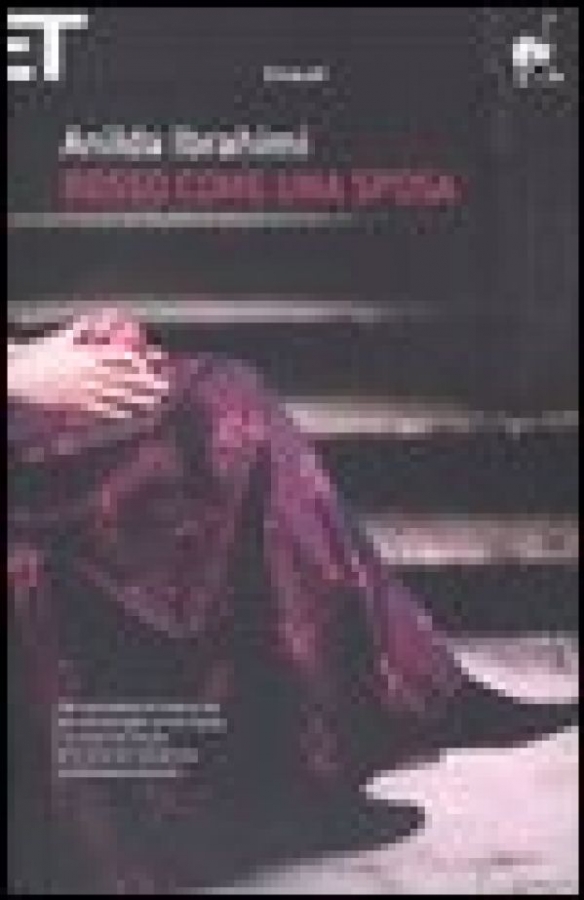
Red as a Bride
Title of the original version reviewed: «Rosso come una sposa»
AI Translation Notice: This review was translated from the original Italian using artificial intelligence. Book quotes and excerpts are translated interpretations and will not match the author's original English phrasing or official published translations.
The book is by an Albanian writer who writes in Italian.
In the first part of the novel, the author retraces the history of her family in a small mountain village.
It is a story of female characters, and in particular of the author’s grandmother: Saba.
It is a life caught in the boundless web of silence of the mountain.
Disturbed only by the murmuring of trees stirred by the wind.
People went about their usual chores.
They occupied themselves with past stories that continually returned to life as though they had occurred the evening before
.
In this motionless and timeless world, the griefs and the burden of life fall upon the women: courageous, hardened, determined to defend their families, yet also ruthless toward other women when any of them fail to abide by the community’s rigid rules.
In this world, “which begins and ends here,” the fate of women is inexorable, and they are not permitted to experience love.
Only death establishes a powerful bond between men and women.
Before her dying husband, who never knew how to love her, Saba
weeps thus, for the time, right or wrong, that has passed...
lies down beside him, takes his face in her hands.
Strokes his wrinkles, strokes the years lost without love
.
The first part of the novel is undoubtedly the most effective, not least because the author did not experience it directly; memory thus breathes life into imagination and into a lyrical, deeply evocative style.
The second part is more autobiographical and recounts the dissolution of old Albania, showing how a country steeped in strong traditions loses its identity upon contact with Western society, particularly Italian.
The loss of the mother tongue, Albanian, in favor of Italian epitomizes this dissolution and renders any dialogue with the past impossible.
The author wishes to speak with Saba, her beloved grandmother, but can no longer manage to do so.
I speak an idiom unknown to her, and so we chase one another from one side to the other.
Yet her tongue, azure, green, yellow, like the seasons of her fields, the one she would wish to hear from me, is no longer mine
.
It is a novel composed of numerous vignettes, often very fine, but which come at the expense of the overarching narrative.
The pursuit—stylistic as well—of individual fragments compromises the novel’s cohesion.
While in the first part the reader is captivated by the individual stories, by the intense emotions arising from the depiction of a harsh and atavistic society, in the second part of the book the events feel predictable, at times banal, and fail to convey the profound social and personal transformations that defined Albanian society.
Ultimately, there is a rift, also in the narrative’s efficacy, between a peasant world, now distant and clouded by nostalgia, and the new urban, industrial life, which cannot help but be Italian.
Why not read it? Certain fragments of the narrative are very beautiful.
On the whole, however, the narrative fails to sustain interest precisely when it shifts to depict the transition of Albanian society toward the West: consequently, even the representation of the peasant world remains suspended, reduced to a kind of folkloric anthropology.