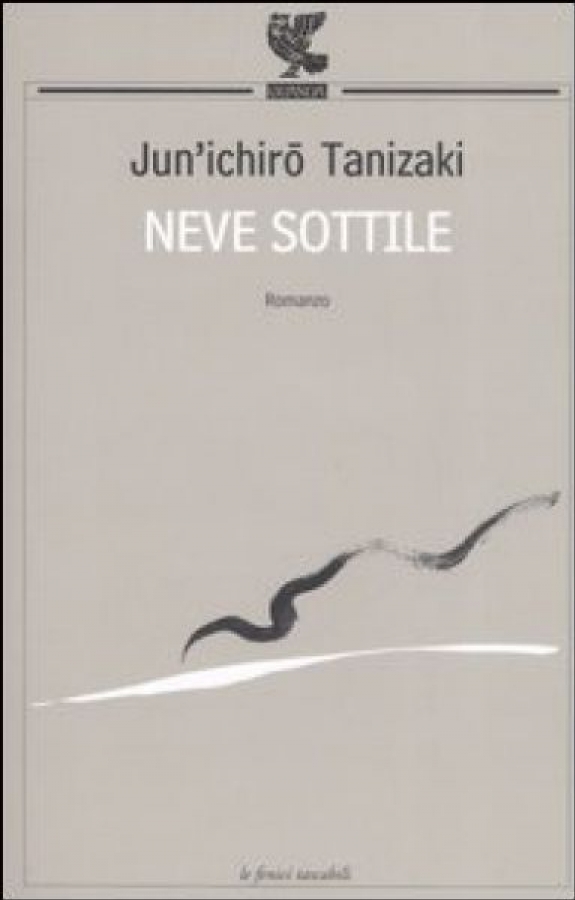
The Makioka Sisters
The setting is Japan across a chronological span that stretches from the years immediately preceding the Second World War up to the outbreak of the conflict. Against a backdrop of unease and mounting economic hardship, a family drama unfolds: the story of four sisters. An ancient family, now in decline, has split into a main branch—which moves to Tokyo and retains the authority over fundamental family decisions—and a secondary branch, residing in Osaka and centered around the protagonist, one of the sisters: Sachiko. This woman assumes responsibility for her two younger sisters: one unable to find a husband due to her shyness and aloofness, and the other, more modern and emancipated, who works as an artist and weaves a web of romantic affairs, including with men of a lower social standing than the family. The novel is an assemblage of small episodes, featuring a narrative arc that appears fragmented, yet builds precisely upon the portrayal of the intimacy of a Japanese household, and the clash between the tradition of customs and values on the one hand and Western modernity on the other. The women wear kimonos, but also Western dress; they attend the theater to watch ancient Japanese performances, yet devour Western books and films. Even the most rebellious girl, one of the younger sisters, who dreams of going to France to study dressmaking, attends a traditional dance school and gains renown by crafting traditional Japanese dolls. The strictures of tradition fail to confine or ossify familial affections. Sachiko’s repeated matchmaking efforts on behalf of one of the younger sisters fall through because she cannot bring herself to thwart her sister’s will and temperament. The scandals provoked by the other sister ultimately meet with Sachiko’s forgiveness and benevolence. The love among the sisters and within the family proves stronger than any rule or imposition. One might assume the context is defined by the war, and that conflict must eventually burst into the novel (much like a sort of *War and Peace*). This is not the case: the war remains perpetually in the background, scarcely mentioned, and what matters above all are the private tribulations, the protagonists' search for serenity and balance. Only the letters from Western friends who have left Japan evoke the approaching military conflict, of which, however, there is not yet full awareness. Perhaps the author wishes to reassure the reader (it should be remembered that it was serialized during the war), or perhaps he offers a subtle critique of familism, of that excessive fixation on individual feelings and personal friendships, which delays an awakening to the reality of unfolding events. It would have been compelling had there been a sequel to the novel, to observe the characters’ conduct during the final phase of the conflict, beneath the bombings. The true fabric of the novel is woven from the customs and values of Japanese society, captured across myriad moments yet epitomized by nature—such as the family’s excursions to view the cherry blossoms. The peace, order, and serenity emanating from the natural world stand in stark contrast both to the complexity of the emotions and events, and to the creeping emergence of the war. The novel unfolds slowly, marked by a pronounced scarcity of plot-driven action, as everything hinges on minute particulars. Ultimately, it feels long-winded, though never dull, and at times repetitive.
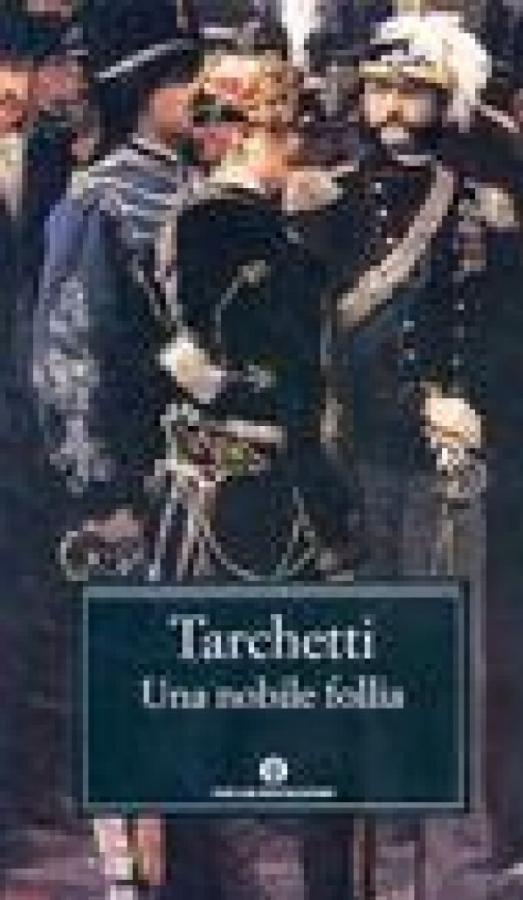
A noble madness
Igino Ugo Tarchetti lived between 1839 and 1869. He is, therefore, a Risorgimento writer who was sidelined because he advanced a fierce critique of war and a clear recognition of the value of desertion and conscientious objection. The novel, partly autobiographical, relates the trials of Vincenzo D.: > one of those minds that cannot choose between prosperity and conscience, and are ever wretched creatures . The narrative is structured into three parts. The first part concerns the protagonist's childhood and adolescence. Abandoned, he grows up in an orphanage, where he meets Margherita, the great love of his life. It is a bombastic and rhetorical section, dominated by a romantic and spiritualistic view of life and the world. It is an unmitigated exaltation of love and nature, taken as an idyllic realm. A typical dialogue runs as follows: Margherita asks: > Where are we going? To love each other. And what are those fireflies doing? They love each other. And all those stars? They love each other. God, how beautiful the night is! It is love that adorns it . By page 71, the temptation to abandon the book is strong. The second part recounts the military life of Vincenzo D. Just as the two lovers resolve to marry, Vincenzo is called to arms. In pages of great efficacy, the narrative chronicles the individual and social transformation of a person forced to endure military discipline. Anyone who has completed military service cannot fail to recognize themselves in the author's words: > the drills, the march, the measured and mechanical motion, the deafening cadence of the drum, the novelty of the uniform, the harshness of command, and the discipline daze his mind, divert it from serious and sustained reflection, create new needs, new ideas, new semblances. The good have become bad, the bad worse, the worse wicked . Vincenzo's military life takes a turn when he is summoned to fight in the Crimean War. The very casus belli invoked by the author is of such futility that it constitutes in itself a critique of the absurdity of armed conflict: a Russian prince refuses to pay a visit to the Turkish minister and strolls through the streets of Constantinople with "whip in hand." This section of the book features the description of the Battle of the Chernaya: it feels like watching a modern special-effects film and, at once, a battle from the *Iliad*. Mangled bodies, severed heads, blood, and devastation are depicted with such chromatic force that one visualizes them as if in a painting. The narrative reaches its peak impact when nature itself (here no longer benign, but man's adversary) takes part in the battle: > the sea casts back upon the shore the masts, the rigging, the corpses. A gigantic wave, which seems to reabsorb into itself all the other waves of the ocean, draws near slow and majestic to the shore. A long line of shipwrecked men appears atop it, thrashing their chests and arms: they feel the ground beneath their feet, but the wave pressing behind them surges forward, breaks over them, sweeps them away, and drags them back onto the high surface of the sea . Yet Vincenzo manages to survive, having not yet killed anyone, buried as he was beneath a heap of corpses. Upon regaining consciousness, he faces an enemy soldier and, much like in Fabrizio De André's *Canzone di Piero*, he is forced to kill him, only to rush to beg his forgiveness and realize that the slain soldier > was handsome, with a beauty at once virile and gentle; he had blond, ringleted hair, a broad and serene brow . On the verge of death, the soldier asks Vincenzo, "Why did you kill me?" At that point, the protagonist resolves to desert and claim his freedom: > I had thrown down the gauntlet to humanity; I had nothing with me but my conscience: how was I to sustain that struggle? The third part is the descent into madness, rooted in the homicide. By now, the narrative devolves into philosophy and a collection of aphorisms, in some instances nonsensical. A trenchant declaration against war and, above all, against military life clearly emerges, while a pantheistic worldview now prevails. The whole degenerates into a confused political manifesto. The author relies on a narrative framing device (Vincenzo D. recounts to the writer, who in turn recounts to a friend), which, rather than enlivening the reading, contributes to weighing it down, as the tale unfolds entirely in the first person in the form of a narration: a narration that often serves as an occasion for tedious philosophical digressions that drag down the narrative pace. The bombastic, emphatic style, heavily laden with adjectives, frequently makes for a turgid read. Why not read it? It is sufficient to visit a public library and confine oneself to the pages depicting military life and the great Battle of the Chernaya (forty pages in all).
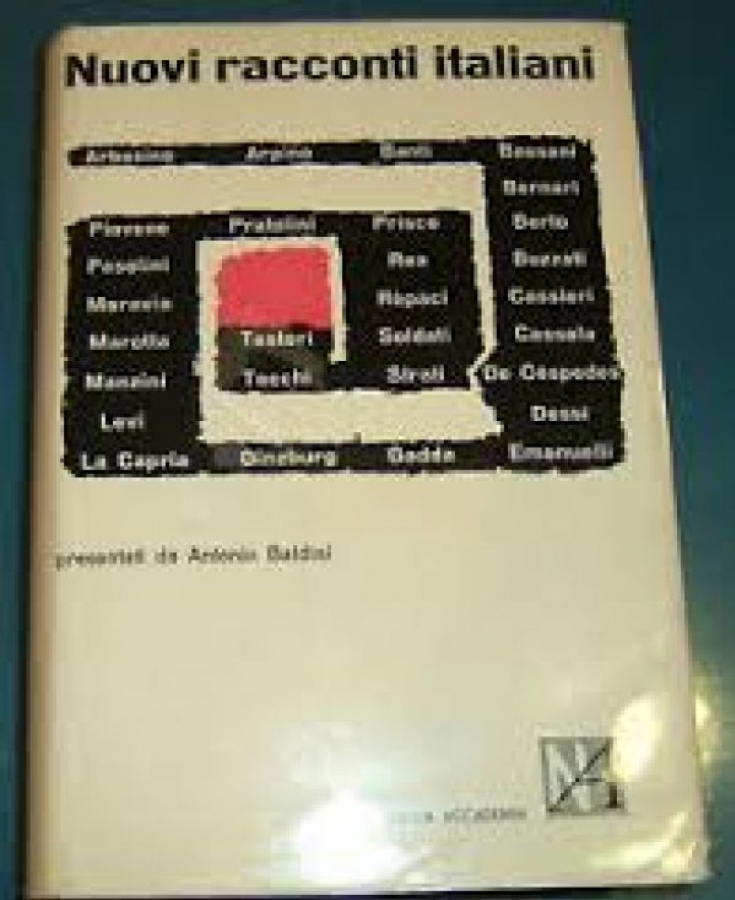
New Italian Short Stories
The book brings together 29 short stories, an anthology that includes famous writers such as Bassani, Buzzati, Gadda, Moravia, Pasolini, Pratolini, Cassola, and others; but also lesser-known authors, nonetheless representative of our country's literature. It is impossible to account for every story—many, in fact, not particularly successful—so I shall dwell only on a few. They share a common trait: they speak of the material living conditions of 1950s Italy, through an approach poised between truth and poetry, between social design and personal histories. Carlo Bernari is a forgotten writer today, yet in 1929 he penned a novel (*Tre operai*) that offered a realistic portrait of the working-class condition under Fascism, and which for this reason circulated semi-clandestinely. In his long story, *Il crumiro*, Bernari tells us of Peppino, a resourceful Neapolitan: in post-war Bari, he manages to find work as a factory handyman, build himself a house—unauthorized, naturally—hook into the electricity and water supplies, on the sly as always, and raise a family. > The Neapolitan way, his workmates would tease him, when in the morning they discovered the mended tap, the new steam intake, a stool fashioned from an old packing crate (...). Not exactly by the book, but haphazardly—yes, the Neapolitan way—yet it was done all the same . And if it is true that everything (the house, the job, and the numerous brood) comes with its drawbacks ( > but really, inside they hear us, outside they see us, will you tell me what kind of love this is? ) Peppino feels he has achieved many milestones, modest to today's eyes, yet significant in the Italy of that era. When, following a rain that had been pouring down for days, > the drains blocked, a muddy, greenish water surged back up from underground (...) reaching the furthest courtyard, where Peppino lived: and there it stagnated and destroyed the house of Peppino and his family, annihilating his dreams. Alongside Rea, Prisco, Ortese, and others, Raffaele La Capria belongs to that Neapolitan narrative vein tracing back to Matilde Serao. In this short story (*Ninì prende il largo*), La Capria speaks of freedom, and does so through the Posillipo sea. Ninì is a «scugnizzo». His bony, sun-blackened back, flecked with salt, one with the rock, was already beginning to scorch under the sun (...) But Ninì's attention was fixed on the transparent little hollow, among those four stones on the bottom, which if you picked them up and brought them to the surface were stones like any other, (...) yet when you saw them under half a meter of water so clear, they were full of adventures«. He is fishing for rock goby (a rockfish that »even the cat turns its nose up at > ), when a friend shouts for him to get into the boat. And there he is, rowing towards the tip of Posillipo, calling out to the girls to come to the balconies, playing the swaggerer to those on the rocks: and he wiggled his little backside on the prow of the boat, drumming with his heels against the sides, as if to spur it on. (...) Now, as the boat pressed forward, the horizon line shifted further and further away, behind the Cape of Posillipo, and the promontory receded further into the coast, and before Ninì's eyes the perfect circle of the gulf opened up, revealing glimpses of other distances. (...) Thinking back on it now, the transparent hollow beneath the rocks of Palazzo Donn'Anna seemed to Ninì no larger than a washtub > . Bonaventura Tecchi won the Premio Bancarella in 1960 with the novel *Gli egoisti*«. In *La ragazza della filanda*, the protagonist is a mill worker »big and bony, almost like a man > , (...) retaining beneath that masculine frame a curious innocence, partly timid and partly simple-minded . She has not yet known sex, and laughs when her workmates tell her that love > is a taste, pretty much like the one you get from eating delicious treats . > It seemed that her very body, so square and strong, was a suit of armor, inside which love could never have entered through malice, perhaps only through violence . And so it happens: a man, simply because he «had her close at hand», courts her, convinces her to let him take her home, and when he realizes that > she truly had never been touched by love, he felt almost a sense of resentment, (...) and when the swift, violent pleasure arrived, and the immense satisfaction, his male pride, even then there remained (...) the desire to humiliate her . And she, dumped after a few days, walks > away alone down the lane, those bony shoulders shuddering under the little shawl, yet without crying. Giovanni Testori is known as a playwright, but he wrote numerous short stories and novels. The short story *Guardati intorno ed impara* is enigmatic, so much so that its overall meaning remains unclear until the very end. A young woman flees from a house, stumbles, leans against a wall, attempts to reconnect with life: she realizes > that she has nothing left to do but hide herself, not only from people but from things as well . This is the opening of a story: as it slowly unfolds, we understand that the young woman has killed a man, not because she truly wanted to, but because of a familial mechanism. Sister, brother, and mother are bound to one another by a knot that > in its elemental nature was almost tragic: bonds withheld from any sentimental expression, yet manifesting in all their force whenever the family's life passed through some difficult situation. Then a word, a question, or a mere reference was enough for the three to find themselves constrained and almost damned to a single destiny. (...) It would have been necessary to destroy, by dint of being all-powerful, every human remnant. The stories of Peppino, Ninì, the mill worker, and the young woman are paradigmatic of a society and an existential condition. Hustling, often in vain; yearning for freedom, even for a fleeting moment; settling for any kind of love; letting oneself be ensnared by familial mechanisms—these are the defining traits of an Italy on the verge of change, yet where resignation still prevails. Despite the prevailing pessimism, the four stories exhibit narrative power and innovation: the authors construct elegant and compelling plots, significant and substantial characters; they have something to say, and they do so in a prose that is cultured, yet already contemporary. Spoken language is making its way into the written word and will later do so with overwhelming force; for now, it serves to prevent the stories from cutting "the tedious and wretched figure of the antiquated (Antonio Baldini in the introduction). Why not read it? They are four fine stories, but they are not worth the chore of reading more than five hundred pages..