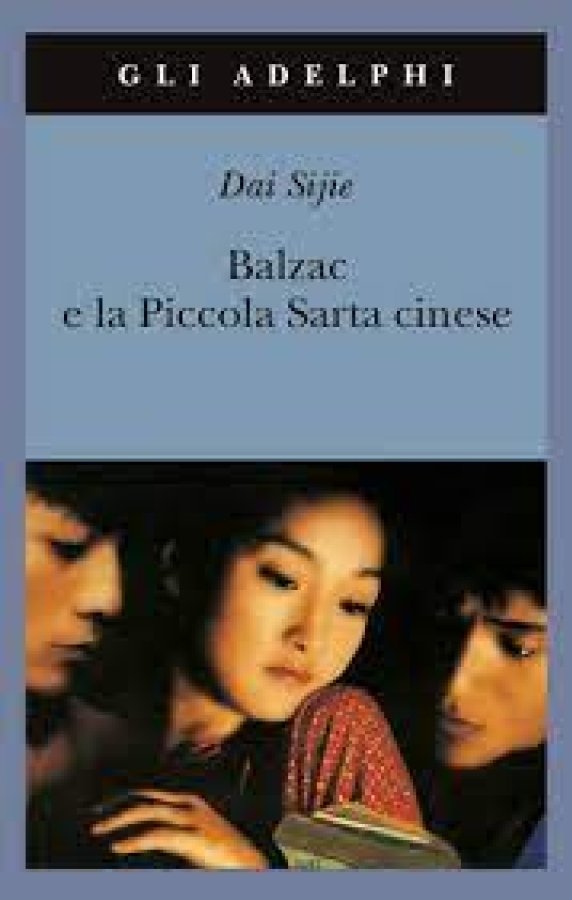
Balzac and the Little Chinese Seamstress
The year is 1971, in China during Mao’s Cultural Revolution. Two youths are sent for re-education to a remote mountain village. One is the narrator, while the other is his friend Luo. Unquestionably, a critique of the Communist regime runs through the entire novel—a critique mounted with irony and lightness, yet no less incisive for it. Were it confined to recounting how two charming and unfortunate city boys survived in an environment so far removed from their social and cultural origins, the book would remain trapped within its historically dated dimension; in truth, the author engages with the universal theme of the book as self-discovery and an instrument of emancipation. The two friends cross paths with a young woman, the daughter of the local tailor. > When she bent over the sewing machine, the gleaming metal base reflected the neckline of her white blouse, her oval face, and the sparkle in her eyes, undoubtedly the finest in the district . Sophisticated and elegant, “in a place where nearly everyone went barefoot,” the Little Seamstress captivates the boys, lending meaning to their wretched existence. Another event intervenes to alter the destiny of the two friends, and of the Little Seamstress: the discovery of a trunk containing the great masterpieces of French literature, from Balzac to Flaubert. They come into possession of the books and devour them ravenously. > Leafing through them with my fingertips made me feel as if my fragile hands were touching human lives . It is a wondrous yet insidious sensation, for immersing oneself in human nature through the pen of the great nineteenth-century writers will overwhelm the young men and transform the Little Chinese Seamstress. “She will no longer be a simple mountain girl.” In Luo, now her lover, there arises something akin to a delusion of omnipotence: the ability to govern the cultural maturation of the Little Seamstress. Is that possible? > She wants to go to the city, (the father) said. She mentioned Balzac. (...) She said she learned one thing from Balzac: that a woman’s beauty is a treasure beyond any price . Was it perhaps better to have left her in ignorance? For the most part, the novel follows a linear plot, rich in delightful, surprising, and joyful episodes. It is as if the two friends were revelling in it: they disguise themselves, for instance, as Mao to coax the lyrics of folk songs from a wild old mountaineer and hand them over to the owner of the books in exchange for several novels—a scheme crowned with success, yet ultimately doomed because the songs are brazenly erotic, and thus at odds with socialist morality. At a certain point, the narrative shifts tone, turning somber and oppressive. Two metaphors emerge—the precipice and the raven—omens of the disaster toward which the two friends are hurtling (in Chinese culture, oracles bear fundamental significance, revealing as they do “the Way of Heaven”). Later, the narrator steps back to make way for the accounts of other characters: the old mountaineer, Luo, and the Little Seamstress. It is a lyrical juncture, detached from the narrative approach maintained until then. It is as though the narrator has definitively accepted a subservient role; nevertheless, we perceive that he too is traversing his own path toward an understanding of femininity. And finally, we witness the resigned, desperate account of the Little Seamstress’s abortion, as she makes her choices unbeknownst to Luo, who impregnated her. It is as though a woman’s freedom always demands a painful act. The writing is elegant, adept at orchestrating diverse lexical and syntactic registers. Fluid, spirited, effervescent, the author manages never to dissipate the narrative drive despite engaging with numerous themes, many of which overlap and even clash. He can steer a steady course through to the end—surprising and unsettling—because the story revolves around the mysterious allure of the book. Why read it? It is a gem!

Bilal
This book belongs to a literary genre whose pinnacle is *Gomorrah*, and which could offer an opportunity for revival to an otherwise bloodless Italian literature. It is a hybrid of novel and investigative journalism. Fabrizio Gatti is a journalist who conducts his investigations into immigration by masquerading as a migrant, thereby experiencing their living conditions firsthand. The novel arises organically, as the author personally lives through the events narrated and the encounters depicted. In the first part of the book, the author retraces the route between Dakar and the Libyan border, chronicling the inhumane conditions and, above all, the violence inherent to these journeys. In reality, people are at the mercy of criminal syndicates—colluding with local police forces—who seize every opportunity to extort these desperate souls. Transit relies on makeshift vehicles (dilapidated trucks, off-road vehicles) that routinely break down along the way, abandoning passengers to certain death in the desert. The lack of funds to continue the journey reduces migrants to a form of servitude in transit hubs, where they are forced to work merely to have something to eat. This is the finest section of the book, both for its descriptions of place (at times almost evoking travel literature) and, above all, for the bonds of friendship the author forms with some of his companions. Here, the author's driving impulse behind these experiences becomes strikingly clear—a quest for adventure coupled with an investigation into the roots of one of the great agonies of our era: > and tonight, as I update my journal, tucked inside my sleeping bag with the mini flashlight wedged between my neck and shoulder, I feel that I am at the mercy of this immense river of arms. I realize there are no safe havens. It is no longer I who am making this journey. It is the journey, in its boundless cruelty, that is shaping me . In the second part of the book, the author reproduces an email correspondence with two friends, met during the earlier leg of the journey, who became stranded in Libya. It is the novel's weakest section, yet it still offers an insight into Libya and the plight of migrants within this country—which is not merely a transit point, as commonly assumed in Italy, but frequently an end destination for labor. Under Italian pressure, Libya carries out a veritable persecution of migrants, who are often rounded up in camps at the edge of the desert and subsequently abandoned to certain death. There are then two sections of the book that do not allow us to detach ourselves from the issue by dismissing it as someone else's affair. First, Fabrizio Gatti manages to pass himself off as a Kurd and gets himself "imprisoned" in the Lampedusa reception center. What emerges is a shameful picture of the material living conditions and the conduct of the Italian police, in flagrant violation of the principles enshrined in our constitution. Next, the journalist recounts his undercover investigation into the living and working conditions among tomato pickers in Apulia. The essence of its impact on the reader is encapsulated in a reflection by the author: > would you have let them be killed? The answer is a watershed. There is no middle ground. There is no room for compromise between a world of civil struggles and its surrogates of violence . Finally, in the closing section, the author retraces the journey "in reverse" from Libya to Dakar, partly to document the expulsion of migrants from Libya and partly in search of his lost friends. It is a muddled section, one where the limitations of Fabrizio Gatti’s prose become starkly evident—too journalistic to sustain a book of such length and complexity. The question one must ask is why such a "forceful" book met with such modest resonance. A primary explanation certainly lies in the shortcomings of style and narrative pacing: the former too fragmented to be fluid, the latter frequently repetitive and verbose. A second reason is to be found in the general Italian apathy toward the plight of migrants. We are confronted with pervasive indifference toward the "modern slave trade." Alas, dear Fabrizio Gatti, there is indeed a compromise between a world of civil struggles and its surrogates of violence: burying one's head in the sand and retreating into the seclusion of one's apartment building.

Billiards at Half-Past Nine
Il romanzo si avvia in un'atmosfera kafkiana: l'ingegner Robert Fahmel, esperto di calcoli strutturali, si lamenta con la segreteria per aver disubbidito a un suo preciso ordine: non dire mai dove si trova, se non alla madre e al padre, ai figli, e a un certo Schrella, che scopriremo poi essere suo cognato e amico di liceo, quando entrambi non aderirono alla gioventù nazista. Siamo nel 1958, nella Germania dell'immediato dopoguerra, quando > everything seemed submerged in the past, yet present. In the regular, even liturgical routine of his life, the distinguished engineer Fahmel goes every day, from nine-thirty to eleven, to play billiards in a grand hotel, doing so solely in the presence of an errand boy, to whom he recounts his high-school years when his classmates had partaken of "the sacrament of the buffalo" (a clear reference to Nazism, which is never explicitly named) and beat the "lambs of God," those who refused to adhere to Nazi ideology. > He struck a ball with a stroke now gentle, now hard, seemingly without reason or purpose; (...) five times, six times, as the struck ball hit the cushion or the other balls. (...) The carousel of lines was always anchored to the corners, obedient to the laws of geometry and physics. Is the daily, solitary game of billiards the pastime of a man enamored of the laws of statics, or does it conceal some mystery that engineer Robert Fahmel carries within himself? For a while, the question finds no answer in a novel characterized by a continuous shifting of narrators, from the third person to the first, and by ever-new windows opening onto the past and the present, as the laws of remembrance dictate. For pages on end, we follow the account of Robert’s father; of when, in 1909, he arrived in the city from the countryside to take part in an important competition: the construction of the Abbey of St. Anthony. The description of the hours spent in a café preparing the project drawings, eating cheese with ginger, is a light and amusing interlude in a grim, hopeless novel. Robert’s father, on the other hand, harbors great expectations, confirmed when he is awarded the construction of the Abbey, which will open up for him a future of success and renown as a great architect, and allow him an advantageous marriage, with the promise of a large family of children, grandchildren, and great-grandchildren. But at the very moment he was submitting the drawings, Robert’s father sensed an omen of the future: > squinting my eyes, the entire massive construction seemed to stand before me, already real, as if I were looking at it from a window: the monks bent over their work, the pilgrims quenching their thirst, and the female workers already singing below, anxiously awaiting the end of the workday, their voices bright and somber, reaching me up here like a death knell. Then I closed my eyes and already felt that chill that only fifty years later, as a grown man in the midst of swarming life, I was to feel again. Illness, Nazism, and the Second World War will take away many of his children and his young daughter-in-law, culminating in his wife’s descent into madness; the Abbey itself will also be destroyed, demolished by the Germans themselves to leave scorched earth for the Allies. From the past we return to the present, in 1958, with a seemingly marginal scene. Joseph, Robert's son, is with his fiancée, but he is taciturn, withdrawn into himself, unwilling to speak and reluctant to attend a family lunch. An architect himself, Joseph is working on the construction of the new Abbey and has discovered some numbers written by his father in several spots among the ruins of the old building: they are the markings indicating where to place the dynamite to demolish the Abbey. It was Robert, then, an officer in the combat engineers, who destroyed that masterpiece, which had meant so much in his grandfather's life. The balls, > red on green, white on green, the monotonous music of the balls, like the rhythm of a Gregorian chant, (...) almost tokens of a severe poetry , are the metaphor for the quest for an order that might heal, through its daily liturgy, the incurable wounds of a Germany in which the guilt of a people is intertwined with that of individuals, and torn family destinies are bound up with a nation's delusion of power. "Why why why"—this questioning refrain recurs often in the novel. How is it possible that an intelligent and cultured people spawned so much death? And is reconciliation with the past even possible? Through a family history pivoting on the meticulous rationality of engineering—in construction as in demolition—Böll succeeds in conveying the pain and confusion, the disorientation and despair of a people. In *And Never Said a Word* (1952), Böll depicted the condition of a people reduced to starvation amid the rubble of post-war Germany; later, in 1963, in *The Clown*, Böll would delineate the moral ravages of the economic miracle (see the reviews on this site); in this novel, the writer seems to want to distance himself from the Nazi madness, yet without succeeding: the past resurfaces incessantly, and the characters are like extras, groping between madness and indifference—perhaps the only way to process their grief. Whatever the outcome, Böll reckons with history without taking refuge behind an easy self-absolution. Have we Italians done the same? Did the likes of Moravia, Calvino, and the other post-war writers write of our own guilt, or did they retreat into familism, abstraction, or victimhood, as in Elsa Morante's *History* (see the review of this novel on this site)? We must not expect a linear plot; to appreciate the novel, one must let oneself be captivated by the writing, by the allure of a prose that at times recalls Thomas Mann (see the review of *Buddenbrooks* on this site) and at others the musicality of László Krasznahorkai (see the review of *The Melancholy of Resistance* on this site). It is a pity that, in the end, the novel loses itself in a delirious drift toward nothingness. Why read it? An anguished masterpiece upon which we Italians ought to reflect.
The Forest of Wool and Steel
Those who listen to music often fail to realize just how much the quality of sound depends on the tuning of the instrument. Between musician and tuner there exists an intricate bond, rendered by the author through the imagery of magpies. In an ancient Chinese legend, magpies form a bridge across the Milky Way between the stars Vega and Altair on the seventh day of the seventh lunar month: celestial lovers, sorrowful in their separation, who on that day can finally unite in the fulfillment of a great love. Sound—an inexplicable and captivating creation of both nature and man—lies at the heart of this novel. Tomura is a high school student living in an isolated mountain town; for him, it was enough to > scrape through school somehow until graduation, find any kind of job, and keep on living . It would have been sufficient for him merely to contemplate, year after year, the miracle of spring in the mountains, when “the bare trees all bud at once.” (...) > The entire mountain seemed to radiate light, from the vast expanse of branches softly suffused with a reddish glow. Overwhelmed by the sight of those illusory flames burning across the mountains, I stood spellbound, unable to do a thing. And I was happy for it . His life changes when a piano tuner arrives to service the school’s modest piano. Watching the man work, Tomura chooses this vocation. He enrolls in a vocational school and is subsequently hired by a musical instrument firm. At first an apprentice accompanying more experienced colleagues on client visits, he is gradually—and not without setbacks—permitted to work on his own. > I have no talent (Tomura told himself). (...) I couldn't hide behind the word talent: I mustn't use it as an excuse to give up. Experience, practice, effort, wisdom, presence of mind, perseverance, and then passion: if talent wasn't enough, I would replace it with these. (...) Clinging to something, and using it like a cane to lean on and pull oneself up. Once again, the turning point erupts from the outside. He attends a piano performance by the very young Kazune and is entranced, captivated by the music and by the girl's playing. > Kazune's piano was a spring connected to the world, one that never ran dry; indeed, it would have continued to pour forth ceaselessly, even if there were no one to listen . And an episode from his childhood comes back to him. As a boy, he was walking in the woods when he saw lights that > crowded upon the slender branches of an elm and shone dazzlingly. I don't know what phenomenon it was. But it was beautiful. Almost terrifying. Listening to Kazune's music, Tomura is certain that somewhere in the mountains, in a place unknown to him, a tree was glowing. Love, unreserved and unconditional—a feeling that expects nothing in return—compels Tomura to overcome his self-doubt and become a concert tuner, in service of Kazune, the piano, and music itself. It is undeniably a *Bildungsroman*. Tomura learns a trade while simultaneously coming of age. Aided by a workplace environment that is benevolent, perhaps beyond plausibility, the young man comes to understand that his humble, rustic mountain origins are not an impediment; rather, they grant him a stubborn tenacity that will prove to be his strength. Up to this point, it might seem a conventional narrative, woven from protracted dialogues with colleagues who dispense “nuggets of wisdom,” and weighted down by technical minutiae regarding the art of tuning—intriguing yet redundant curiosities. What endows the novel with an original and compelling dimension is that sense of the magical arising from the juxtaposition of the piano's sound with the lights and murmurs of the forest: a Shinto-inflected touch quintessential to Japanese culture, possessing nothing of the Romantic nor of the trivially pantheistic. While the piano is an invention of nineteenth-century Europe, its sweet melody and luminous atmosphere evoke sensations of the forest that our own positivistic and idealistic culture has forsaken for centuries. Beneath its ostensibly realistic veneer, the tale beckons us to achieve harmony with the Universe, guided by music. The narrative style is spare, almost minimalist: short sentences, sparing with adjectives—fitting, after all, for a narrator in his early twenties who was never particularly gifted in school. The recurring allusion to Hara Tamiki, where the poet of the Holocaust defines the complex ambiguity of style, signals that the prose’s simplicity is a deliberate aesthetic choice by the author, and an entirely successful one. Paraphrasing Tamiki, we might say: > a style that may seem gentle, up to a point, but is instead fraught with severity and depth; a style as beautiful as a dream, yet as certain as reality . Why read it? Luminous, quiet, replete with love and nostalgia.