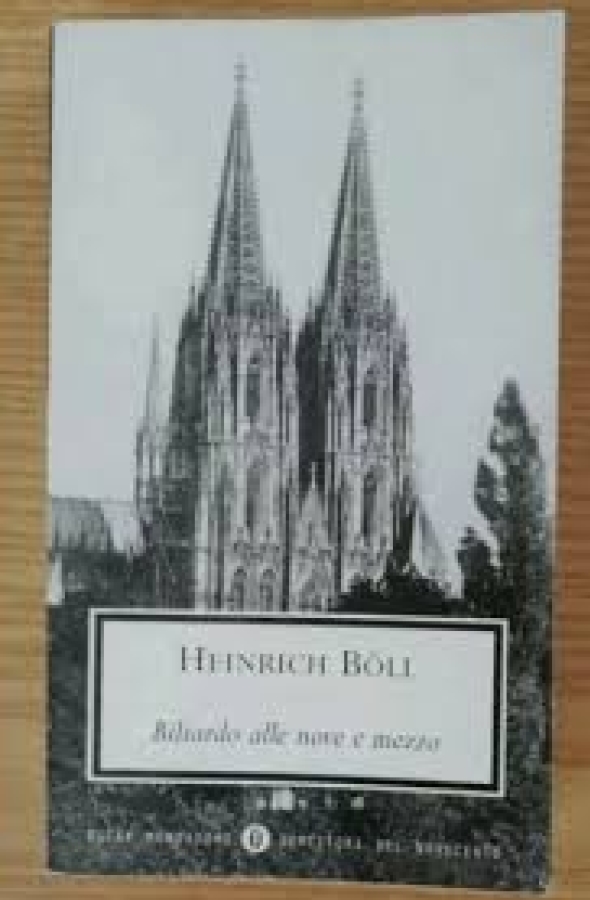
Finished reading on: December 08, 2025
Billiards at Half-Past Nine
Title of the original version reviewed: «Biliardo alle nove e mezzo»
AI Translation Notice: This review was translated from the original Italian using artificial intelligence. Book quotes and excerpts are translated interpretations and will not match the author's original English phrasing or official published translations.
Il romanzo si avvia in un'atmosfera kafkiana: l'ingegner Robert Fahmel, esperto di calcoli strutturali, si lamenta con la segreteria per aver disubbidito a un suo preciso ordine: non dire mai dove si trova, se non alla madre e al padre, ai figli, e a un certo Schrella, che scopriremo poi essere suo cognato e amico di liceo, quando entrambi non aderirono alla gioventù nazista. Siamo nel 1958, nella Germania dell'immediato dopoguerra, quando
everything seemed submerged in the past, yet present. In the regular, even liturgical routine of his life, the distinguished engineer Fahmel goes every day, from nine-thirty to eleven, to play billiards in a grand hotel, doing so solely in the presence of an errand boy, to whom he recounts his high-school years when his classmates had partaken of "the sacrament of the buffalo" (a clear reference to Nazism, which is never explicitly named) and beat the "lambs of God," those who refused to adhere to Nazi ideology.
He struck a ball with a stroke now gentle, now hard, seemingly without reason or purpose; (...) five times, six times, as the struck ball hit the cushion or the other balls. (...) The carousel of lines was always anchored to the corners, obedient to the laws of geometry and physics. Is the daily, solitary game of billiards the pastime of a man enamored of the laws of statics, or does it conceal some mystery that engineer Robert Fahmel carries within himself? For a while, the question finds no answer in a novel characterized by a continuous shifting of narrators, from the third person to the first, and by ever-new windows opening onto the past and the present, as the laws of remembrance dictate. For pages on end, we follow the account of Robert’s father; of when, in 1909, he arrived in the city from the countryside to take part in an important competition: the construction of the Abbey of St. Anthony. The description of the hours spent in a café preparing the project drawings, eating cheese with ginger, is a light and amusing interlude in a grim, hopeless novel. Robert’s father, on the other hand, harbors great expectations, confirmed when he is awarded the construction of the Abbey, which will open up for him a future of success and renown as a great architect, and allow him an advantageous marriage, with the promise of a large family of children, grandchildren, and great-grandchildren. But at the very moment he was submitting the drawings, Robert’s father sensed an omen of the future:
squinting my eyes, the entire massive construction seemed to stand before me, already real, as if I were looking at it from a window: the monks bent over their work, the pilgrims quenching their thirst, and the female workers already singing below, anxiously awaiting the end of the workday, their voices bright and somber, reaching me up here like a death knell. Then I closed my eyes and already felt that chill that only fifty years later, as a grown man in the midst of swarming life, I was to feel again. Illness, Nazism, and the Second World War will take away many of his children and his young daughter-in-law, culminating in his wife’s descent into madness; the Abbey itself will also be destroyed, demolished by the Germans themselves to leave scorched earth for the Allies. From the past we return to the present, in 1958, with a seemingly marginal scene. Joseph, Robert's son, is with his fiancée, but he is taciturn, withdrawn into himself, unwilling to speak and reluctant to attend a family lunch. An architect himself, Joseph is working on the construction of the new Abbey and has discovered some numbers written by his father in several spots among the ruins of the old building: they are the markings indicating where to place the dynamite to demolish the Abbey. It was Robert, then, an officer in the combat engineers, who destroyed that masterpiece, which had meant so much in his grandfather's life. The balls,
red on green, white on green, the monotonous music of the balls, like the rhythm of a Gregorian chant, (...) almost tokens of a severe poetry
, are the metaphor for the quest for an order that might heal, through its daily liturgy, the incurable wounds of a Germany in which the guilt of a people is intertwined with that of individuals, and torn family destinies are bound up with a nation's delusion of power.
"Why why why"—this questioning refrain recurs often in the novel. How is it possible that an intelligent and cultured people spawned so much death? And is reconciliation with the past even possible? Through a family history pivoting on the meticulous rationality of engineering—in construction as in demolition—Böll succeeds in conveying the pain and confusion, the disorientation and despair of a people. In And Never Said a Word (1952), Böll depicted the condition of a people reduced to starvation amid the rubble of post-war Germany; later, in 1963, in The Clown, Böll would delineate the moral ravages of the economic miracle (see the reviews on this site); in this novel, the writer seems to want to distance himself from the Nazi madness, yet without succeeding: the past resurfaces incessantly, and the characters are like extras, groping between madness and indifference—perhaps the only way to process their grief. Whatever the outcome, Böll reckons with history without taking refuge behind an easy self-absolution. Have we Italians done the same? Did the likes of Moravia, Calvino, and the other post-war writers write of our own guilt, or did they retreat into familism, abstraction, or victimhood, as in Elsa Morante's History (see the review of this novel on this site)?
We must not expect a linear plot; to appreciate the novel, one must let oneself be captivated by the writing, by the allure of a prose that at times recalls Thomas Mann (see the review of Buddenbrooks on this site) and at others the musicality of László Krasznahorkai (see the review of The Melancholy of Resistance on this site). It is a pity that, in the end, the novel loses itself in a delirious drift toward nothingness.
Why read it? An anguished masterpiece upon which we Italians ought to reflect.