
Rabbit Redux
It is the 1960s in a provincial American town. The Vietnam War and profound changes—cultural, social, and sexual—serve as the backdrop to the novel, whose central thread is aptly summarized by what the protagonist says at the end of the narrative: > confusion is just a local view of things working out in general . Can one remain oneself, as if nothing were wrong, in a “terrible period, of profound confusion,” such as the one America was going through in the 1960s? Henry works as a typesetter and leads a seemingly peaceful life with his wife Janice and Nelson, their only child. Their marital relationship has been deeply shattered by the death of their other daughter, raising a wall between the two spouses that inevitably affects their sex life as well. Henry can be defined as a conservative: he believes in American values, the righteousness of the Vietnam War, and the idea that Blacks should stay in their place. This precarious balance is overturned by Janice’s affair with a colleague, a Greek man, with whom Henry has a furious argument specifically over the Vietnam War. Janice abandons the family to move in with her lover, leaving Henry to shoulder the burden of the house and their son. On the surface, he appears to be a solid man; in reality, beneath an apparent observance of the roles and conventions imposed by a respectable society, Henry is deeply restless. One evening, he is invited to dinner by a female friend who has just been left by her husband, and everything suggests the evening ought to end in bed, as tradition would have it. Instead, Henry ignores the woman’s overt signals and finishes the evening in a bar frequented primarily by Blacks. Here he meets Jill, an eccentric runaway girl, and Skeeter, a sort of visionary Black man. He takes them into his home and begins a relationship with Jill. A long portion of the novel, rendered verbose and tedious by its heavy ideological imprint, chronicles the life of the four (Henry, Jill, Skeeter, and Nelson) and the increasingly complex and ambiguous entanglement among them. From joints, they move on to hard drugs. Jill also sleeps with Skeeter and perhaps with Nelson, but what dominates above all is the figure of Skeeter and the reading of Black revolution texts. Somehow, Henry reconstructs his cognitive world to the point of defending Skeeter to his neighbors. Then, a terrible fire, perhaps set by the neighbors themselves, destroys the house and kills Jill. Henry, who helps Skeeter—the police’s prime suspect—flee, loses everything, including his job. The novel draws to a weary close: Janice wants to get back together with Henry and persuades him to stay at a hotel. Yet too many things have happened, and the burden of guilt weighs heavily on Henry in particular: “I feel so guilty.” “About what?”, Janice replies. “About everything.” “Relax, not everything is your fault.” “I can't accept that.” “He lets her breasts drop, lets them float away, lovely debris.” Updike’s chief virtue is his narrative style and, above all, his ability to bring characters and events to life through a rich and skillful use of adjectives. This novel lacks precisely that touch, dominated instead by the author’s urge to voice his own perspective—conservative and nostalgic for 1950s America—on the monumental events that convulsed the United States. The character of Skeeter, the glorification of revolutionary principles, and the political arguments are banal and predictable. They make the novel long-winded and, above all, overshadow Henry’s complex transformation and his fundamentally existential suffering. Why not read it? It is verbose and deeply dated.
Reading Lolita in Tehran
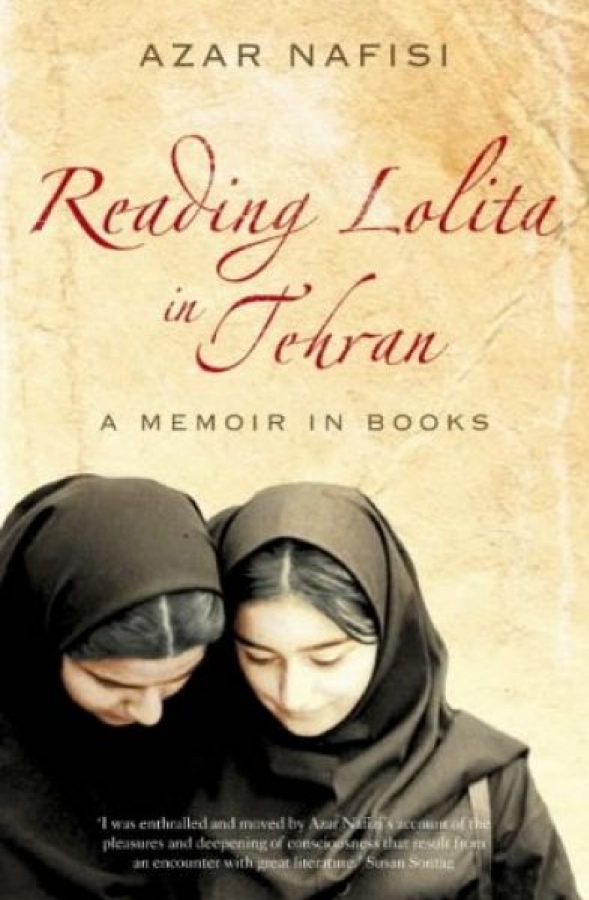
A very fine book, especially the first chapter, in which the writer achieves a density of prose and depth of concept reminiscent of Nadine Gordimer. The book is structured around four periods in the writer's life: each is in some way symbolized by four great authors of literature in English: Nabokov with *Lolita*, Fitzgerald with *The Great Gatsby*, James, and Austen. The narrative does not follow a chronological path. In the first chapter, the author has already left the university and established a reading group in her home. The young women, her former students, arrive at the gathering clad in veil and chador, rendered impersonal by the attire and posture they must adopt to walk the streets; they undress and thereby assume their true personalities. The character of Lolita, a twelve-year-old girl who becomes the lover of an older man, lies at the center of their conversation as a symbol of their existential condition, forced to behave and even think as men dictate. Alongside the literary theme, their personal stories emerge and their interpersonal relationships intertwine, forged of rivalries but also of profound understanding and tenderness. The synthesis of this chapter, and of the entire book, is encapsulated in a profound phrase: "not to be a fragment of someone else's imagination." Lolita possesses no personality of her own; rather, she is forged by the old man, who desires her precisely because he can mold her to his will. In much the same way, Iranian women are expected to conform to the dictates of religious society, unable to genuinely express their individuality or live their own lives. And so literature is not "a luxury, but a necessity"; the realm of the imagination allows one to reclaim the freedom that society seeks to suppress. At this point, the writer introduces the theme of beauty, emphasizing how the younger generations are indifferent to ideology and political stances. > I still find it in the letters from my students when, despite their fears and anxieties about a future without work or security and a fragile, uncertain present, they write about their search for beauty . > I think that somehow our readings and discussions of novels in that class became our respite, our link to another world of tenderness, brilliance, and beauty . In the second chapter, the context is the revolutionary phase, during which it is unclear who will take power, the clerics or the leftist forces. It is thus a transitional phase, yet one characterized by a conviction shared by fundamentalists and leftist revolutionaries alike: individual liberties and the role of women must be subordinated to a massifying ideology. The writer's critique is therefore directed at the Left, which fails to grasp the importance of civil rights and reasons, in effect, no differently than the religious factions. The most interesting episode, from a narrative standpoint as well, is the trial of *The Great Gatsby*, singled out by some as an emblematic figure of Western individualism. The dynamic of the trial sets in motion a dialectic within the classroom, revealing more clearly that the true subject of Fitzgerald's novel is the dream of self-realization in a society that tends to homogenize the individual: > Dreams... are perfect ideals, complete in themselves. How can you impose them on a reality constantly changing, imperfect, and incomplete? You could become a Humbert, destroying the object of your dream: or a Gatsby, destroying yourself. When I left the class that day, I did not tell the students what I myself was beginning to discover: how similar our fate was to Gatsby’s. He wanted to fulfill a dream by retracing the past, and in the end he discovered that the past was dead, the present a shame, and there was no future. Was this not like our revolution, which had imposed itself in the name of our collective past and had destroyed our lives in the name of a dream? . The third chapter is set during the Iran–Iraq War. The revolution has by now firmly imposed itself, women's freedom has been eradicated, and the country lives suspended within a nightmare (the casualties, the bombings, etc. ), gripped by a fierce nationalism and without any hope that this war might come to an end. These are terrible years, in which one cannot help but retreat into feeling. The writer quotes a passage by James, the master of feminine ambiguity, > I cannot tell you not to grieve and not to rebel, writes James, because I have such an imagination of all things and because I am unable to tell you not to feel. To feel, I say, to feel for what is worth it, and even if it kills you, for this is the only way to live, especially living under this terrible pressure, and it is the only way to celebrate and honor this admirable being who is our pride and our inspiration . And the writer adds, > feeling creates empathy and reminds us that life is worth living . It is a profoundly feminine sentiment, harboring that solidarity based on care and relationships that underpins feminine thought. The fourth chapter returns to the context of the first. The war is over, and it becomes fully apparent that there is no genuine possibility of evolution within a regime structurally opposed to civil liberties and the feminine dimension. Nothing remains but flight into intimacy and exile abroad. In a world where religion has become ideology, there seems to be no room left for the individual dimension. In this sense, Austen is hated by the regime. > Austen's women, gentle and beautiful, are the rebels who say no to the choices of foolish mothers, incompetent fathers, and a rigid, orthodox society. They risk ostracism and poverty to win love and friendship (to assert the importance of love and understanding in marriage, and not the importance of marriage itself) in order to embrace that unattainable goal of democracy: the right to choose . Beyond Iranian society, the book addresses universal themes (freedom of choice, the primacy of affection over rigid dogmas, the power of literature and the imagination, etc. ) that can be traced back to the statement: not to be a fragment of someone else's imagination. Yet how is this possible in an increasingly oppressive and homogenizing society, even if ostensibly democratic? How can one defend oneself against the invasion of images, of clichéd commonplaces broadcast by television, of clamorous debates, and so on? It seems to me that the true perspective lies in the rediscovery of literature and culture in general—both as a return to the individual sphere and as a revival of the imagination, and thus as an instrument of resistance and redemption for tomorrow: thinking and feeling are, perhaps, the keystones to conceiving and ultimately realizing a better society.

The road to Los Angeles
It is the second book of the Bandini saga. While the first book still revolves around the theme of the Italian family, rendered in a realistic style lacking in evocative resonance, this novel effectively abandons ethnic and folkloric references to chronicle the coming of age of an eighteen-year-old youth who reads voraciously and lives primarily through imagination and fantasy. The Italian family context is indeed present (the deeply religious mother and sister, an uncle who expects his nephew to shoulder his responsibilities), yet Arturo’s experiences are fundamentally those of any young man his age, compelled to reconcile labor—often grueling and alienating—with his own aspirations and dreams. The book’s first theme is rage, the urge to rebel against an unjust society, frequently expressed through acts of violence (superb is the scene where Arturo slaughters crabs, imagining himself an ancient knight), through diatribes against the Catholic religion, and in allusions to the great nineteenth-century philosophers. The second theme is the erotic realm, the pursuit of a connection with women, which inevitably passes through pornographic magazines and the solitude of his room. Truly extraordinary from a stylistic standpoint is the chapter in which the author recounts Arturo’s destruction of the photographs of the women he loves! The final theme, and perhaps the most important, is that of imagination—the dreams and fantasies bound up with Arturo’s ambitions, with his desire to feel like a great writer. And it is precisely the disappointment resulting from the reading of his first story that drives Arturo to flee his family and journey toward Los Angeles, and thus toward his own independence and maturity. Fante abandons the cold, realistic style that had characterized the first book, moving toward increasingly intense expressions and syntactic constructions, rich in evocative power. To the meaning of the word are added increasingly rich and nuanced "signs," generated by rhythm, phonetics, and the deployment of adjectives, often heightened by neologisms.