
Family dancing
The central theme of the story is the family, viewed by Leavitt as a closed, central nucleus in which relationships among members are vitiated by convictions and hypocrisies. A family reunion is organized, serving, however, as an occasion for each to expect roles and behaviors from the other that often bear no relation to the individual’s true desires. Not even the discovery of one of the family members’ homosexuality manages to break this pattern, as the gay condition is subsumed within the roles and rules of the bourgeois family. David Leavitt has often been regarded as the writer of homosexuality. In truth, he is the chronicler of the bourgeois family in an open society, which accepts anything provided it is reabsorbed into established frameworks. The elegant and effective prose cannot conceal the passage of time on this story, now dated against the neoconservative wave that has restored to homosexuality its status as an otherness and a threat to the family. Why not read it? Because it is predictable and stale.

Red Leaves
For William Faulkner, the short story is akin to poetry, "almost every word must be the right one"; and indeed, the narrative is dense, hermetic, rich in symbolism, and difficult to interpret. As in *Red Leaves*, the very choice of title raises numerous questions: what does it signify? For some commentators, the writer intended to refer to the cycle of the seasons, thereby emphasizing that what suffocates and destroys the Negro people is a natural destiny. The red leaves are said to express an existential, cosmic condition, as in Giuseppe Ungaretti’s poem addressed to the soldiers of the First World War: "Like leaves on trees in autumn." A great Indian chief has died; as tribal tradition dictates, those who served him in life (the dog, the horse, and his Negro slave) must follow him into the grave. Two Indians head to the slave quarters to retrieve the man. What disgusts them is the stench of the bodies, a revolting smell. The Negroes > seemed to be suspended as upon something remote, inscrutable. (...) They were like the roots of a great uptorn tree, the earth momentarily sheared away from the contorted, thick, fusty maze of its outraged and despairing life. From what the two men say, we learn that slavery is a burden, the fruit of the pure Indian people’s contamination by the white man. Born of a mixed marriage between an Indian and a white woman, the deceased himself had been to Europe and returned with several objects whose utility he did not understand; among them, a pair of red slippers; whenever his son tries to put them on, he falls into an unconscious state. What does this mean? Perhaps because > this world (...) is being ruined by white men. We got along fine for years and years, before the white men whooped us into using negroes. In the old days the old men sat in the shade and ate parched corn and venison slowly over the fire, and smoked and talked about honor and big things; and now what do we do? Contamination does not break the absurd ritual of death, as if to say that white, technological, and advanced society reinforces ancestral customs rather than evolving them toward civilized forms. It is mere corruption in an immobile society; it is not progress. Faulkner’s reflection does not concern only the American South, which, at least from what we know, seems trapped in nostalgia for the past; consider certain phenomena that strike us as inexplicable—femicide, infibulation, brutal exploitation—so widespread in our advanced Europe, despite proclaimed laws and values. Only individual acts of Resistance can overcome corruption and generate new visions and moral rules. Paradoxically, this is what the victim in our story does. The Negro, destined to follow his master into the grave, flees into the forest and, when captured, fights for life until the very end: he amputates an arm to survive the bite of a venomous snake; he accepts water on the brink of death. > It’s just that I didn't want to die, he said. Then he said again, it’s just that I didn’t want to die, in a quiet tone, of slow, faint wonderment, as if it were something which, until the words had formed themselves, he had not known, or not known the depth and measure of his desire . The death endured, without resignation yet with equanimity, bears witness to a moral strength absent in the story’s other characters, corrupted by white society while trapped in ancestral rituals. > The Negro was still about to step, his knee raised and bent, his head up as if he were looking into the teeth of a millrace. The pupils of his eyes were wild and cold, like a horse’s . Ralph Ellison, the first great African American writer, said that Faulkner > has actually explored the nature of man. (...) Faulkner, more than most men, was aware of human strength as well as man's weakness. He knew that understanding and overcoming fear was a large part of a writer's reason for being. Faulkner’s narrative is imbued with a strong ethical tension, a desperate quest for human goodness, for that which is deepest in the human being. He pursues this aim within his world, the American South, where everything in reality seems static and violent; yet what he narrates concerns us all; and quoting Ungaretti once again, one could say: "I seek an innocent country." At the center of his writing is the word, not the plot or the characters; and this is precisely its limitation, at least in the short stories: it is difficult to understand, it must be read too many times to grasp its manifold meanings, it demands too much imagination to interpret. Why not read it? It is difficult to interpret and, in fact, boring.
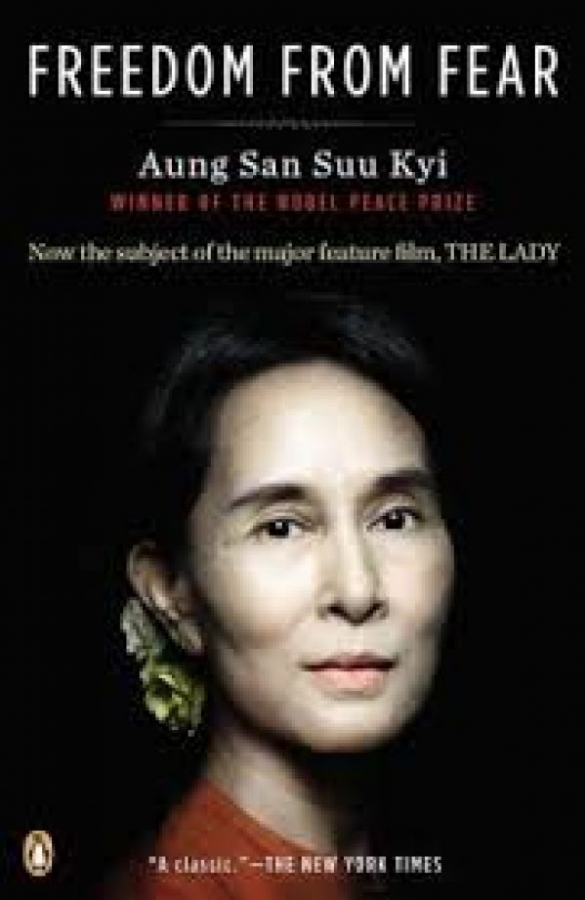
Freedom from Fear and other writings
San Suu was born in 1945, two years before the assassination of her father, founder of independent Burma and national hero. This biographical detail is essential to understanding this collection of essays, speeches, letters, and interviews, published between 1984 and 1994. Aims and prose vary, circumstances change, yet San Suu’s concern always shines through: to understand her father’s legacy, > to communicate what she has understood and to apply it to the problems of her own country . The essay that lends its title to the collection (*Freedom from Fear*) must not mislead: San Suu is not a moral philosopher, a sort of modern holy figure; she is, first and foremost, a political persona, characterized by a strong and prevailing ethical dimension. When the Burmese dissident calls for liberation from fear and corruption, she intends to assert > the firm conviction in the sanctity of ethical principles combined with a historical vision: despite setbacks, the human condition is placed on an ultimate path of spiritual and material progress . In a recent speech at the International Women’s Forum, San Suu defined politics as > the means to change society, and the change must be effective, not symbolic. And how effective it is depends on how correctly we evaluate the needs of the people and the country (quoted in *La Stampa*, 9 December 2014). That this is a long-pondered reflection emerges from a key essay included in the collection (*Quest for Democracy*). In it she affirms that > the true measure of the justice of a system is the amount of protection it guarantees to the weakest. Where there is no justice there cannot be a secure peace . We are speaking, therefore, of social justice, certainly not of abstract concepts belonging to the realm of philosophy and religion. To properly interpret San Suu’s thought, one must read the insightful analysis the author provides of intellectual life in Burma and India during colonialism. It is impossible to summarize such a complex essay: suffice it to say, in short, that the comparison with India allows San Suu to advance a severe critique of Burmese culture, of Buddhism itself, a “monolithic religion (...) with inflexible barriers”; to identify the sources of the regime’s consensus not so much in repression as in ethnic differences and chauvinism against Chinese and Indian communities; and to clarify how her inspirations are Gandhi and, above all, Nehru, her true spiritual father: a great politician, therefore, is her touchstone. If one does not stop at the vacuous, banal words of *Freedom from Fear* (but why does it lend its title to the collection?), one realizes that San Suu has no intention of locking herself within the spiritualist and Buddhist persona that the West would like to assign to her; she wants to be judged by what she manages to achieve for her country. To those urging her to leave Burma, > I replied that I would do nothing from abroad, and that if I wished to commit myself to a political movement, I would have to do so from within the country . Having read the entire collection, one asks oneself: has San Suu truly reckoned with her father? The answer is no. The daughter, San Suu, continues to idealize the father figure, without asking herself why the dictatorship originated in an army forged by her father: a man educated in monasteries, yet trained militarily and politically by the Japanese. As often happens, filial love compromises the lucidity and detachment that are, in any case, necessary in a political figure. Why not read it? It is dull, perhaps pointless. fragmentary, repetitive, and prolix.