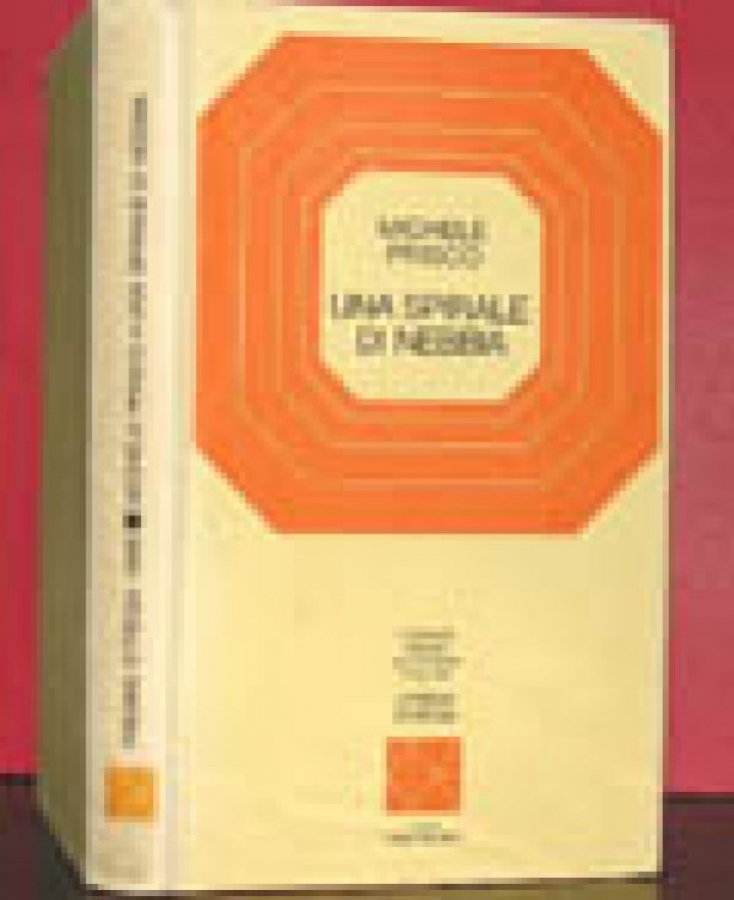
Finished reading on: November 11, 2019
A Spiral of Mist
Title of the original version reviewed: «Una spirale di nebbia»
AI Translation Notice: This review was translated from the original Italian using artificial intelligence. Book quotes and excerpts are translated interpretations and will not match the author's original English phrasing or official published translations.
Life is
a kind of deception, one trains oneself for, this lying to oneself about oneself
, fleeing (...) “the unknown, murky fear of revelation.” As in Teju Cole's Open City (see the review on this site), where the protagonist even forgot having raped a girl because “for myself, I am always the hero” (yet “the pleasure of denial was not available to her”), this novel also investigates
that mysterious, secret depth made of unexpressed emotions, of truths concealed from everyone's eyes
. The investigation takes on the outward guise of a detective novel. Valeria, the Milanese wife of Fabrizio Sangermano—a powerful Campanian family—is killed during a hunting trip with her husband: an accident or a murder? There is a police commissioner, there are numerous characters supposed to help unravel the plot, but that is not what interests the author: Valeria's death should be that traumatic event capable of finally dissolving the fog of human feelings. A series of portraits unfolds. We witness the family gathering, bewildered and worried as they debate Fabrizio’s possible involvement, which would drag the Sangermano clan into scandal; the discussion comes to an abrupt halt when the grandfather, the grand old man,
waved his hand and then said: I am glad to have foreseen the conclusion of this meeting of ours
, (...) silence fell once more in the study, aunts, uncles, and cousins assumed the contrite expression they had learned to master to perfection after so many years of training and acquiescence: attentive, indifferent, expressionless faces of people suddenly emptied of their most intimate personality
. Maria Teresa, a Sangermano who risked remaining an old maid, married a prominent Curia lawyer at the family's behest: an esteemed and influential man. The marriage was never consummated because he is impotent, and when she finds out (having been deceived by his lies), even knowing she should not give a damn about the scandal, even repeating to herself that she must not yield, she said,
as in a dream, without realizing it “that it was fine this way,” speak no more of it, do not be afraid
. And what does the illustrious Curia lawyer do? He impregnates the housemaid to prove he is not impotent and can file for the dissolution of the marriage on the grounds of his wife’s fault; and the wife retreats into silence as a final act of dignity. There are other tales of deception, of hypocrisy, of unsaid things, in certain cases merely the result of that
monotonous, mechanical course “of everyday life, which leads” irreparably away from the essence of life, from discovering what life truly is, as happens to so many millions of individuals who grow up and live short or long lives, yet consecrated, one might say, by constitution or incapacity or who knows what else, to a kind of perpetual renunciation of life
. It is a mortiferous approach, which could only culminate in an unsettling portrait of Valeria's funeral, she, as a corpse, finally part of the Sangermano family that had rejected her in life. The grandfather
stood between the altar and a kneeler in a sedate posture “: was he truly moved or feigning? And the Sangermanos are all around, although” no one weeps, no one was moved: but was it really necessary to be moved? (...) And now the fog was returning, (...) perhaps it rose right from the earth with no other purpose than to smooth over every contour and confuse, annul, at least for the duration of its presence, even them: not their physical bodies, but the resentments and passions and hopes and sorrows and fears, in short, the dense, inextricable knot of feelings.
The novel feels suspended: there is no resolution, and above all, the narrative does not evolve; it remains tangled in the psychological introspection of characters excavated to their core, dissected in their feelings yet without empathy. On the other hand, there is no dynamism in the human drama; everything is enclosed within the superficiality of social relations, in the resignation to an individual destiny already sealed by society. It recalls the existential cages of Andre Dubus, whose stories do not progress because the protagonists are prisoners of interpersonal relationships and their own lies (see on this site
Separate Flights and Other Stories and Dirty Love). Outside the human drama looms a gray backdrop—not stormy, but rainy and foggy:
rather than rain, it was a dust of water, falling softly and soundlessly as though the fog itself were dissolving into a light, moist silver down
.
It is a novel from the 1960s, yet the stylistic distance from today is abyssal. The “fine Italian” of the classical high school permeates the deft articulation of sentences, its rich punctuation, the well-chosen and well-placed adjectives, words brimming with expressive potential. At times one is captivated, but ultimately one realizes the author is relishing his own skill with a narcissism that seems to declare: look how good I am! And we feel an intense nostalgia for Cesare Pavese, for his sober prose, devoid of virtuosity. Perhaps we can no longer write like Prisco, or like Moravia, but it is better this way: our language has gained in terms of readability and accessibility.
Why read it? One must savor the writing; it remains, nonetheless, beautiful prose.