Finished reading on: April 28, 2015
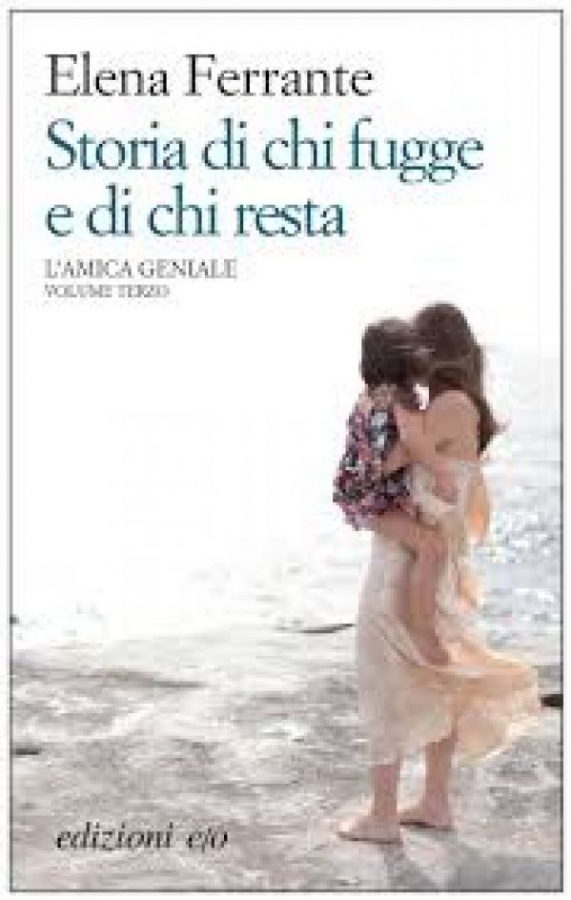
Those Who Leave and Those Who Stay
Title of the original version reviewed: «Storia di chi fugge e di chi resta»
AI Translation Notice: This review was translated from the original Italian using artificial intelligence. Book quotes and excerpts are translated interpretations and will not match the author's original English phrasing or official published translations.
To become.
It was a verb that had always obsessed me (...).
I wanted to become, even though I hadn't known what.
And I had become, that was certain, but without an object, without a true passion, without a determined ambition.
I had wanted to become something, that was the point, only because I feared that Lila would become who knows who and I would be left behind.
My becoming was a becoming in her wake.
I had to start becoming again, but for myself, as an adult, outside of her
.
This long quotation captures the essence of this third volume in the story of a friendship, that between Elena and Lila.
The former has reached
a land of good reasons, governed by rules (...) that gave meaning to everything
: already a successful writer, married to a young, brilliant professor,
always guided by a higher order that, while having a familial rather than divine origin, nonetheless gave him the certainty of being on the side of truth and justice.
Yet beneath a veneer of bourgeois—albeit left-wing—achievements, a deep and intimate dissatisfaction lurks within Elena.
Her visits to the neighborhood are always greeted with deference and admiration, even if tinged with an envious acrimony toward someone who has abandoned her roots; but how to explain the cost of this extraordinary social climb, that
since the age of six I have been a slave to letters and numbers, that my mood depends on the success of their combinations, that this joy of having done well is rare, unstable, lasting an hour, an afternoon, a night?
For much of its length, the novel follows a predictable path, with Elena as the judicious, self-assured woman and Lila in her role as the tormented, unfortunate friend.
The lengthy account of the misadventures of the “brilliant friend” (Lila), her illness—undoubtedly psychosomatic in origin—and Elena's decisive intervention seem to confirm the predictable roles between the two friends.
And the reader expects new literary triumphs for Elena, an intense life from an intellectual and political standpoint, the pursuit of social advancement: none of this comes to pass.
Slowly, but inexorably, Elena retreats into an opaque bourgeois life.
A mother of two young girls, it seemed to her that daily chores bore witness to her maturity as a woman,
that becoming like the mothers of the neighborhood was not a threat, but the natural order of things.
It’s fine like this.
I told myself
.
That a subtle malaise lies beneath this quiet family life is shown not so much by the arid marital relations, accepted with resignation, as by the loss of that authenticity which had sustained Elena as a young writer.
And it once again falls to Lila to tell her the truth, as has always been the case.
After reading her friend's second book, Lila hurls her rage in her face:
don't make me read anything anymore, (...) the disgusting face of things was not enough to write a novel: without imagination it didn't look like a real face, but a mask
.
And it is precisely this judgment, inexorable and cruel, through which Lila asserts her “unrivaled power,” that drives Elena to a disruptive act.
She meets Nino, the man yearned for in her adolescence and stolen away by her friend; she begins an extramarital affair with him that culminates in fleeing her family.
At the news, Lila
began to scream.
(...) Why did you study so much? What the fuck was the point of imagining that you would enjoy a wonderful life for me, too? I was wrong, you're an idiot
.
Yet wasn't Nino the very man who had brought Lila close to self-annihilation? But then, Elena wonders after an intense day of lovemaking with her lover, “we weren't doing, but redoing.”
One might hastily say that Lila's verdict on Elena's book applies to this third volume as well.
The narrative has lost its vigor; it lingers pointlessly on the clichés of the 1960s, on facile observations regarding the female condition, and on fragile, predictable psychological insights.
Lila's figure recedes into the background and, consequently, the novel loses its originality; Elena comes across as a bored, inconclusive, petty-bourgeois woman; the other characters are vacuous figures, beginning with Nino—a capricious and irresponsible lover, for whom the love affair with Elena is a “repetition,” as Elena herself acknowledges.
The only truly compelling scene in the book is the one set in a drawing room in Posillipo: the Solaras, neighborhood bosses who have grown rich, celebrate their mother's sixtieth birthday in their luxurious apartment.
Napoletanità returns to breathe life into the narration, drawing all the characters back into the life of the neighborhood.
Ultimately, this lack of energy is reflected in the writing—still fluid, but tired and prosaic.
Why read it? To see how it ends.