Finished reading on: February 18, 2013
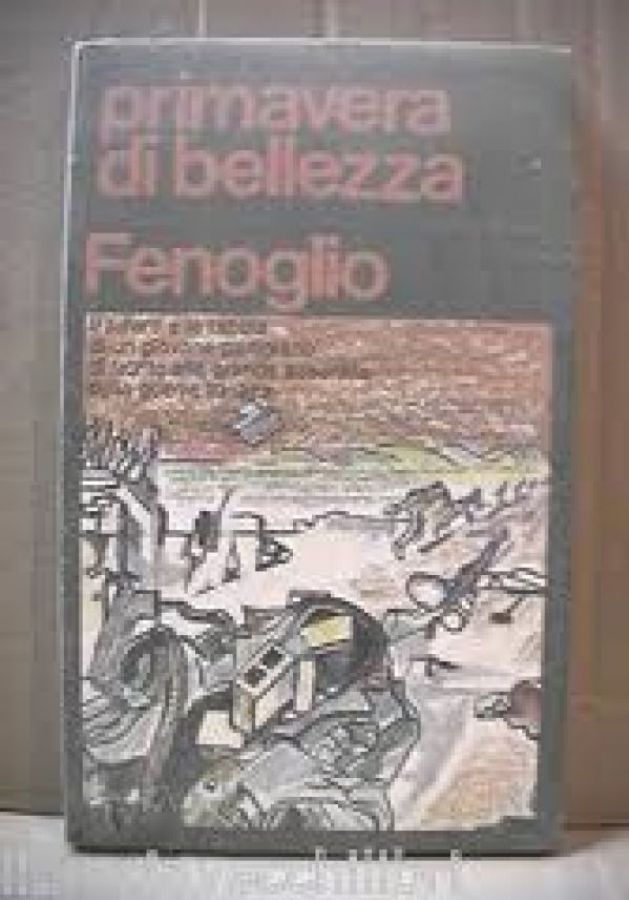
Spring of Beauty
Title of the original version reviewed: «Primavera di bellezza»
AI Translation Notice: This review was translated from the original Italian using artificial intelligence. Book quotes and excerpts are translated interpretations and will not match the author's original English phrasing or official published translations.
The novel is set in 1943, during the dramatic months that led to the fall of Mussolini—replaced by Badoglio—the Armistice of September 8, and the king's flight from Rome.
In this brief span of time, Italians came to realize what the Fascist regime had truly been, and into what disaster it had plunged them.
Like the novel's protagonist, the officer cadet Johnny, Italians were seized by an indignation that
loaded them like a shell into the mouth of a cannon: murderous swine, filthy bluffer!
.
The novel recounts, precisely, this tragic coming-of-age, narrating it from the perspective of young soldiers left to their own devices, as was the entire country. The novel opens in a barracks in Piedmont, where Johnny is attending an officer cadet course.
The military environment is slipshod, marked more by hollow rituals than genuine training.
In truth, no one, not even the highest-ranking officers, believes in Italy's victory or in the war's justification.
Discouragement and pessimism prevail.
A disconnect exists between reality and the repetitive, futile drills to which the young recruits are stubbornly held.
Exhausted by that excess of freedom and oblivion, he had to lean against the trunk of a poplar; he felt the soft, warm bark, and failed to hear the distant trumpet sound the cease-fire.
This by the river was reality; the morbid dream was the Italian army
.
How unreal appear the slogans painted on the walls, «Vincere», when the Italian troops, «greasy, down-at-heel, gypsylike», are transferred to Rome: it seems the American army has landed in Sicily.
The officer cadets' hope of seeing combat swiftly fades.
They are stationed in a barracks in Montesacro, resuming their pointless drills.
It wasn't so bad after all, an entire, fairly close-knit squad idling in the delightful quiet of a nearly deserted barracks....
it felt like being in a clinic
.
The armistice catches them completely unprepared.
Johnny, with a group of comrades, is guarding an ammunition depot in the Roman countryside when he sees droves of soldiers arriving, half in civilian clothes and half in uniform, fleeing Rome.
The king, Badoglio, and the senior officers have abandoned the capital without leaving orders on how to act:
resist the Germans, do not resist, kill the Germans, do not open fire on the Germans, do not surrender your weapons, self-disarm....
hurry up and find yourselves some civilian rags, too
.
Resignation and flight prevail; after all, «it had to end somehow».
«Full of misery, with no room left for fear», Johnny too resolves to return home to Piedmont.
A journey begins aboard trains overflowing with fugitives, while at the stations Germans round up Italian soldiers to dispatch them to concentration camps in Germany.
Often, some of the Italians are shot on the spot when attempting to escape.
The stench of that Italian multitude, bowed, attempting to do the smallest and most necessary things with an air of absolute harmlessness and submission.
Often beneath the shed roofs a brutish German call rang out, and then those little soldiers, so trim and solid, cut irresistibly through the suspended Italian mass toward mysterious appointments and duties
.
These few lines render magnificently how Italians had been reduced by an improvident and cowardly ruling class: an abandonment mirrored by the aimless efficiency of Hitler's army.
Two nations in disarray, albeit in markedly different ways.
Johnny miraculously manages to reach Piedmont, just a few kilometers from home, when he encounters a detachment of soldiers who have resolved not to surrender and to fight the Germans.
He decides to join the partisans, certainly not out of political conviction, but out of an emotional impulse, so as not to feel
too inferior to a spit...
because it repels him to come out of it like that (like a fugitive)
.
Johnny's fate is sealed during an assault on a convoy:
the German was coming, a young face and an old uniform, and now lowered the already-aimed machinepistol.
Johnny perceived an infinitesimal click
.
The splendor of this novel does not reside solely in Johnny's tragic and emblematic story.
Its exceptional nature lies in the language used: rich, imaginative, and inventive.
It is as if Fenoglio sought to transfigure history, refusing to reduce it to a dry and cold report.
The Italian language is molded to forge a suspended, unreal atmosphere, as though everything that happened to Johnny had not truly occurred, but belonged to a nightmare—both personal and national.
Reading this marvelous book, one feels overcome by an intense melancholy, for what Italy was, but also for what our language might have become, had it not withered into a hasty, impoverished, and sterile narrative style.
Why read it? It is the account of a momentous juncture in our history, and a captivating read.