Finished reading on: October 27, 2014
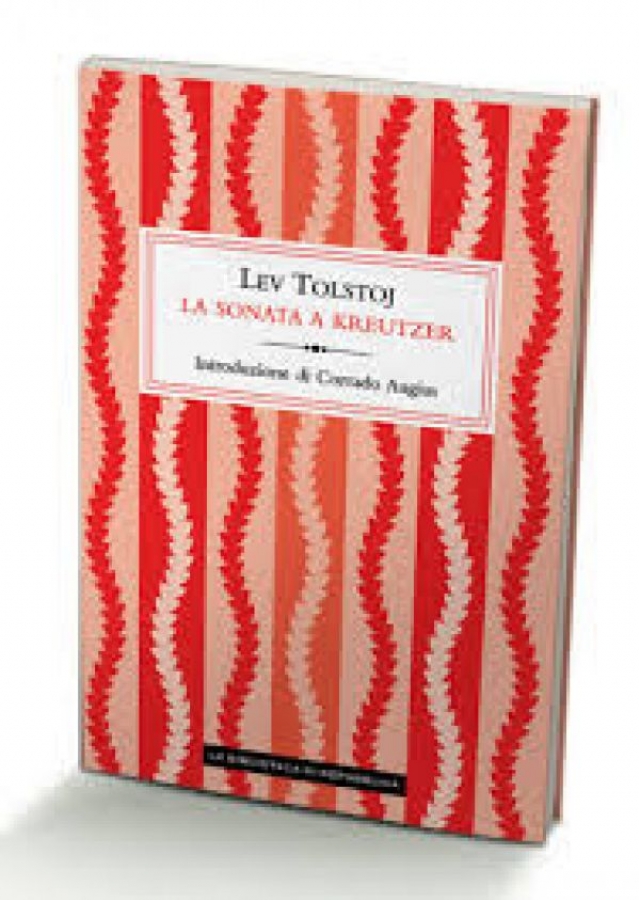
The Kreutzer Sonata
Title of the original version reviewed: «La sonata a Kreutzer»
AI Translation Notice: This review was translated from the original Italian using artificial intelligence. Book quotes and excerpts are translated interpretations and will not match the author's original English phrasing or official published translations.
During a long train journey, the passengers begin a discussion on the institution of marriage.
Can there be spiritual affinity in married life, or is it nothing more than
a horrifying hell, on account of which one ends up an alcoholic, shoots oneself, or commits murder
? The conversation is abruptly interrupted when a traveler declares that he is “the one who, fancy that, killed his wife.”
And he begins to recount his story.
Like most men, he had led a licentious life for many years, frequenting brothels and despising women, from whom he sought only sexual pleasure.
Then, like everyone of his social standing, he married, because that was simply what one must do.
Already during the honeymoon,
the infatuation had run dry with the satisfaction of the senses, and we found ourselves facing one another in the true reality of our relations: that of two egoists, utter strangers to one another, wishing for nothing more than to extract from the other as much pleasure as possible
.
For many pages, the narrative serves as an occasion to discuss marriage and, more broadly, the relations between men and women: reflections to which Tolstoy would return more explicitly in his postscript.
We must live an authentic life, the great Russian writer asserts, in the service of a higher ideal: love of God and of one’s neighbor.
Along this path, marriage—a mere compliance with external rules—is a disruptive impediment, because
one ends up dedicating the finest period of one’s existence—men, respectively, to eyeing, seeking out, and possessing the finest objects of love in the form of love affairs and marriage, and women and girls to luring and drawing men into an affair or into marriage
.
And to those who counter that marriage legitimizes sexual relations without which there would be no procreation, and thus the human species would become extinct, Tolstoy responds drastically:
a Christian would be conscious of not sinning or not falling, in marrying, only if the necessities of life were guaranteed for all the children in the world
.
Is the novella, then, a moral essay? In large measure, yes, and that is how his contemporaries interpreted it.
At a certain point, however, comes an unexpected turning point.
The protagonist, the murderous narrator, attends his wife’s concert, in which she plays, alongside her lover, a piece by Beethoven: the first presto of the Kreutzer Sonata.
Many authors have written about music, more often than not associating listening with an elevation of the human soul.
Tolstoy astounds us once again.
They say that music elevates the soul: nonsense, it isn’t true! (...) Music compels me to forget myself, my true state of mind; it transports me into a different, alien situation; under the spell of music, I seem to feel what I do not actually feel, to understand what I do not understand, to be capable of what I am incapable of.
(...) Upon me, at least, this piece had a terrible effect; feelings were revealed to me that seemed completely new, new possibilities I had never known before.
Not as I had previously thought and lived, but as though a new voice were speaking within my soul
.
And an irrepressible force rises within the protagonist’s consciousness, one the reader has already encountered in the final pages of Anna Karenina, immediately before the suicide:
some demon, entirely outside my will, devised and suggested the most bloodcurdling hypotheses
.
From this moment on, the narrative, previously slow and somewhat tedious, becomes relentless and overwhelming, driving toward a dramatic scene.
Returning home unexpectedly, he catches his wife and her alleged lover in the drawing room; first he attacks the man, who flees—unpursued, at that (“it was ridiculous to run in stockinged feet”—even during a murder, bourgeois propriety prevails!); then he violently turns upon his wife, stabbing her to death.
He even has the impudence to beg her forgiveness.
“Forgive you? That is nonsense. If only I didn't have to die!” the woman replies.
The novella hinges entirely on its final forty pages, both from a literary standpoint and in terms of thematic substance.
The narration of the murder, as the final act of a lucid and frenzied hatred, possesses an astonishing expressive power: even while foreseeing the inevitable conclusion, the reader hopes until the very end that something might happen (a pang of conscience, someone’s intervention), before ultimately surrendering to a sentence terrible in its cold matter-of-factness.
I felt and remember the momentary resistance offered by the corset, and beneath it something else, then the knife sinking into the softness
.
Tolstoy’s condemnation of the man is clear and unequivocal: the victim is the woman, the culprit is the husband, who is fully conscious of what he is doing.
The judges will decide otherwise, acquitting the murderer on the grounds of the alleged adultery.
Conscience will not acquit him, and the novella closes with a desperate plea for forgiveness.
Why read it? If one pushes past the first eighty pages, one discovers a story of femicide, recounted by a great writer.