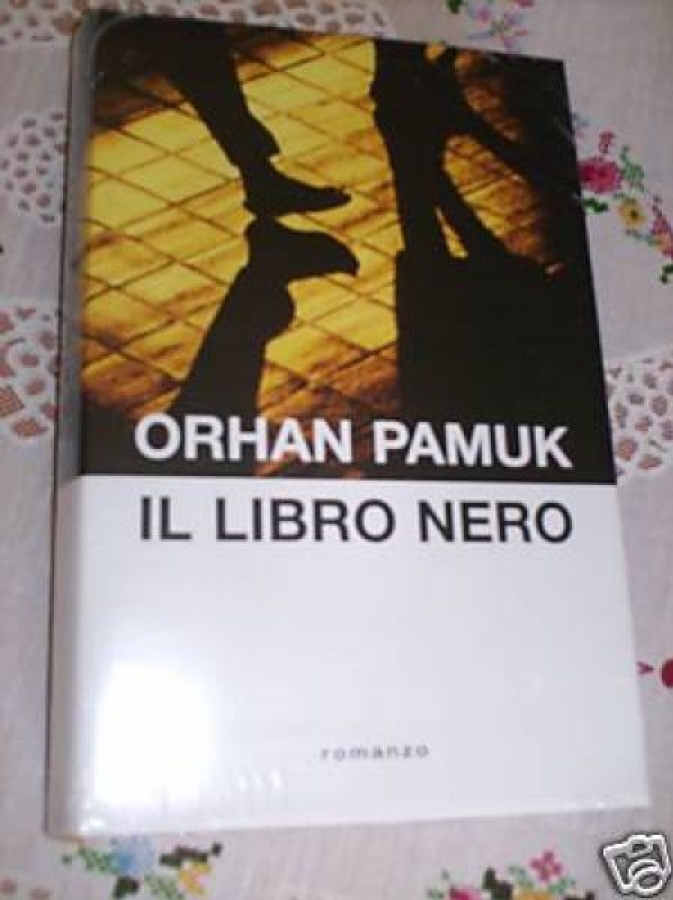
Finished reading on: December 27, 2005
The Black Book
Title of the original version reviewed: «Il libro nero»
AI Translation Notice: This review was translated from the original Italian using artificial intelligence. Book quotes and excerpts are translated interpretations and will not match the author's original English phrasing or official published translations.
The novel revolves around two figures: Galip is a young lawyer who has been abandoned by his wife and sets out in search of her, following the clues left behind by the novel’s other character, Celal.
The latter is a journalist who has written a column for many years, and is both Galip’s cousin and his wife’s half-brother.
The book unfolds across two voices.
A third-person voice recounts Galip’s wanderings through Istanbul on the trail of his wife and cousin.
Celal, in the first person, draws upon reflections—paradoxical at times, yet always evocative—from his column to develop meditations on existence and Turkish society.
It is a deeply dense, complex, and verbose book, with a very slow narrative pace that is, in many stretches, tedious.
A primary theme is undoubtedly the context: Turkish society, poised between Europe and Asia, between modernity and Islamic tradition, perpetually on the verge of shedding nostalgia for past greatness, yet somehow pulled back by history.
In an interview, the author stated that “Turkish is synonymous with confusion,” and this assertion emerges as the book’s dominant theme, particularly in its first part.
From sociological and cultural contours, the focus shifts swiftly to an existential theme: nothing appears as it truly is.
The wife’s ex-husband, a far-left militant, deliberately lives a bourgeois life with a wife and children.
An old friend obsessively compiles documentation on leftist political movements, from the reading of which emerges a total confusion of names and facts, often fabricated.
A former schoolmate married a man simply because he resembled Galip, believing that in this way she could live with him rather than with her husband.
Objects themselves carry a double meaning:
what frightened him was the precise feeling that those objects had a different meaning...
What is it used for?, he asked...
it’s a table leg, replied the other, but some people slip them into the hem of curtains.
It could also be made into a handle.
What must one do to penetrate the arcane world of second meanings and uncover the mystery?
.
At this point, a philosophical theme opens up: there was once a felicitous era in which words (“letters”) fully represented the meaning of the object, and thus narrative and life corresponded.
In that Golden Age, the objects we placed in our homes coincided with the ones we dreamed of...
everyone knew full well that words and what they described were so contiguous that, on foggy mornings, words and meanings blurred together.
Upon waking, people could not distinguish dreams from reality, poetry from life, names from those who bore them.
Stories and lives were so real that no one would have ever even conceived of asking where the former ended and the latter began.
Dreams were lived, and lives were interpreted to their depths
.
The split between words and objects, between poetry and reality, between dream and life, leads to loneliness and to the incommunicability between people, as well as between people and objects:
the world he wanted to enter was not this one, but another realm that Celal had spent a lifetime creating.
According to him, Celal, by calling things by their name and telling stories, had gradually walled off the world where he had sequestered himself, hiding the keys
.
Can one be oneself? Can narrative be reunited with life? Yes, but only in the stillness of mannequins, of cold objects that, even more than living beings, succeed in offering the exact representation of life.
The key chapter of the book is that magnificent one depicting the visit to the underground workshop of a mannequin maker; in this place beneath represented life (“advertising mannequins”), this man had carried on the family tradition of crafting mannequins that genuinely represented the characters and figures of reality.
Yet, if only mannequins allow narrative and life to reunite, is death not the sole moment in which the Golden Age is realized? The book appears in many respects intellectualistic and tedious, locked within philosophical and existential themes that cause the narrative and the characters themselves to lose their luster.
Moreover, it feels fragmentary and redundant.