Finished reading on: March 28, 2022
The Boarding School
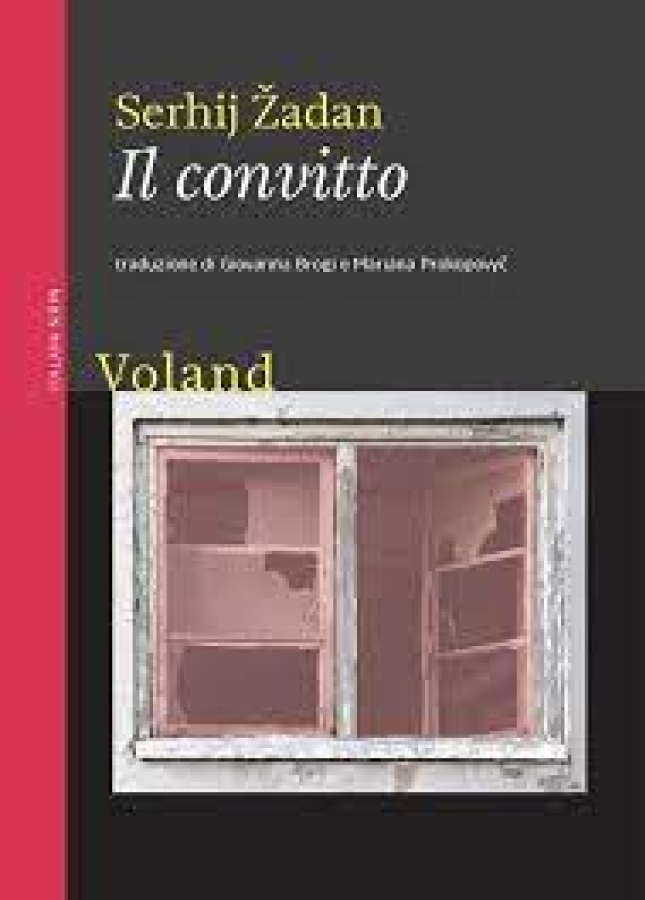
Title of the original version reviewed: «Il convitto»
AI Translation Notice: This review was translated from the original Italian using artificial intelligence. Book quotes and excerpts are translated interpretations and will not match the author's original English phrasing or official published translations.
The novel is the concluding chapter of a trilogy: The Road of the Donbas (2009), Mesopotamia (2014), and The Orphanage (2017). Just as in Cesare Pavese's novel The House on the Hill (see the review on this site) Corrado sought "a stupor, an anesthetic, a certainty of being well hidden" so as not to become embroiled in the Resistance, so Pasha, the protagonist of The Orphanage, responds to those advising him to flee that "he was just a teacher, a simple teacher (...) nothing more than a teacher, the rest mattered little to him. Where was he supposed to go, who would be waiting for him, what was there to fear, everything would be fine, he was just a teacher
. And he remained with his elderly father without even following the news on television while war flared in the Donbas between Ukrainians and Russians.
No one knows how it happened that the bowels of the earth burst open, spitting out that black grime, (...) everything will catch fire like in a medieval city: house by house, street by street, a matter of a few days, and then there will be nothing left
. What shakes him from his torpor is the remorse over having allowed his sister's son to be shut away in a boarding school; he wants to go and retrieve him, even if he must cross the front line, amidst the fighting. He sets out on a journey, a peregrination that continually brings him back to the very same places, as though he were not advancing in any particular direction, but pacing
in circles like a circus bear. (...) For three days I have been walking alongside people I do not even know. As if a spring were pushing me from behind, preventing me from stopping. And the spring pushes them too, in the same way, far from home. Even though at least half of them no longer have either a home or a family. They wander along the ring road without any chance of escaping it. They go round in circles around their own city. And I, too, circle with them, I do not know why
. In a landscape devastated by bombs and violence, where there is mercy for no one, Pasha's wandering becomes a pilgrimage outside of time and space (the 2014 Donbas war): it is like journeying through a nightmare, woven from a medley of characters, destruction, death, and memories of the past. Is it a dream or reality? Why did that soldier, a former pupil of his, spare him? Why did they kill the boarding school’s caretaker, the only teacher who had not fled, staying behind to protect the institution’s young residents? Why will he, so timid and clumsy, be saved?
The illustrious doctor asked him to attend to a wounded man, an adolescent of twenty.
Soon he will be gone; now he will close his eyes and it will all be over. (...) Suddenly Pasha senses another presence beside him, unfamiliar, standing there waiting, pertinacious. (...) Who is it waiting for? Whom has it come for? Surely for me, Pasha imagines. It is this presence that hasn't let me out of its sight for three days, it is what gives off this heavy smell of wet dog, it is hunting me, it is taking aim at me. (...) At that moment the wounded man squeezes his hand. (...) He senses that death is bypassing him, moving away and drawing near the other. (...) Don't look, he tells himself, you must not look, just run, run as fast as you can, while you still have the strength and the time, run and do not look back...
Giovanna Brogi, the fine translator from Ukrainian, interprets the novel in her afterword as a coming-of-age journey for Pasha, who reflects on his own identity—linguistic included—becomes conscious of his own pusillanimity, and realizes he must choose where to stand. This interpretation clashes with the metaphysical darkening that shrouds the entire narrative, where there is no prospect of salvation or rebirth. Consider a passage near the end, rich in symbolism that contrasts with the tale's apparent hyperrealism. We left Pasha in his flight from death.
There is such an abundance of white that it seems as though all colors have been exhausted. (...) White fields and the black asphalt of the road along which he tries to flee, which ought to save him. (...) And he clearly discerns the dark dogs against the white background. (...) They are drawing closer and closer, fierce and fearless; they know the victim cannot escape, has no way out—there it is, just a few leaps ahead, one more moment, a few more seconds, and you will be able to pounce, sink your teeth into its throat as it tries to break free, to cheat fate
. All that remains for Pasha is compassion, the Latin pietas, expressed in the final pages by his no longer adolescent nephew: the boy's recognition of his uncle's fragility, perhaps, saves Pasha.
The essentiality of the prose, the sparse diction, the driving rhythm accompanied by prolonged suspensions, the narrative ability to shift from an intense realism to an oneiric symbolism are the hallmarks of this masterpiece, a welcome surprise in an often banal literary landscape. Could it be that the stark, essential conditions of existence forge works of true value—something impossible when a soft, parlor-room everyday life prevails? Might European literature need war in order to be reborn?
Why read it? It is compelling from a historical perspective, but above all, its literary style is captivating: a masterpiece.