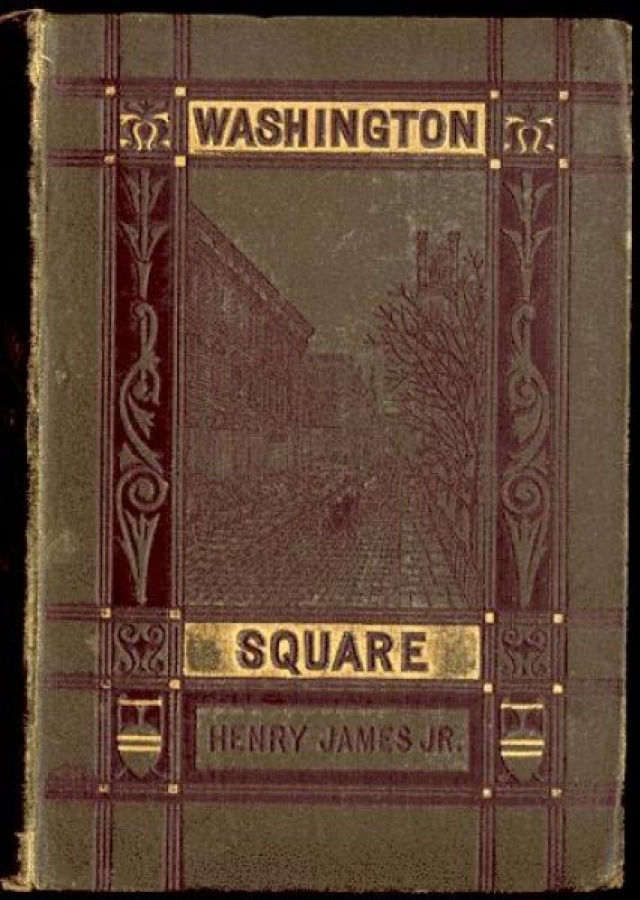
Washington Square
The book is set in late nineteenth-century New York. Catherine, the daughter of a prominent physician in the city, is courted by a young man who is interested in her dowry. Catherine’s father refuses and declares that he will not grant the girl her inheritance. A romantic drama unfolds, in which Catherine’s aunt assumes an important role: a woman who, driven by a romanticized conception of love and the futile pursuit of extraordinary occurrences, wishes the girl would abandon her father and marry the young man regardless. Following a journey to Europe with her father, Catherine realizes that he holds no esteem for her whatsoever, and decides to marry the young man even against her parent’s will. Yet the young man, who had hoped the father would change his mind, abandons the girl, knowing he cannot gain access to the doctor’s fortune. Years pass, Catherine does not marry, and after her father’s death the young man reappears—now an aging man—hoping to resume their former relationship. But Catherine turns him away. The underlying theme of the book is the story of a young woman who is the object of the aspirations and notions of others. The father believes his daughter to be foolish, devoid of qualities, and maintains toward her until the very end a contemptuous attitude, aimed more at asserting his own intellect and foresight (he had grasped from the outset that the young man was after the dowry) than at considering his daughter’s feelings. The aunt is in search of emotional thrills to fill her life and does not consider that her actions (her friendship with the young man, her attempt to manipulate the girl, etc. ) might cause harm to the point of ruining Catherine’s life. The young man is patently a scoundrel, a vacuous figure who seeks until the very end to use the girl to secure a position for himself, unconcerned about returning after so many years to wound her anew. Throughout this story, Catherine’s personality gradually emerges; she finds the strength to take a solitary stand, determined not to compromise with anyone, even at the cost of her own happiness. She has been and continues to be manipulated; her father holds an opinion of her shaped by stereotypes, yet she lives her own life, now indifferent and in opposition to those around her. To the young man, now a mature man, who asks if she is angry, Catherine replies: > no, I am not angry; anger does not last that way for years. But there are other things. Impressions that endure, when they have been strong. But I cannot speak... Catherine picked up her knitting needles, sat down with them again, for life, as it were .
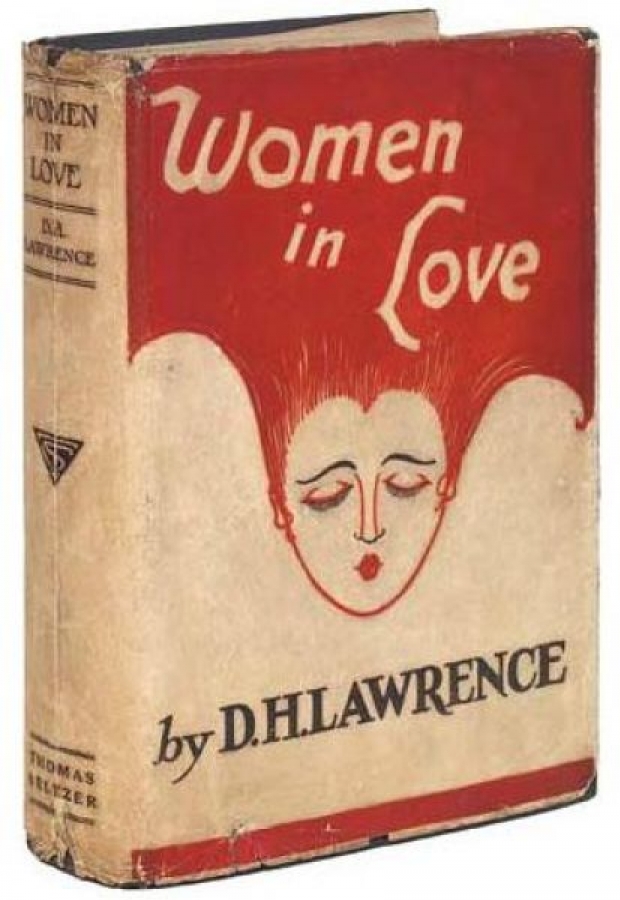
Women in love
The narrative unfolds within a framework of relationships among four protagonists: two men bound by a close friendship, and two sisters, both young schoolteachers. The historical context is England in the second half of the nineteenth century, marked by the advent of machines, positivism, and a yearning for a poetic world, epitomised by the English countryside. The two men operate within the roles assigned to the male by English society. Birkin is a romantic young man who seeks in woman a submissive companion (a wife and a mother), believing that true friendship, essential to a man's completeness, is that shared with other men. One might say his touchstone is Plato's *Symposium*, even if he does not go so far as a homosexual relationship—which, in fact, he gently declines when proposed by his friend. Gerald is a young engineer, a wealthy industrialist who has radically overhauled the organisation of the mines he owns, defying his father’s authority. A horrific childhood incident (he inadvertently contributed to his brother's death), a troubled relationship with his father, and a positivist world-view—which nevertheless conflicts with profound inner torment—conspire to lend him an outward confidence while driving him to seek comfort and solace in woman. In him, male friendship borders, almost overtly, on the pursuit of a homosexual relationship. While the men serve as a point of reference, locked as they are within their social roles and their egos, it is the two women who shatter convention entirely: and this not out of an impulse toward social emancipation, but because sensuality and physical restlessness contribute to subverting the concept of woman as wife and mother. It is Ursula, one of the sisters, who entices Birkin, drawing him into a sexual relationship—intensely erotic even by contemporary standards—that the man himself perhaps did not seek. It is Ursula, once again, who resists marriage, prevaricates, and, when she finally yields, finds herself in conflict with her parents. Gudrun's personality appears more complex: she too is driven by a powerful sensuality, which is sublimated into an intellectual quest for freedom, for an unconventional life. Her relationship with Gerald develops precisely around this contradiction: on the one hand, she experiences a fierce physical attraction; on the other, she disdains him for his prosaic nature, for his conventional view of gender roles. From this contradiction the final tragedy erupts, in which Gerald attempts to kill the young woman before taking his own life. Alongside the protagonists stands nature, which forms an integral part of the tale. It is a kind of pantheism, a living nature that merges with the protagonists: > nothing else would work, nothing else would give satisfaction, except this coolness and this netting of vegetation, which penetrated into the blood. How fortunate he was that there was this pleasant, subtle vegetation interacting, waiting for him as he waited for it; what a fullness, what a joy! . Yet nature also leads toward dissolution, toward death. > A small, bright moon shone just ahead, a brilliant thing, a bearer of sorrow, that was always there, eternal, from which there was no escape. He (Gerald) wanted to go to the end, he could bear no more. Yet he could not sleep . The plot unfolds slowly. At the outset, there is the depiction of the small English town along with the introduction of the protagonists. In truth, these appear as standalone scenes, unframed by a broader narrative arc. Each of these scenes is meant to introduce certain interior themes, tied to the web of relationships, which will later erupt in the second half of the story. At times, the author embarks on digressions into social philosophy, using the protagonists (Birkin in particular) as mouthpieces. The death of Gerald's father and the erotic scene between Ursula and Birkin mark the turning point of the novel, which moves, ever slowly, toward Ursula's marriage to Birkin, Gudrun's decision to enter into a romantic relationship with Gerald, and ultimately the journey to Austria, amidst the snow and cold. Here, Gerald's jealousy of Gudrun, his realisation that he cannot master the young woman, and her decision to leave him drive everything toward the final tragedy. The writer writes exquisitely, with a style steeped—both in its diction and in the cadence of its prose—in a pantheistic sensualism reminiscent of D'Annunzio. The two authors appear remarkably similar in the elegance and refinement of their language as well.