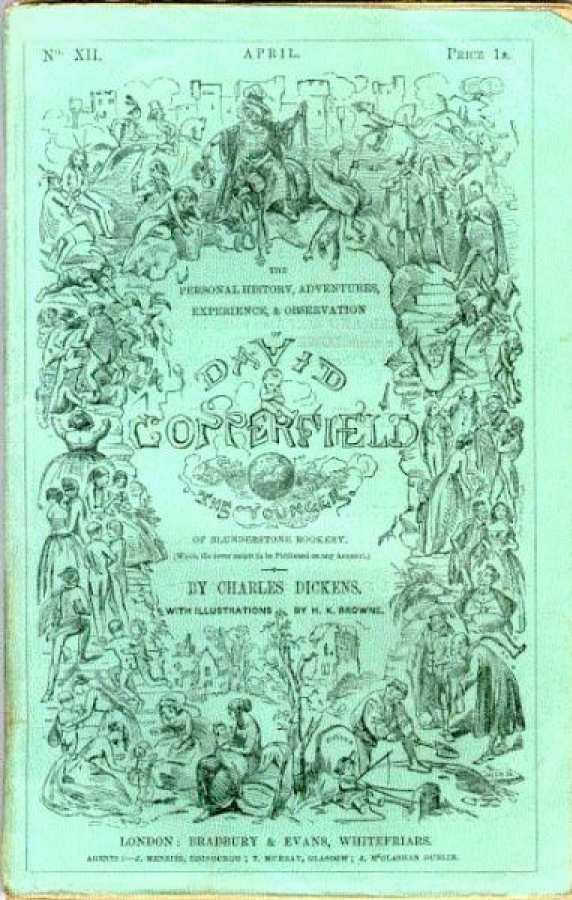
David Copperfield
The novel recounts the life of David Copperfield, who, after a happy childhood with his mother and a nurse, is persecuted by his stepfather. He is sent to a harsh, authoritarian school and, upon the death of his mother, is forced to work in a factory while still a child. He is subsequently taken in by an aunt, who provides him with comfort, an education, and the means for an apprenticeship at a law office. Over time, the young David grows into manhood, working hard, marrying, and gradually establishing himself as a writer. Upon his wife’s death, he embarks on a long journey, which allows him to realize his love for a childhood friend (Agnes), whom he marries upon his return to England. The novel is rich in characters and situations (grotesque, melodramatic, emblematic of contemporary society and widespread social injustice, representative of a harsh and hypocritical morality), such that David’s fortunes intertwine with other subplots, all culminating in happy endings, yet often encumbering the narrative and rendering it prolix, rambling, and fragmentary. Individual episodes stand out more vividly than the overarching plot, while the heightened exaggeration of the characters, for good or ill, comes at the expense of substance and depth in the portrayal of the figures' emotions and distinct idiosyncrasies. In truth, everything revolves around David and his representation of reality; the throng of other characters and the settings themselves constitute «background noise» or a frame within which the imagination of both author and protagonist unfolds. *David Copperfield* has been defined as an autobiographical novel, but this is only partially true. In fact, it is a novel of nostalgia for childhood and of return to a paradise, constituted precisely by the serene maternal sphere and by the figure of Agnes, ever cherished and sought after for her very tranquility and steadfastness. What prevails is a reality interpreted through a melancholic imagination: all events are seen through the eyes of a child, who narrates an unreal England, embellished (even amid its suffering and injustice) by the trusting, idealized vision typical of childhood. From this perspective, it is emblematic, and particularly evocative, how the author conceptualizes the ideal place of refuge: it is a boat, inside which one feels safe even as the waves swell and the wind rises outside, in that it ensures an emotional equilibrium and a peace that are ultimately destroyed by the arrival of adult betrayal and passion, and, metaphorically, by a storm that claims both the betrayer and the betrayed. The style features an exceptionally rich vocabulary and is characterized by a sentence structure that is often difficult to follow. The frequent use of dialectal forms further increases the difficulty of the reading experience.

Dreams in a time of war
Thiongʼo is a Kenyan writer, and in this book he recounts his youth in 1950s Kenya, torn apart by ruthless British repression. It is not a political or historical text, although references to figures and events in the history of the African nation are numerous. > Despite my dashed hopes, the events, even the arrival of British battalions, were largely abstract, happening in a misty land as far away as a story in a distant setting alternating between dreams and nightmares . And indeed, amid dramatic events and social upheavals, the young Thiongʼo pursues a stubborn desire for schooling and education, leading him from the seemingly sealed fate of a peasant to that of a writer. This is the profound core of the book: it is possible to keep dreams alive even in times of war. Thiongʼo was born into a typical Kikuyu family. His father is a small landowner with four wives and many children. The portrayal of this community, with its multitude of brothers and sisters, is the finest part of the book. The author offers a vivid, affectionate representation, rich in memory and steeped in nostalgia. It is a happy childhood anchored by a cornerstone, his mother, who wishes for her son to “always seek the best, whatever the difficulties and obstacles.” And it is by listening to peasant tales and songs that the child “begins to hear the music in words,” the magic of choice, arrangement, cadence—everything that makes a story so beautiful and endures so long in memory. Thiongʼo falls in love with words, both written and spoken, and from that moment on, his destiny is sealed. Family upheavals and national events leave a deep mark on the boy’s adolescence: his mother is repudiated by his father, the extended family disintegrates, and British repression brings death, injustice, and devastation. The educational path itself is fraught with obstacles, as schools must often shut down or conform to British dictates, which oppose the cultural advancement of the local population. In spite of everything, the boy masters English, even having to learn it from an absurd textbook describing two Oxford boys discovering London. He knows everything about the British capital and little to nothing about his own country! He devours the great classics of English and world literature, memorizes *Treasure Island*, and it is precisely thanks to this passion for Stevenson’s great novel that he brilliantly passes the entrance exam for secondary school. He is admitted to one of the finest educational institutions in Kenya. The entire community shares in the boy’s triumph, contributing collectively to pay his tuition and provide the young Thiongʼo with the necessary school kit. Indeed, everyone knows full well that > in our times, education and schooling are the path to bettering men and women . The narrative unfolds unevenly. The portrayal of childhood, of the large paternal family, as well as several observations on the school environment, are lively and engaging. The author holds them vividly in his memory and relishes returning to them. When he shifts to recounting the events of the nation—the independence struggle, the British repression—even when narrating dramatic episodes in which he was personally involved, the prose turns cold, resembling a historian’s report, a bystander’s chronicle. The narrative grows ponderous, loses its vitality, and leaves the reader bewildered by events and figures far removed from their familiarity. Nor, on the other hand, does a clear picture emerge of the events leading to independence, for everything remains fragmented, ill-defined, as though the author himself were incapable of reconstructing his country’s history. The English is textbook-like, elegant and precise, yet—at least on the surface—concedes nothing, in either vocabulary or syntactic construction, to the author’s native tongue. And this, too, contributes to an overarching impression of sterility and abstraction. Why read it? The first part of the book offers a highly interesting and intriguing glimpse into Kikuyu society.