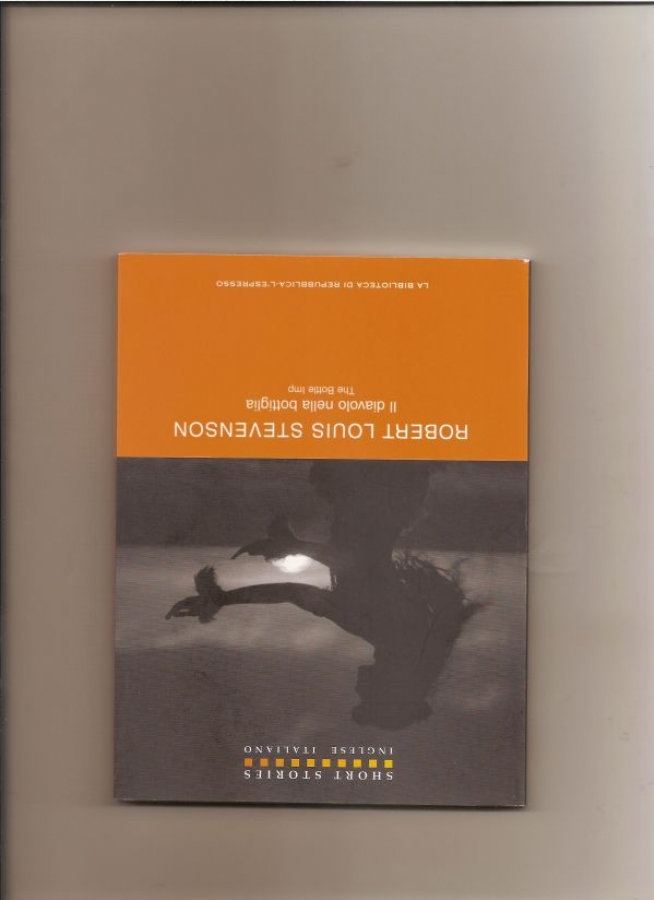
The Bottle Imp
*The Bottle Imp*, in Italian *Il diavoletto nella bottiglia*, is a short story that revolves around man’s ambiguous relationship with evil. Keawe, the protagonist, > was a poor man, brave and industrious; he could read and write like a schoolmaster, and was furthermore a first-rate sailor . One day, in San Francisco, he stops to admire a splendid house. When Keawe expresses his desire to possess such a home, the owner tells him that his entire fortune originated from a bottle in which an imp resides. Whoever purchases this bottle will have all their wishes granted. There are, however, drawbacks: one goes to hell if one dies while still in possession of the bottle, and it must always be sold at a price lower than its purchase cost. Keawe is torn, but ultimately agrees to buy the bottle for fifty dollars. His life swiftly undergoes a radical transformation: he becomes a wealthy man and can afford a magnificent home. He manages to sell the bottle and is thus able to live peacefully and happily, not least because he has since fallen in love with a young woman, Kokua, whom he intends to marry. One day, however, he discovers he has contracted leprosy and resolves to track down the bottle once more so that the imp may cure him. Thus begins a search that leads him to discover that the price of the bottle has been steadily falling, down to a mere two cents. Yet the bottle would then have to be bought for one cent—and how could it ever be sold afterwards, given that the cent is the smallest coin available? Keawe buys it nonetheless and marries Kokua, but finds no happiness, knowing that upon his death he will go to hell. Once she learns the terrible secret, Kokua decides to secretly purchase the bottle herself through an ingenious expedient: she travels to a French-held island where coins of lesser value than a cent are in circulation. Yielding to evil has created a sort of “reverse chain letter,” breeding further evil to the point where the two lovers become entangled in a paradoxical short-circuit, wherein the happiness of the one becomes the source of the other’s torment. Then, as in a fine fairy tale, comes the happy ending: Keawe manages to sell the bottle to a drunkard, ridding himself of it forever. The story mirrors the structure of a fable (the presentation of the initial situation, the hero confronting hardships until he successfully overcomes them) and also bears the hallmarks of a maritime yarn, unfolding as it does among ships and southern cities. The underlying concept, however, is the depiction of the trajectory of evil, played out entirely through its progressive loss of value. As if to say: the more one lives immersed in evil, the more one grows accustomed to it, to the point that the imp is worth less and less. Why read it? It is remarkably well written, if at times repetitive, but above all, the moral underpinning the tale remains profoundly relevant. In recent years, Italians have gradually accepted increasingly illegal, immoral, and vulgar behaviors, the cost of which drops ever lower because they have by now become part of the collective ethos. Beware! There is no end to the worst.