Finished reading on: January 19, 2013
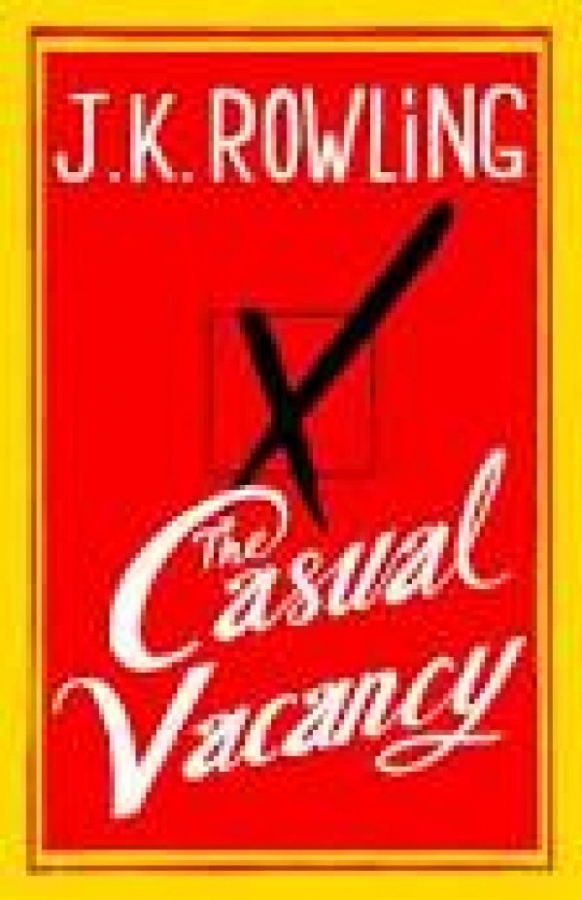
The Casual Vacancy
AI Translation Notice: This review was translated from the original Italian using artificial intelligence. Book quotes and excerpts are translated interpretations and will not match the author's original English phrasing or official published translations.
A successful author decides to abandon her genre to venture into other narrative territory.
As often happens, this attempt turns out to be a resounding failure.
Critics, however, have judged it very favorably: in the magazine Internazionale, the novel was awarded top marks, five stars.
Did I fail to understand the book’s merits, or are publishing houses’ profit expectations dictating critical judgment? The core premise of the story is intriguing.
We are in a small English town, perceived by its inhabitants as a «safe haven», where the respectable bourgeoisie believes it can live comfortably and peacefully, insulated from the problems of the modern world.
A pity that, in the recent past, a major landowner sold a parcel of land upon which a council estate was built, whose social problems now negatively impact the town’s presumed well-being.
Furthermore, an addiction treatment center is run on municipal property, with all the attendant disruptions that ensue.
Well, the sudden death of a councillor—a man of deep social conscience and thus in favor of keeping the center—presents an opportunity to shift the majority on the town council, shut down the center, and transfer the council estate to the neighboring town, which might in turn be keen to alter its own political balance.
A race ensues to claim the seat left vacant on the local council.
One would have expected a narrative with a strong socio-political edge, replete with intrigue and potential plot twists.
This is not the case.
The story plods wearily along through the accounts of the various families involved: marital relations, parent-child dynamics, the school environment, and so forth.
In the first part of the novel, the reader gets lost among the characters, all of whom seem to carry the same weight in the narrative structure.
Later, the book becomes less tedious and more sharply delineated, as certain characters—mostly the «children»—post defamatory emails on the council’s website, not out of political motives, but to vent grudges and a desire for rebellion.
It would have been an interesting idea, but this, too, peters out into nothing.
Ultimately, the reader is left with a novelized version of Desperate Housewives, which wraps up—because every novel must come to an end—in a maudlin fashion, just enough to coax out a few cheap tears.
The author writes very well, in prose that is at once elegant and modern.
Even if one accepts the novel's psychological approach to social issues, it is baffling how generically such complex themes are handled, such as intergenerational relationships and youth in severely disadvantaged families.
The weakest point is the narrative structure.
First of all, the plot is scattered, fragmented, and devoid of action.
How is it possible that such an experienced author was unable to give unity and momentum to the narrative? Secondly, the writer fails to establish a hierarchy of characters—key figures around whom the story can turn and through whom deeper psychological, existential, and social explorations might be developed.
All the characters remain on the same footing, staying superficial and losing the reader across multiple narrative threads.
Why not read it? It is tedious, banal, and pointlessly long.