Finished reading on: October 01, 2024
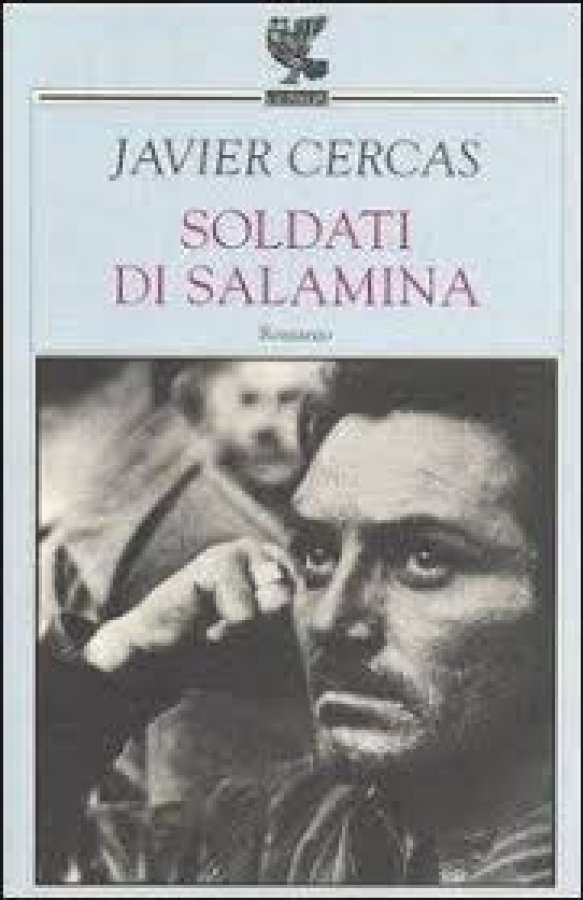
Soldiers of Salamis
Title of the original version reviewed: «Soldati di Salamina»
AI Translation Notice: This review was translated from the original Italian using artificial intelligence. Book quotes and excerpts are translated interpretations and will not match the author's original English phrasing or official published translations.
In 1989, my first novel had been published; (...) the book was met with utter indifference. What followed was a prolonged depression and the breakdown of my marriage, until, coming to the rescue of the failed writer, arrived the sensual Conchi and the miraculous story of Rafael Sánchez Mazas. The former was a fortune-teller,
who was crazy about dating a journalist (an intellectual, she called him)
and who danced singing
Land glorious to my heart,/blessed land of scents and passion,/(...) Alas, what sorrow,/as I part from you, Spain,/for they tear me away from your rose garden. The episode, both famous and incredible, is set in 1939 at the end of the Civil War. The Republican army, retreating toward France, took with it a group of Falangist leaders to execute them by firing squad. Sánchez, founder of the Falangist movement and later a Francoist minister, managed to escape and survive, fashioning around this ordeal his aura of an immortal hero. Cercas imagines that our failed writer comes into possession of a notebook in which Sánchez had jotted down what had happened: the name of the peasant family that took him in and a reference to unspecified "friends of the forest." Fragmentary accounts, contradictions between differing versions, and the very condition of the notebook, which appeared forged, led the aspiring writer to assume that everything was false:
a colossal fabrication meticulously concocted by Sánchez Mazas's imagination, (...) to redeem himself from his reputation as a coward, to conceal some dishonorable incident from his strange wartime vicissitudes. The investigation of archival documents and in the field leads to validating the entire affair: the execution and the escape truly occurred, and the "friends of the forest" are three draft dodgers who had been hiding in the undergrowth and helped Sánchez; a presence expunged by the Falangist leader so as not to admit that he had been aided by brave young men who were not fascists—he, the great poet of the Fatherland. There remains an episode which, who knows why, the aspiring writer does not explore further. In a narrative that seems drawn from Una nobile follia by Ugo Igino Turchetti, which likely inspired Fabrizio De André's Canzone di Piero (see the review on this site), our aspiring writer describes the event thus.
The soldier is looking at him; Sánchez Mazas stares back at him, but his tired, myopic eyes cannot interpret what they see; beneath the locks of wet hair and the broad forehead and dripping eyebrows, the soldier's gaze expresses neither compassion nor hatred, nor even contempt, but a kind of secret or fathomless joy, (...) and at a certain point he shouts into the wind without ceasing to stare at him: "There's no one here!". To truly become a writer, our protagonist must discover who this soldier was: the narrative leaves mere chronicle behind, gains momentum and mystery, and reveals a truly discreet hero in the service of Freedom and Spain, an account of real events, with real people. It is pointless to object that every novel is real to the reader and that one might as well invent characters about whom nothing is known. Unlike Carrère, who, to write about Limonov, draws heavily upon the biographies of the Russian writer and politician himself (see the review on this site), Cercas conducts an investigation like a good journalist. Too bad that when he writes a factual account, however brilliant, the narrative flattens, becomes tedious, and the reader wonders why bother when we already have historians. On the contrary, on all the pages where the writer relies on imagination and mystery (think of the figure of Conchi and the discovery of the soldier-hero), the story changes tenor, becoming intriguing and engaging. In the end, one senses the passion when the writer comes out into the open and extols the soldier-hero. We ought to find a boundary between fiction, chronicle, and historiography; we live in the present and process the past through the facts of the present, yet the representation of the past conditions our vision of reality and must therefore be handled with care, pursuing the "truth" on the basis of historical research methodologies.
The prose flows smoothly and with slight mischief. The author creates an almost unreal atmosphere, so that the events, even the dramatic ones, and the characters dance to the tune of the celebrated song. Its merit lies precisely in a narrative style far removed from the journalistic, capable of making us dream. Its main defect is the plot, confused and repetitive.
Why read it? The story is interesting, and some pages are truly beautiful.