Finished reading on: November 24, 2012
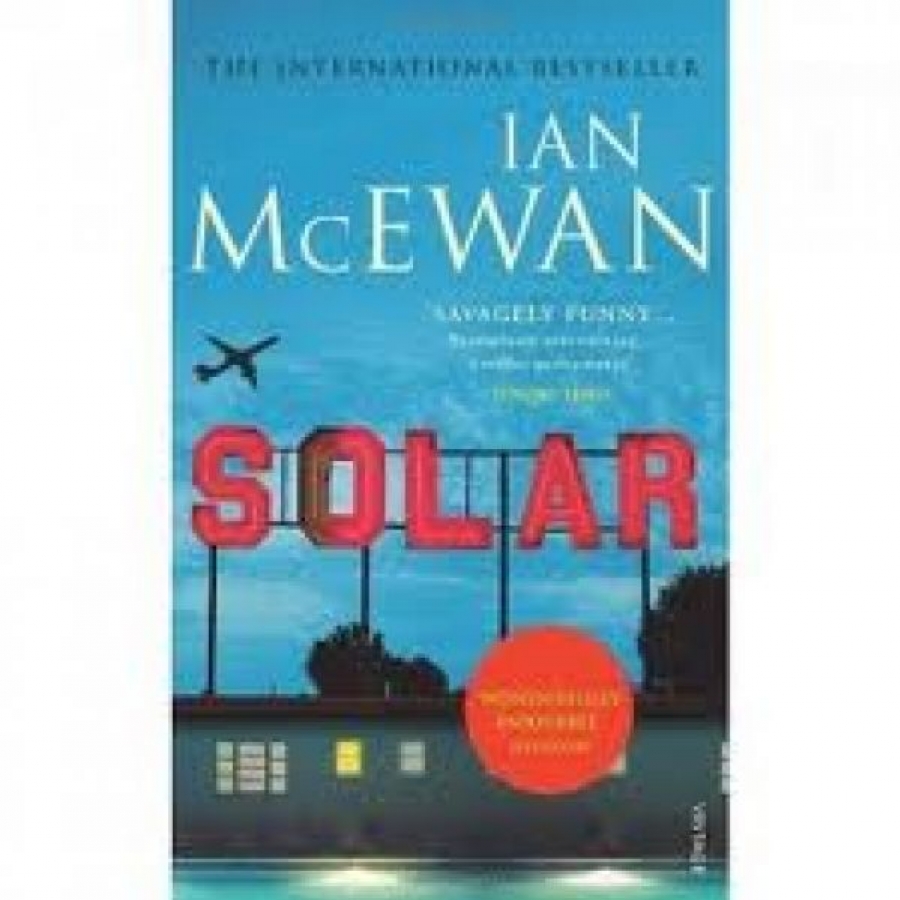
Solar
AI Translation Notice: This review was translated from the original Italian using artificial intelligence. Book quotes and excerpts are translated interpretations and will not match the author's original English phrasing or official published translations.
Michael Beard was awarded the Nobel Prize when he was barely in his twenties.
He himself cannot fathom the reasons for such a prestigious accolade (perhaps the committee confused him with Sir Michael Bird?), but ever since,
like a castaway, he had clung to this solitary plank, seeing himself as a privileged being
.
The novel has little to do with science and solar energy; rather, it primarily recounts the tale of a wretched man—lying, selfish, opportunistic—who moves through the affections of those closest to him with sheer indifference.
The narrative opens at the moment of Michael’s separation from his fifth wife, who is cheating on him in retaliation for her husband’s numerous infidelities.
Michael heads a government research centre tasked with finding solutions to reduce carbon dioxide emissions and thereby combat climate change.
In reality, our protagonist does not believe in the catastrophic effects of atmospheric pollution in the slightest; yet, with the very same flippancy that governs his love life, he endorses an absurd project to install small wind turbines on every British home.
The brainchild of a young researcher, a renewable energy fanatic, who irritates the cynical Michael with his environmentalist idealism.
Returning from an expedition to the Antarctic continent—where he was compelled to take part in an eccentric research party studying melting ice caps—Michael catches the young researcher in his home: he is one of his wife’s lovers.
During the exchange that follows the discovery, the young researcher kills himself, tripping over a rug as he rushes toward Michael to beg not to be sacked.
Our protagonist is entirely innocent, yet he realises he might be the prime suspect.
And so he orchestrates the wrongful conviction of another of his wife’s lovers, a violent and absurdly jealous man.
To this first deceit, another is soon added: Michael comes into possession of the young researcher’s papers, which demonstrate the feasibility of extracting hydrogen from water using solar energy.
It is the breakthrough of the century, poised to resolve at a single stroke both carbon emissions and the depletion of energy reserves.
The narrative then leaps forward many years.
Michael—now an obese man, an insatiable gourmand and drinker—has persisted in his cynical, superficial existence.
In his private life, alongside casual mistresses, he finds himself burdened with two ongoing relationships: one with an Englishwoman, who bore him a daughter despite his fierce resistance, and another with an American, whom he met in New Mexico where he is overseeing the prototype plant for extracting hydrogen from water, critical to proving the industrial viability of the concept.
On the business front, he must contend with investors who are often sceptical of the venture, questioning above all whether it is worth sinking money into such unproven technology when an environmental catastrophe is not even guaranteed—meaning fossil fuels (such as coal, oil, and the like) might not actually need to be abandoned.
Confronted by the anxieties of his partner, who has invested several million dollars and cites the opinions of numerous experts denying global warming, Beard, bolstered by his Nobel status,
placed a hand on his friend’s arm, a clear sign that he was overstepping his mark.
Toby, listen, the catastrophe is coming
.
He, who had never believed in global warming! Yet, unlike the theory that earned him the Nobel Prize—which untangles the intricate interplay between energy and mass with mathematical precision—Michael remains ensnared in the tangle of falsehoods and contradictions that define his life.
Just as he is on the verge of proving his sheer genius (though is this what truly drives him, or does only momentary gratification matter?), his "women" call him to account for his hollow promises, the wrongly convicted man returns seeking vengeance, and a lawsuit is brought against him for intellectual theft.
He realises he has failed, while keenly feeling the cancer that is killing him.
Finally conscious of his own wretchedness, he sees his daughter, who loves him unconditionally, running toward him, but
he doubted, as he held her, that anyone would ever believe him now that it was true love
.
The prose is brilliant, the plot unfolds engagingly in parts, and the characters are sharply drawn: all elements that ought to captivate the reader.
Yet, much like the novel’s protagonist, there is a certain flippancy and an excess of irony that renders the narrative evanescent.
Everything feels paradoxical; consequently, deceit and cynicism—the core themes of the tale and such emblematic traits of our age—remain addressed only superficially, failing to deliver the revelatory weight one would expect.
McEwan is a major author squandering his craft.
Why read it? It is exquisitely written, and the premise is compelling.