Finished reading on: September 06, 2007
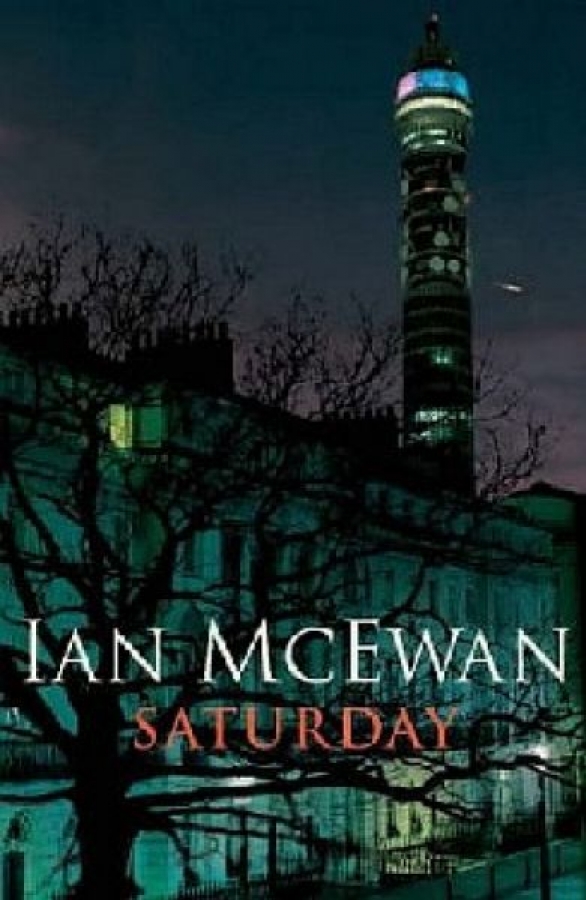
Saturday
AI Translation Notice: This review was translated from the original Italian using artificial intelligence. Book quotes and excerpts are translated interpretations and will not match the author's original English phrasing or official published translations.
Henry is a neurosurgeon living in London with his wife, a lawyer, and two children: his son, a musician, and his daughter, a poet temporarily living in Paris.
He wakes up one Saturday morning, watches an airplane make an emergency landing from his window, and imagines it to be an act of terrorism.
Thus begins Saturday, a day shaped both by broader events (television news reports on the impending war in Iraq, the anti-war pacifist march, the aftermath of the plane's emergency landing) and private occurrences (his relationship with his wife, a squash match with a friend, a visit to his mother suffering from Alzheimer’s, attending his son's gig, preparing dinner for his daughter’s return and the arrival of his father-in-law, himself an eminent poet).
The narrative unfolds within this contrast between the catastrophism of the external world and the quest for domestic peace, for a serene existence beyond the external turbulence.
This attempt fails, and a minor car accident is enough to let violence and the unforeseen burst into intimate, family life.
To avoid the peace march, Henry commits a traffic violation and collides with a car carrying a group of thugs, who attempt to assault the surgeon.
Henry nevertheless manages to extricate himself from a perilous situation by destabilizing the thugs' ringleader, named Baxter, recognizing that he suffers from a severe neurodegenerative disorder.
Baxter vows revenge for the humiliation and breaks into Henry's home just as the family is celebrating the arrival of the daughter and the grandfather, the renowned poet.
Baxter threatens Henry’s wife and orders the young woman to strip: amid extreme tension, she recites lines of poetry, which mollify Baxter; he abandons his violent intent and is subsequently pushed down the stairs by Henry and his son.
The novel concludes with Henry’s decision to operate on Baxter, who was gravely injured, followed by a series of existential reflections on the surgeon’s part:
all he feels is fear.
He is weak and ignorant, frightened of the unpredictable consequences of an action that has slipped out of control and is generating new events, new consequences, until you are led to a place where you never dreamed of being and would never have chosen, a knife to your throat
.
The book revolves around deeply philosophical themes: human helplessness in the face of an increasingly inexplicable world, the impact of catastrophism on everyday life, the pursuit of domestic serenity, the fragility of the barriers separating the outside world from intimacy, the burden of heredity and a life beyond our control, and the role of affective bonds.
Yet the narrative's most compelling theme is the clash between scientific culture—which strives to impose order and rationality—and literary culture, poetry in particular, which interprets the world through frameworks irreducible to scientific reason and, perhaps for this very reason, succeeds in grasping the innermost meaning of things and resolving crises.
It is the poem recited by his daughter that draws Baxter out of his madness, not Henry’s logical reasoning.
What, then, is the way out of a situation that can no longer be comprehended through the tenets of scientific rationality? One finds oneself at an impasse, encapsulated by the words of the poet Matthew Arnold:
ah, love, let us be true to one another! For the world, which seems to lie before us like a land of dreams, so various, so beautiful, so new.
Hath really neither joy, nor light, nor love, nor certitude, nor peace, nor help for pain; and we are here as on a darkling plain, swept with confused alarms of struggle and flight, where ignorant armies clash by night
.
The clash between desire (the love that makes us see the world as a land of dreams) and reality, which appears to us only as a bearer of death—is this contradiction not resolvable solely through a rational approach? The heavy philosophical content and the multiplicity of themes do not serve the narrative pace or the cohesion of the discourse.
It is, as usual, very well written, yet at times it leans too heavily into intellectualism, and the characters remain flattened within assigned roles that conform more to stereotypes than to any genuine depth of character.