Finished reading on: February 11, 2018
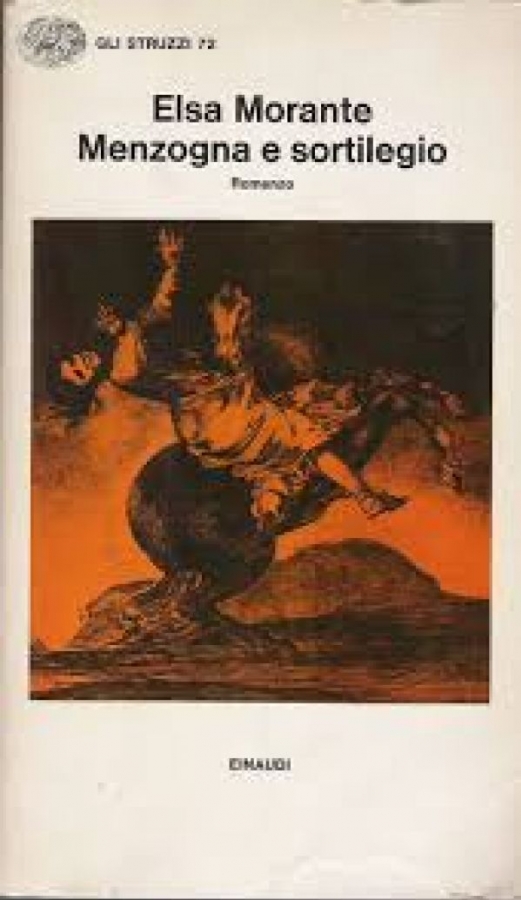
Lies and Sorcery
Title of the original version reviewed: «Menzogna e sortilegio»
AI Translation Notice: This review was translated from the original Italian using artificial intelligence. Book quotes and excerpts are translated interpretations and will not match the author's original English phrasing or official published translations.
Elisa wanders through the rooms, in silence and solitude, and when she unexpectedly catches sight of her own reflection, she seems to see
a shape moving in these funereal, solitary waters, (...) like a jellyfish
, not a saint: “rather a witch.”
It is precisely to explain the sorcery that led her to shut herself up in a few rooms that Elisa offers us the tale of her family: and it is “an appearance of shadows,” a “fantastic malady” that speaks of love and death, as in fairy-tale books: “with thee, Fiction, I gird myself, fatuous raiment.”
The novel can be divided into two parts.
In the first, Elisa has not witnessed the events and characters she narrates: everything is filtered through the reminiscences of those who were still living when she was a child, or through clues, papers, and places.
On the other hand,
the past and the future are two fields of mist and vertigo, which the living cannot explore except through fantasy and memory.
(...) What is the use of plumbing this palace of death? The mere attempt to plumb it produces anguish and nausea, as when one looks out over a precipice
.
We will never know whether what she tells us is true, not least because it reads like the narration of a grand deception, of lies meant to cloak the beloved in “fire and splendor.”
Thus the maternal grandfather is a scoundrel and a sluggard, yet he captivates his daughter Anna with wondrous tales of travel, jewels, honors, and glory; and Anna forgets that she lives in poverty, venting her rage on her mother Cesira, a petty and desperate woman.
The paternal grandparents are hardworking peasants and could have been an anchor of solid substance: their son Francesco, however, was born of the mother’s fleeting affair with a rogue, himself a fabulist and a peddler of "smoke
.
One should not be surprised if Francesco, upon going to study in the city, introduces himself as a baron, and one with revolutionary ideas to boot.
And what of Edoardo, the wealthy cousin of the destitute Anna: charming, with feminine features, vacuously intelligent, enamored of himself, ready to love, beguile, and betray anyone, purely for the ambiguous pleasure of amusing himself.
Anna and Francesco are too naive not to fall into his tempting coils: Anna falls in love with her cousin, dreaming of a bond that can never materialize due to the difference in social standing and, above all, Edoardo’s character, far too superficial for an enduring and responsible relationship; Francesco believes he has found a true friend in Edoardo, unaware that he is being led by the hand from a genuine love (that of the prostitute Rosaria) toward a yearned-for and idealized one, his passion for Anna.
And so Anna and Francesco find themselves married, as if under a spell: Anna loves Edoardo and binds herself to Francesco out of despair, while the latter has deceived the woman, masquerading as a wealthy landowner and a young man on the rise.
At this point Elisa steps onto the stage, no longer merely the narrator.
Henceforth ended is my privilege of attending, a solitary spectator, a comedy of spirits.
(...) A lucid insomnia takes hold of me, and in this taciturn and deserted room, henceforth I can interrogate nothing other than my true memory.
I can recount nothing, that is, except the things I saw with my own eyes, heard with my own ears, and of which my father and mother, in their differing insanities, made me their confidante and witness
.
To be protagonists is an act of maturity, and at the same time of sorrow, because one cannot defend oneself with imaginary remembrance.
Memories, like animals that have lain in hibernation, stir at my call, and approach me with velvety, funereal steps
.
The experience of the adolescent Elisa is truly extraordinary; she is not merely a party to a toxic and perverse relationship, the cause of her parents’ psychophysical decline; the girl is swallowed into a kind of triangulation with Francesco and Anna on one side, and on the other the ghost of Edoardo, dead of consumption.
To humor Concetta, Edoardo’s now-deranged mother, but in reality to gratify herself, Anna invents an epistolary exchange of letters from her cousin.
What virtue did this counterfeit correspondence possess?
Dwelling within it, full of feast and fire, was a Thought: (...) it possessed inspired movements, chivalric demeanor, and a coquetry cast, like a bold and light armor, over its bitter voluptuousness.
Moreover, its shadowy beauty flaunted adolescent fatuity like an oriflamme, that dear, venial fatuity
.
But who was truly the author of this correspondence? The Cousin in his ethereal form as a ghost, or Satan, as might appear from the
infernal postmarks
of the letters, or Anna herself, as any doctor would have said,
hybrid fruit of a poor, morbid mind”.
Were this so, “the counterfeit Epistolary turns within me into a mirror, in which Anna’s beloved face appears to me so disfigured and contorted that memory, will, and fantasy urge me to choose a lie in place of this diagnosis.
(...) Of Anna, of this twofold idol of mine, of my sleeping, precious Phoenix, it makes an object of wretchedness and pity.
And finally, over the fantastic Epistolary, over our renowned correspondence, it sheds the dismal pallor of insanity, and the shapeless tedium of death
.
And then the fantastic Epistolary, just like the novel as a whole, comes to be a
stanza of love”, a desperate way by which “the spirit that presides over childish things” seeks to overcome death, “at least in play.
The novel has a nineteenth-century architecture: a complex plot, meticulous description of settings, in-depth character analysis, richly vaporous prose of refined elegance.
One must not, however, be deceived; if love and death are tightly interwoven—because as soon as one loves, one already knows the beloved will perish—only dreaming, fantasizing, lying to others and to oneself allow us to survive, to keep suffering at bay.
The sorcery lies in this: Elisa prefers to shut herself in the solitary rooms, pursuing her own shadows, rather than reckon with reality and retrace the demented aspirations of those who came before her.
Does the novel not speak, perhaps, of Elisa’s consciousness? Might it not be the fruit of her diseased mind? Only Alvaro the Cat, Elisa’s faithful companion, knows.
When every light is quenched, kindle your pupils in the dark, o torch of my half-sleep, and the solemn truce cracks, a thousand ephemeral torches blaze, childish tigers chase one another in sweet deliria".
In reading Menzogna e Sortilegio, the mind turns to Thomas Mann.
We are in Southern Italy; the colors and characters are those of our South; and yet there is the same demolition of the traditional novel, and one breathes the very same air of decay, of slow decline toward death.
Its excessive length is regrettable: we are before a work of great originality, which deserves to be rediscovered and read anew.
Why read it? Splendid writing, and long live the imagination!