Finished reading on: November 23, 2025
Memorial
Title of the original version reviewed: «Memoriale»
AI Translation Notice: This review was translated from the original Italian using artificial intelligence. Book quotes and excerpts are translated interpretations and will not match the author's original English phrasing or official published translations.
Albino is a young peasant who lives above a lake with his mother, an alcoholic, taciturn, and emotionally detached woman. From the sparse details of his past life, we learn that he spent his childhood in France, lost his father as soon as the family returned to Italy, served as a soldier in World War II, and was held in a prisoner-of-war camp, where he likely contracted tuberculosis. Within Albino dwell a nostalgia for a happier time, a need for points of reference (his mother, religion), and an unshakable conviction that he is being persecuted (by officers, by doctors, and later by factory foremen), coupled with a confused anarchism rooted in the peasant world in which he was raised. The lake stands as an allegorical representation of a solitary disquiet.
Blue mists hung over the lake, neither high nor low; only over the lake, like smoke. The sky was clear, and already high up, beneath the veils of day, was a small moon:
see, Albino, I thought, if only all your troubles were like those mists that the moon will surely have consumed by midnight. (...) I touched my shoulders as I had as a boy during my illness, tasting the flavour of myself, a thread of my youth. It is 1946 when Albino presents himself at the Personnel Office of a large factory to be hired as a milling machine operator. From this point two narrative strands branch out, developing in an intertwined fashion: one sociological, the other existential. Volponi, with his experience as an industrial manager, portrays the alienating factory environment with great precision: before their workstations
everyone had a taut muscle, or clenched lips, or squinted eyes, or furrowed brows. It means everyone had a thought pounding inside their head, ricocheting throughout the factory and still pounding. (...) The work itself offered no relief; it required no accompanying thought, it went on by itself pulling our hands along, because inside the factory nothing else was possible. Unlike what emerges from Ermanno Rea’s novel (
La dimissione
see the review on this site), there is no discernible sense of belonging to the product, to the machines, or to the organization of labour: the factory is a hostile body; Albino stands apart, feeling no solidarity with the others, nor does he accept the corporate hierarchy, which even suggests he act as an informant. A trade unionist friend tells him,
but you always keep to yourself. Was I under attack, then, because I was alone?
, Albino wonders. Despite his illness and his accusations against the factory doctors, Albino is protected by Management (who knows why?), who assign him a quiet job as a gate guard. It is right from the factory gate that Albino witnesses one of the first post-war strikes and rushes to warn the canteen staff to refrain from work, in order to support the workers' struggle (today, it is difficult for us to grasp the importance of the canteen). This act of insubordination is unacceptable to Management, and they fire him. Were this the whole story, the novel would merely be a fresco of 1950s industrial Italy. But Volponi seeks to convey an existential malaise that transcends the historical context and the theme of alienation—a topic pervasive in the Marxist commentary of the 1960s. The author imagines Albino writing a kind of confession, through which he seems intent on definitively coming to terms with his state of abandonment.
As always, I watched the lake gradually swell beneath my eyes on the climb toward home. In the clarity of the afternoon, the lake had no subtleties of tone, no arms reaching out toward the countryside and the trees; locked within its shores. And its colour neither shone nor spread outward. (...) At that point I realized that no one could come to my aid: not the factory, not my comrades, not the doctors, scoundrels or not, nor much less my mother:
I am a drop/the first or the last of a downpour/fallen from the gutter/when in the air/no rain was expected,/not even that drop./my drop is lost, /no one enjoyed it.
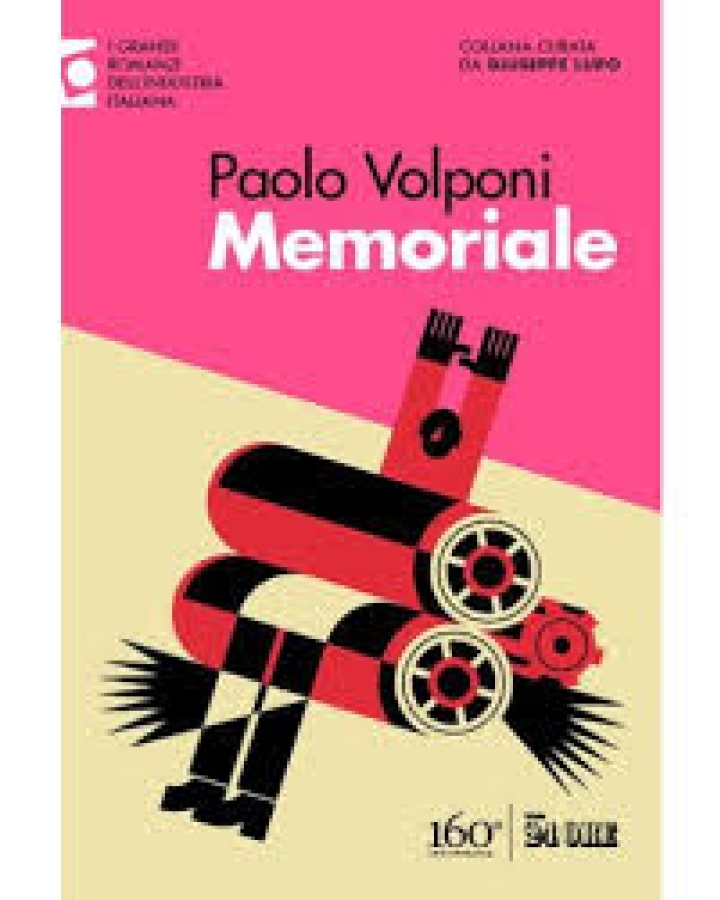
In his fine preface, Giuseppe Lupo regards the novel as an elegy for the factory, for a world set to the rhythm of machines that has savagely displaced the cycle of seasons and agricultural labours that once defined rural life. Of this transition, Giuseppe Lupo seems to suggest, Albino is both victim and bard; hence the solemn, dreamlike rhythm of the novel. It is remarkable that an industrial executive at Olivetti, such as Paolo Volponi, should have written a work at once so realistic and existential, with tones that seem to verge on psychoanalysis. If we consider that
Memoriale is Volponi’s debut work, we must forgive its narrative confusion, needless repetitions, or digressions; and we must do so because Albino's malaise seems to mirror Volponi’s own, caught between managerial rationality and poetic tension.
Written in the form of a confession, the first-person narrator is Albino himself. The extensive reading in the sanatorium and the leisure time spent in the library must have taught the poor peasant a great deal, given how well the novel is written: fluid, if at times convoluted, phrasing, tight dialogue, and descriptions of the rural landscape steeped in symbolism (echoes of Pascoli resonate throughout), contrasted with an oneiric realism when depicting the factory. What the novel lacks is plot: it stretches out needlessly over many pages, losing concision and growing prolix.
Why read it? The marriage between industrial rationality and the magic of the peasant world is compelling.