Finished reading on: October 25, 2025
The Melancholy of Resistance
Title of the original version reviewed: «Melanconia della resistenza»
AI Translation Notice: This review was translated from the original Italian using artificial intelligence. Book quotes and excerpts are translated interpretations and will not match the author's original English phrasing or official published translations.
It is singular to open the review of a Hungarian novel by invoking Hideo Fukukawa's Tokyo Soundtrack (see the review on this site). It is precisely the geographical and cultural distance that makes the comparison compelling. While the Japanese narrative chronicles the environmental and social unraveling of Tokyo, here the same theme unfolds in a Magyar provincial town swept up in a slow, inexplicable disorder, as if
that lethal, utterly down-to-earth reality seemed irreversibly destined to evaporate. Numerous were the unmistakable signs: the garbage piling up in the streets without anyone collecting it, the increasingly frequent power outages, centuries-old trees collapsing, public transit in chaos, few and frightened people about, even hordes of cats,
enormous beasts, gone feral, (...) returned to the primal instinct of predators, witnesses and emperors of an announced twilight—yet apparently postponed indefinitely—
, akin to the dogs and crows of Tokyo Soundtrack, and to the wild boars, coypus, wolves, and other wild animals that now roam our streets, alongside the triumphant rat population.
A quagmire over the swamp (...) was the ideal foundation for the situation, [with] the feeling that houses, trees, streetlamps, and advertising pillars were sinking into it. It is a prophecy, if we think of our world seeming to slide into an insidious future, with us living in "a hopeless waiting." It is no easy task to identify the narrative threads of a tale steeped in magical realism, deliberately confusing and fragmented (and how could it be otherwise, when what happens is no longer rational?), marked by extensive, even philosophical digressions, by an ironic and paradoxical tone reminiscent of Kafka. I shall attempt to do so by starting with the protagonists, who, as the great German scholar Erich Auerbach remarked of Dante's characters, are a "figural representation": human beings, with their personal destiny, and allegories of timeless ideas of decline and disorder. Let us take the first character, Mrs. Pflaum; we meet her in a hilarious scene: traveling on an overcrowded train, beside dirty and uncouth people, she herself so neat and orderly. Equally amusing is the description of the small house amid
the immaculate objects of the apartment, and everything seemed to her perfectly in order, (...) it was utterly clear that all those who, like her, lived in their quiet little nest
, would avoid the terrible things happening outside. How many Mrs. Pflaums do we know who are certain that tending to plants, polishing furniture, and small daily routines protect them from devastating misfortunes! Then there is Valuska,
this exceptional artist of ecstatic life
, convinced that he has found harmony in the perfection of the constellations; he gazes up at the sky so as not to see what happens on earth. He does not notice—or is quite content with the fact—that his drinking companions mock him when he reconstructs the Moon's rotation around the Earth with living bodies. How many of us seek refuge in abstract ideals to avoid grappling with reality? There is also the musician Etszter: he resigned as Director of the Conservatory upon realizing that piano tuning flattened sounds into an abstract and unnatural harmony, and now lives shut away in his apartment, playing an out-of-tune piano, pontificating on the irrationality of the real with his only pupil: the kind, simple-minded Valuska. How often are we forced to listen to authoritative philosophers on the crisis of the West, or rather on the Apocalypse awaiting the earth, because our European "City of Light" cannot defend the values of the Enlightenment and Christianity! And finally, there is Mrs. Etszter, with her enormous, sensual body,
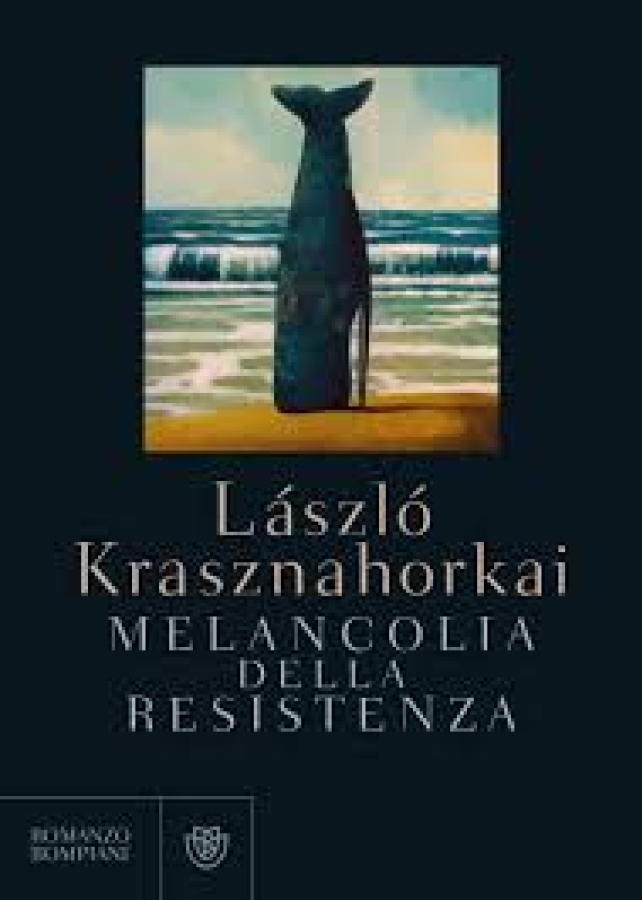
feeling herself mistress of the future, she looked upon the town with the eyes of a bold heiress, convinced that she stood on the threshold of a radically new era, fraught with promise, which would sweep everything away. But just as occurred in the first decade of the twentieth century, when many signs portended the end of a world seemingly joyful and secure, yet it took the eruption of the First World War to overwhelm that golden age, so too the arrival of a circus displaying the mummified carcass of an enormous whale shatters the fragile, declining equilibrium; and nothing is ever the same again. To halt the looting and brutalities, directed perhaps by a mysterious figure known as the Prince (the devil, the personification of Evil?), one can no longer beat around the bush, take shelter in modest domestic peace, daydream about distant worlds, or philosophize about whether "the real is rational"; what is needed is the firm, energetic hand of one who knows how to command. The town readily yields power to Mrs. Etszter, the personification of authoritarian rule. We might sorrowfully stop here: it seems undeniable that only dictatorship can grant us that craved tranquility, our cherished little domestic habits. Yet, perhaps,
the workmen of destruction
(commanded by the Prince?) are still at work. As in Thomas Mann's Buddenbrooks (see the review on this site), the final chapter is devoted to the body's dissolution in death: a detailed and precise description reminding us how man, in his long evolution, has seen
billions of restless things, poised for continuous change; he had seen how they engaged in stern dialogue with one another, without head or tail, each on its own; billions of relations, billions of stories, billions, yet reduced to a single one that contained all the others: the struggle between that which resists and that which attempts to overcome resistance.
In a recent interview (La Stampa, October 25, 2025) Orhan Pamuk states that
too much ethics kills literature. (...) Literature is not meant to make moral judgments. It is an art of connections, of understanding. It allows us to enter the minds of people we do not like
. And I would add: it answers humanity's need to listen to and tell stories, to become passionately invested in characters, to love and despise them; literature teaches us the complexity of the human being. All of this is missing in Krasznahorkai. To be sure, the characters are described as human beings, with their weaknesses and characteristic traits; but there is no psychological depth—they are treated ironically, without empathy, the prerequisite for understanding. This holds particularly true for Valuska, who is ultimately the protagonist. His description always remains on the surface, never going beyond a paradoxical depiction of him:
the postal greatcoat, along with the leather shoulder bag, cap, a pair of boots. But who is this young man, already destined for the asylum like the village idiot? What are his feelings? Why his trusting bond with the Conservatory Director? Everything remains unresolved.
The novel's paramount merit is its writing: long periods, dense with parenthetical clauses, unfolding without interruption—a flow of words and sentences that grips the reader. It is an exhausting read; one must read many pages at a stretch to enter the narrative style, allowing oneself to be guided by the author through the narrative's numerous threads; yet after fifty pages or so, one must pause, catch one's breath, and summon the strength and willpower to continue. In the end, fatigue prevails, and, it must be admitted, one cannot wait to reach the end.
Why read it? The writing is intoxicating, at times thoroughly amusing.