Finished reading on: July 06, 2024
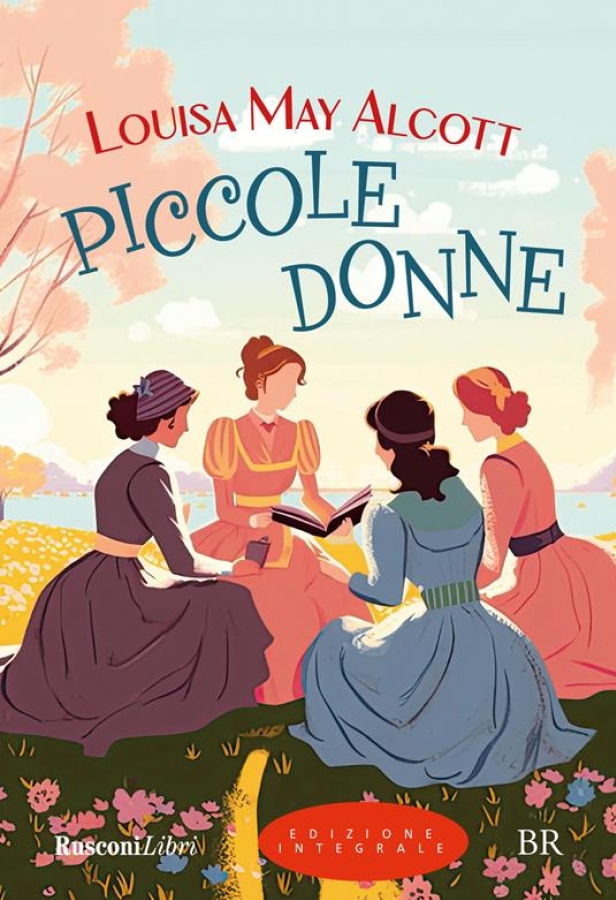
Little Women and Good Wives (Piccole donne and Piccole donne crescono)
Title of the original version reviewed: «Little women e Good Wives (piccole donne e piccole donne crescono)»
AI Translation Notice: This review was translated from the original Italian using artificial intelligence. Book quotes and excerpts are translated interpretations and will not match the author's original English phrasing or official published translations.
Four little chests all in a row / Veiled in dust, and worn by time, / Four women, who have learned from scars and sorrows, / To love and endure in the prime of life. These lines of Jo's epitomize the meaning of the entire novel, which recounts the passage from adolescence to adulthood, and also tells us how every woman has but one destiny: to become a "good wife." The "four little chests all in a row" are four sisters, whom we meet from the opening pages of Little Women: Meg is the eldest,
with fair skin and large eyes, with thick, soft brown hair, a sweet expression, and white hands, of which she was particularly proud, (...) Jo was tall, thin, brown-complexioned, and resembled a colt, for she seemed never to know what to do with her long limbs, (...) grey, observant eyes, which saw everything, and were by turns fierce, amused, or thoughtful; (...) Beth, a rosy girl of thirteen, (...) of shy manners, a timid voice, and a tranquil expression. (...) Amy, though the youngest, was the most important person, at least in her own opinion. (...) Blue eyes, blonde hair, (...) pale and slender, she always behaved like a well-mannered young lady. They live in a modest home, pervaded by
a pleasant atmosphere of peace
, governed by a mother
not elegantly dressed, but a woman of noble bearing, and the girls thought that the grey coat and unfashionable bonnet covered the most splendid mother in the world. There is an air of Guido Gozzano's world of "small things," yet stripped of the poet's gentle irony; the whole is pervaded by a pedagogical moralism, rooted in steadfast values and upright customs. The father, a devout man dedicated to teaching, volunteered for the war (the novel is set during the American Civil War); the paternal presence manifests through letters to the family, a decalog of good intentions. The girls grow up sensible and industrious, mindful of the family's financial straits, convinced of what their mother says: that being poor is no fault, but can rather be a virtue. Contentment seems to be the guiding rule of life; on the other hand, sisterhood seems sufficient to enrich and enliven existence, all the more so when spurred on by Laurie, a restless lad, welcomed by the girls like a brother. Anyone raised in a large family recognizes themselves perfectly in the narrative, just as teenage girls in the 1950s, before the explosion of consumer culture, likely still saw themselves mirrored in Little Women. As Gozzano writes,
Carlotta sings. Speranza plays. Sweet and blooming, / life unfolds to the romance of a thousand promises
(from L'amica di Buona Speranza selected from Poesia italiana del Novecento edited by Eduardo Sanguineti). In one of the finest episodes of Little Women, the four sisters have a picnic with Laurie: five adolescents building "castles in the air," to which they hold the keys, though they know not whether they will ever be able to open the door, as Jo says. Meg
would like a lovely house, (...) I must be mistress of it, and manage it as I like. Jo
wants to write books, and become rich and famous: that would please me, that is my dearest dream. Mine is to stay peacefully at home with Father and Mother, and take care of the family, said Beth happily. Amy
has so many wishes, but the chief one is to be an artist, and go to Rome, (...) and be the best artist in the world. At the end of Good Wives, the girls wonder which of these dreams came true. As in Alba De Céspedes's Nessuno torna indietro (see the review on this site), life turned out quite differently from their castle in the air. Meg has a small house, a devoted yet poor husband, two darling children; she has known the hardships and deprivations of a housewife.
My castle is very different from what I had planned
, says Amy, who had to abandon her aspirations of becoming a great artist, but marriage to Laurie made her
sweeter, deeper, and more tender, while Laurie has grown more serious, strong, and resolute, and both have learned that beauty, youth, wealth, even love itself, cannot keep from the greater part of life its duties and griefs, bereavement and suffering. As Ungaretti says, life
flows ever on as living ever does, / Unexpected gift and grief / In the ceaseless whirlwind / Of vain mutations
(from
Ultimi cori per la Terra Promessa). Jo is the one who suffered the severest disappointments, not from fate, but by virtue of her own choices: she refused Laurie's hand, simply because she did not love him and regarded him merely as a brother; she ceased writing sensational adventure potboilers, which earned her a living but were unworthy of her moral values and of good literature; she returned to her parents' home to attend Beth's deathbed, after which she inherited the role of
angel in the house
, future spinster and mere aunt. Until one day, aided by the rain and an umbrella, she discovers love with a German professor, much older than she, yet wise and eccentric like her father. With him she will open a boys' school, a home for destitute children, where she can pursue innovative pedagogies. To her mother's praise for such a courageous endeavor in raising youth, Jo replies with a shout,
with those impetuous outbursts she could never control, (...) Not half so good as yours, Mother. Here we are, and we can never thank you enough for your patient sowing and for the harvest you have reaped.
The book is an autobiographical novel. Jo is undoubtedly the author, just as the father's character mirrors Alcott's own father, who pursued unorthodox educational methods throughout his life, founding schools that were invariably doomed to fail. Ostensibly, the protagonists are the four sisters, whose stories form the plot of the two novels: a family saga that would continue with
Little Men and Jo's Boys. The true protagonist, however, is the mother: grounded, affectionate, of steadfast moral principles, and ever ready to offer the right counsel—advice aimed at helping her daughters accept the realities of life, whether it be marital relations for Meg or Jo's headstrong exuberance. It is she who tells Jo that Laurie is not the right man, because, like Jo herself, he is restless and unpredictable. The irony is that this will become Jo's very argument to justify turning down his proposal! Unlike Jane Austen's independent and willful heroines (see the reviews of the English author's books on this site), the "Little Women" do not rebel; they wearily resign themselves to the destiny of "good wives." They are not who truly interests Alcott: it is American and European society. The former was drifting away from Puritan virtues, swept along by the capitalist transformations of the late nineteenth century; the latter, European society, was vain and evanescent, certainly no model for young American women. The stories of Little Women, so immediate to our sensibilities and above all to those of young girls, serve to reinforce and disseminate a Protestant moralism (one utterly detached from Catholicism): an ethic steeped in social idealism, frugal habits, and philanthropy, yet fundamentally conservative.
Beyond the plot, which is intricately woven and deftly conducted, the fundamental merit of the two novels lies in the writing. We do not refer so much to the psychological analysis of sentiment (we are far removed from Jane Austen!); the feminine realm is stereotyped, predictable in its dynamics (perhaps the very reason for its success, as girls from every corner of the world can see themselves reflected in
Little Women). Alcott's allure stems from her lexical richness, deeply American in character, to the point that many words are difficult to find in a standard dictionary. If in Henry James—a contemporary of Alcott's in the second half of the nineteenth century—the style remains profoundly English, in both vocabulary and syntax (see on this site
Selected Short Stories, a collection of tales highly representative of this author's literary output), Alcott's robust and proud American stamp leads her to revive idioms, syntactic turns, and vocabulary that are at times archaic (consider the use of blest instead of blessed), and at times drawn from the vernacular of the triumphant new Nation. We are confronted with a linguistic tour de force that could not fail to leave its imprint on the evolution of United States literature, propelled by the novels' immense popular acclaim.
Why read it? The language is beautiful, certain passages are captivating, but it is long-winded and ultimately melodramatic.