Finished reading on: September 25, 2015
Editori Riuniti
1951
195
Italiano
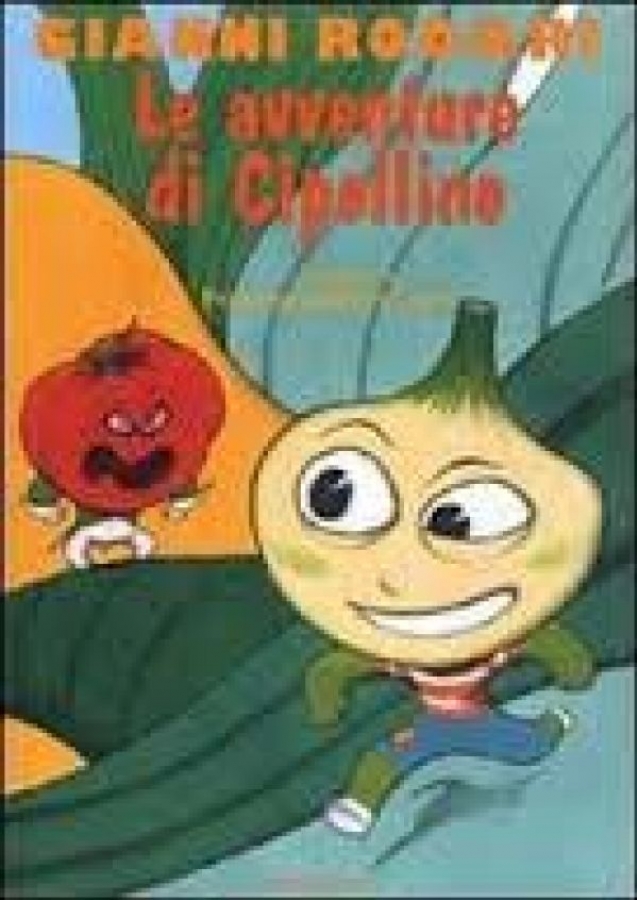
The Adventures of Cipollino
Title of the original version reviewed: «Le avventure di Cipollino»
AI Translation Notice: This review was translated from the original Italian using artificial intelligence. Book quotes and excerpts are translated interpretations and will not match the author's original English phrasing or official published translations.
Cipollino was the son of Cipollone and had seven brothers.
(...) Decent folk, it must be said right away, though rather unlucky.
What do you expect, when you are born an onion, tears come with the territory
.
Thus begins the book.
In a few simple words, the author introduces the protagonist—Cipollino himself—the world of the novel, where the characters are fruit and vegetables, and the gentle irony that characterizes the entire tale.
There are no humans, nor the typical figures of peasant life; with a stroke of genius, the author develops the narrative around the very foods we are constantly urged to eat in childhood and do so reluctantly.
In this way, Rodari subverts the question: no moralizing for children; instead, the hated food becomes the protagonist of incredible, magnificent stories, offering an occasion to reflect upon freedom.
What do Cipollino and these other extraordinary characters tell us? Freedom means fighting for an authentic life, free of superficial pretenses—a life in which what truly matters are friends, rather than social hierarchies, conventions, or deference to power.
It is an invitation to be oneself, yet without affectation, leaving the child—and us adults—the pleasure of pure enjoyment.
The story takes off from an act of abuse: Sor Zucchina has built himself a tiny house, where
the right hand is in the kitchen, the left hand is in the cellar, the legs are in the bedroom, and the head sticks out of the roof
.
Pomodoro wants to confiscate the little house, claiming it was built on the land of the Countess Cherries.
Cipollino rebels, and from there the plot unfolds: the village folk (Mister Uvetta, Fagiolino, Pero Pera, and others) hide the little house with Sor Mirtillo, who "lived in a chestnut burr" and had posted a sign inviting the
gentlemen thieves, before entering kindly ring the bell
.
The narrative then introduces us to the Cherry Castle, where Ciliegino lives, a lonely and melancholic boy because, as Rodari writes, "oh, what an awful affliction it is to have no company."
Cipollino and Ciliegino become friends—one among the lowliest of vegetables, the other among the most delectable of fruits.
So much for social barriers! Together they fight to free their friends, who have since been thrown into prison, to save Sor Zucchina’s little house, and to defeat the story’s villains—yet without bitterness, almost with commiseration.
The adventures are many, and they do not always turn out well.
There are two minor characters who, more than others, highlight Rodari’s subtlety.
Sor Pisello is the quintessential pettifogger, fearful and servile.
Despite having been rescued by Cipollino, he betrays our friends to curry favor with the authorities: is he the archetypal Italian intellectual, ever ready to turn his coat depending on the whims of the powerful? Mister Carotino is a famous detective who, naturally, never uncovers a single thing.
Whatever Mister Carotino says is repeated, yet amplified, by his faithful hound, Segugio; for instance:
We are in danger—Carotino noted, without batting an eye, reaching for his butterfly net—We are in great, great danger—echoed the dog
.
If we think of the police investigations in our own country, which often lead to nothing while generating an immense clamor, perhaps Rodari intended to demystify the police apparatus, as if to say: do not be afraid, they are all just like Carotino! In the end, the good triumph, but above all, the world is turned on its head.
Events rush headlong and we let them rush: days tumble one upon the other like sheets from a calendar, weeks pass seven by seven, and we have no time to see anything at all, just like when at the cinema the projector goes wild, and no sooner does it slow down enough for us to finally see what is happening than everything has changed.
With Rodari, it is easy to fall into the trap of hunting for hidden meanings in his characters and stories; yet one is inexorably driven in this direction because the world he depicts is all too similar to our own, all too often mirroring the mechanisms of our society—absurdly oppressive and unjust.
Could the world be anything other than a vast matryoshka doll, in which every social and ethical distortion is replicated across all tiers of nature? What pulls us back from this bitter conclusion, reminding us that we are before a splendid children’s tale, is the narrative style: elegant, witty, seemingly simple, light yet profound.
Words are Rodari’s true magic, so much so that only by being read aloud does the story acquire its full charm and its true meaning: a flight of imagination, of fantasy where anything is possible, where even onions have a soul.
Why read it? Thought-provoking, delightful, intoxicating.