Finished reading on: March 20, 2014
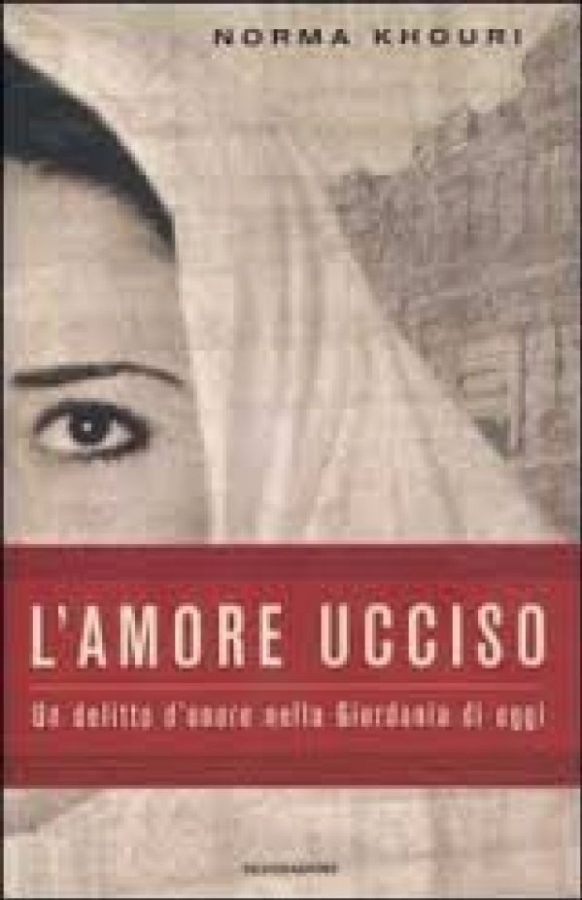
Murdered Love
Title of the original version reviewed: «L'amore ucciso»
AI Translation Notice: This review was translated from the original Italian using artificial intelligence. Book quotes and excerpts are translated interpretations and will not match the author's original English phrasing or official published translations.
Imagine something akin to Anna Premoli’s novel (Ti prego lasciati odiare): a love story, delicate, mildly ironic, woven from brisk dialogue and youthful musings.
It could be a tender fairy tale, were it not set in Jordan—which, for most women, is
an oppressive prison, its atmosphere rendered all the more fraught by the risk of dying at the hands of one’s own relatives.
Jordan is my home.
I love its rugged beauty, its sweeping history.
Yet, perhaps, I may never return there again
.
There can be no happy ending to an impossible love story in a society where
a woman who breaks any of the rules she is expected to respect is not afforded the luxury of forgiveness
.
As readers, we foresee the novel’s tragic conclusion from the very beginning.
This breeds a mounting anxiety, which prevents us from fully losing ourselves in and savoring the beautiful friendship between Norma and Delia.
Though belonging to different faiths, they grew up together sharing the same dreams of freedom and emancipation from an age-old female condition.
Our parents insinuated into daily life the idea that men were superior to women.
We were not enslaved with whip and chains, but rather persuaded by centuries-old words and teachings to place ourselves in that condition of our own free will
.
While their mothers believed in "the Arab way of life," Norma and Dalia conform to the oppressive customs of tradition out of fear.
Yet
fear can be overcome....
and so, sooner or later, things will have to change
.
To carve out their own space of freedom, the two young women devise a business venture: hairdressing, a typically feminine occupation that poses no threat to tradition, a sort of holding pattern awaiting the arranged marriage to which they are inexorably destined.
Once left in the shop by whichever brother is "on duty," tasked with chaperoning them, Norma and Delia feel free to talk, to share confidences, to read women’s magazines, to dream.
This haven in an "insidious sea of religious rules" is upended by the arrival of a young man, who forces them "to behave as we should not have."
On the other hand,
were we to rely on subterfuge and deceit to get what we wanted, and let a suburban beauty salon, a hotbed of gossip, define the boundaries of our lives—boundaries that could have been so much broader? Could we risk our necks for a love story?
.
The two girls have no doubts, even knowing that Delia, a Muslim, can never marry the young man, because he is Catholic.
The rules of Jordanian society prohibit marriages between people of different faiths.
They know the risks they run.
By seeing a young man without her father’s permission, the girl dishonors her family, and her relatives are permitted to punish her with death.
Yet we are not faced with just another tale of star-crossed lovers forbidden to love.
Norma and Delia reject their inexorable destiny.
Although it had all amounted to little more than some pastries and a coffee, the taste of that ordinary freedom was too delicious to surrender.
We had traveled only a few kilometers, yet we had entered another world
.
As the narrative draws closer to its tragic denouement—Delia’s murder at her father’s hands—the writing style shifts, imperceptibly at first.
The increasingly reckless encounters between Delia and the young man are still recounted with apparent lightness, which nevertheless fails to mask the girls' fear and anguish.
Then, all at once, the narrative becomes dense and dramatic.
With the death of her friend, Norma grows up in an instant.
She realizes that her ties to Jordan and its traditions have died with Delia.
Yet, as she flees her homeland, she grasps, as never before, her mother’s profound sorrow, the barrier
she had erected to protect her soul from the harshness of life...
the surviving remnants of that unique, independent person
.
Refusing to be trapped by pity for her mother, even while feeling closer to her than ever, makes Norma free as a person, even before being free as a woman.
The novel can be read from many perspectives: a sociological and anthropological portrait of Jordan, a country that conceals a cruel, pervasive tribal tradition beneath a veneer of modernity; an impassioned indictment of the widespread acceptance of honor killings and, more broadly, of the condition of women in Arab countries; the chronicle of a sweet friendship, of a shattered bond; a Bildungsroman, a painful path toward adulthood.
When Norma heeds her mother’s prudent advice—to apologize to Delia’s father, the very man who killed her friend—the girl cynically embraces the lie, recognizing that only through subterfuge and deception can a woman survive.
Does she risk deluding herself, as her mother did, "glimpsing ghosts of lost opportunities in her heart," or does she open herself to a new life, truly free and autonomous? Is fleeing Jordan enough to be recognized as a person?
Why read it? A novel that is ironic and light at first, then, in its final pages, intense and dramatic.
A book that prompts deep reflection on the female condition.