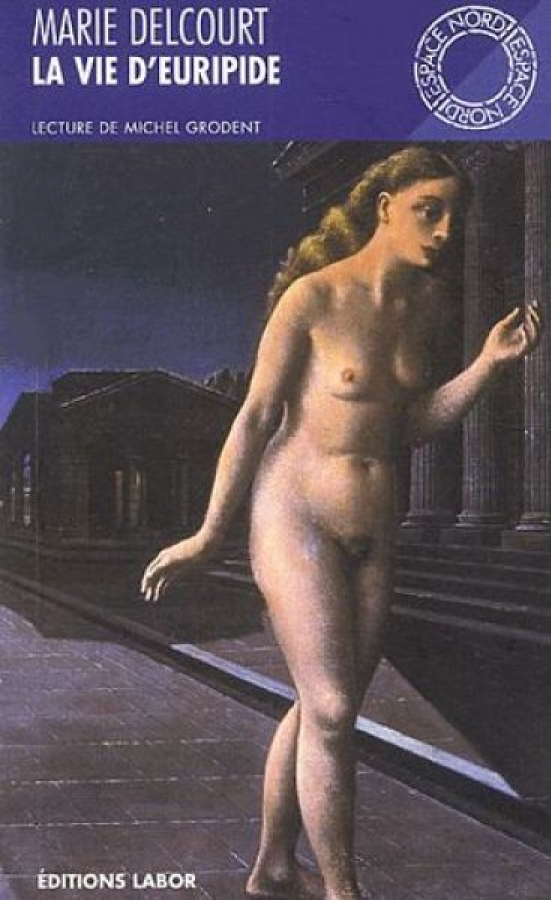
Finished reading on: August 26, 2004
The Life of Euripides
Title of the original version reviewed: «La vie d'Euripide»
AI Translation Notice: This review was translated from the original Italian using artificial intelligence. Book quotes and excerpts are translated interpretations and will not match the author's original English phrasing or official published translations.
Euripides is one of the three great tragic playwrights of ancient Greece (the other two being Aeschylus and Sophocles) and lived between 480 and 408 B.
C.
in a historical period characterized by three fundamental phases: the peak years of Athens under the governance of Pericles, the prolonged Peloponnesian War between Athens and Sparta with the consequent decline of the former’s political and cultural life, and the defeat followed by the emergence of Macedonia as a hegemonic power.
Marie Delcourt is a Belgian scholar and humanist who belonged to the French literary circles of the 1930s and was particularly influenced by Gide.
Her biography of Euripides highlights the link between the evolution of his literary output and three fundamental aspects: the political and civic fortunes of Athens: the author paints a portrait of Euripides as deeply nostalgic for the Periclean era and underscores the constant invocation in his tragedies of the values of civic coexistence, tolerance, and hospitality characteristic of the Athens of that time.
It is precisely the quest for a “prince” that drives Euripides to leave Athens and move to the court of the King of Macedonia, where he would meet his death; the philosophical currents of the era: the figure of Anaxagoras (and therefore the influence of his naturalistic views and critical stance toward myth and religion in general), the dialectic of the Sophists as a destructive force against truths and rules, and finally the thought of Socrates, as a search for values no longer rooted in religion but grounded in individual conscience.
In reality, this familiarity seems to translate in Euripides into a confused syncretism in which the individual dimension prevails, with difficulty, over the collective one; the innovative and contradictory nature of Euripides, who is perpetually exploring new inspirations and expressive techniques, never willing to settle upon what has already been established and achieved.
It is difficult to determine how much of these considerations stems from a critically rigorous reading of Euripides and how much, instead, reflects the existential and cultural milieu of the author.
The fact remains that the author succeeds in offering a highly stimulating and engaging profile of Euripides, one that also prompts a series of reflections on the current state of disorientation in Italian society: one is led to think how valuable an author like Euripides would be for our country, capable of interpreting it beyond intimistic readings and sociological analyses.
Reading the book is at times demanding due to the relentless historical and literary references, yet it is generally smooth and pleasurable: the style is frequently rhetorical and emphatic, the sentence structure convoluted and ornate, as is the vocabulary.